NBA YOUNGBOY GOT THE CLEANEST OUTCOME IN AMERICA
NOV 13, 2026 · SPLASH · HIP-HOP · THE RECORD
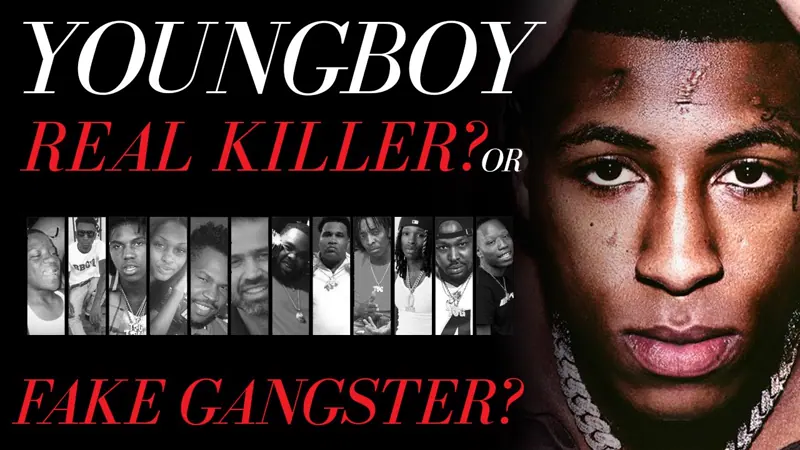
THE RECORD. Attempted murder counts at 17. A federal gun sentence. 46 Utah felonies cut to misdemeanors. A pardon. And a one-way ticket.
THE WRONG QUESTION. The source documentary is called YoungBoy: Real Killer or Fake Gangster? — 4.2 million views, four hours, and a title that asks you to decide what a man is.
That's not a question a court ever asked. The record is narrower and more interesting: what was he actually charged with, what was he actually convicted of, and what did a presidential pardon actually erase?
THE 2016 CASE — WHERE THE "KILLER" QUESTION COMES FROM. In 2016, at 17, Kentrell Gaulden was charged as an adult in Baton Rouge with two counts of attempted second-degree murder over a shooting.
In May 2017 he pleaded guilty to a lesser charge: aggravated assault with a firearm. Judge Bonnie Jackson suspended the sentence and placed him on three years of active supervised probation.
That's the disposition. Not a murder conviction, not an acquittal — a plea to a felony assault charge and probation. The attempted-murder counts were dismissed as part of the deal.
And then probation became the leash: in 2018 prosecutors moved to revoke it after an out-of-state arrest, and in 2019 he was jailed in Louisiana again over a Miami incident before being released that August.
THE FEDERAL CASE — GUNS, NOT BODIES. In September 2020, Baton Rouge federal agents arrested him before a video shoot; the charge was possession of firearms by a convicted felon.
He was convicted and, in 2024, sentenced to 23 months in federal prison. He served the time in a federal facility in Utah — the state where he had relocated and bought a home.
Note what the federal system charged him with: the guns. Not the shootings.
THE UTAH RING — THE PART THAT SOUNDS INVENTED AND ISN'T. In 2024, Utah prosecutors charged Gaulden in connection with a prescription drug fraud operation run out of his own multimillion-dollar home near Huntsville: people impersonating medical providers to obtain promethazine with codeine — the syrup in the cup.
The initial charging document was enormous: 46 felony counts.
On November 18, 2024, he pleaded guilty in Logan District Court — and the deal collapsed those 46 felonies into a few misdemeanors, avoiding prison time in Utah.
46 felonies to a handful of misdemeanors is the most instructive number in this entire story, and it has nothing to do with whether he's tough. It's how charging works: the initial sheet is the opening ask.
THE PARDON. He was released from federal prison in March 2025, having served his 23 months. Then, on May 28, 2025, President Donald Trump granted him a full pardon for the federal conviction.
What a pardon does: it erases the federal conviction — the felony status, the collateral consequences, the record that made him a prohibited person in the first place.
What a pardon does not do: give back the 23 months. Or touch state matters — the Utah misdemeanors and the Louisiana probation history are state-court records a presidential pardon doesn't reach.
It also doesn't answer the question in the title. A pardon is an act of grace, not a finding of innocence. It says the president forgave it, not that it didn't happen.
THE EXIT. In August 2026, Gaulden said on a podcast that he had left the United States and was living in South Korea — and that he would "never" move back.
Read that against the pardon. He got the cleanest legal outcome available in America and then left the country anyway.
That's not a gangster move or a fake-gangster move. That's a man who understands what the next charge would cost — and who can afford to make his family's life somewhere that doesn't have a file on him.
THE BUSINESS THAT FUNDED ALL OF IT. Here's the number that explains why any of this mattered: YoungBoy Never Broke Again is one of the most-streamed artists in the world, on a release pace almost nobody in the industry can match — dozens of projects, hundreds of songs, an imprint called Never Broke Again.
That catalog paid for the lawyers, the Utah house, the plea deals and the move. The music didn't stop for a single case — not the 2016 charge, not the probation, not the federal arrest, not the prison sentence.
Volume was the strategy, and it worked: the machine kept producing income while the legal system did its slow work.
SPLASH'S READ: The documentary wants a verdict on his character. The court record already gave one, and it's boring: a felony assault plea at 17, probation violations, a federal gun conviction, a prescription-fraud plea reduced to misdemeanors, and a pardon.
Nothing in that list says "killer." Nothing in it says "innocent" either. What it says is that the state charged him hard four times and landed a real conviction once — and that the one conviction got erased by politics, not by evidence.
He left the country a free man with a catalog that pays him forever. In Baton Rouge, that's not a loss.
HOW LONG WAS HE ACTUALLY SENTENCED TO — AND WHY THE NUMBER MOVED
Because two different numbers went out, and both are still online.
September 2024: multiple outlets reported 27 months after his guilty plea in the federal gun case.
December 2024: the Utah federal judge sentenced him to 23 months — just under two years — plus a five-year term of supervised release afterward.
So the number in the first headline isn’t the number that survived — the sentencing date is the one that counts, and it says 23.
THE THREE DATES PEOPLE KEEP CONFLATING
December 2024 — sentenced.
March 2025 — released from custody, reported at the time and confirmed by an associate.
Late May 2025 — the pardon.
Those are three separate events, not one. He got out first and was pardoned second — which is why you’ll see “Trump got him out” attached to a March date that has nothing to do with the pardon.
The supervised release mattered too: five years of it is the part nobody screenshots — and a pardon doesn’t erase the record the way people assume.
“BIG YES”: HE SAYS HE OWNS 100% OF HIS MASTERS
Every other page in this cluster is about a label holding the paper. This one is the reverse.
In the Complex sit-down with Jordan Rose, filmed at a Utah ski resort as Slime Cry arrived, the question was put to him directly:
“I remember you said a while ago that you own 100% of your masters. Is that still true?”
“Big yes.”
And then, when the interviewer said he appreciated the straight answer: “I don’t want to lie to you.”
Which is the whole difference between him and the rest of this cluster. Birdman says masters retention “don’t happen.” Wayne held 49% of his own imprint. The Lox spent a decade getting out of a 80/20. This one came in at sixteen, stayed independent through a federal case, and says he kept the catalog.
WOULD HE SELL IT?
Yes — and he said so without blinking.
“I say yes. Why not?”
Which is the least romantic answer available and the most honest one: ownership isn’t a museum, it’s a position. You own it so that you’re the one who decides when to sell — not so that you never do.
“I DON’T KNOW NOTHING ABOUT THAT”
Then there’s the pardon, which is the part of his story most people retell for him.
Asked about Trump pardoning him and getting him off house arrest:
“I don’t know nothing about that.”
Asked again — did he ever speak to him about it: “Nothing about that.”
Asked if he’d ever met Trump: “Why do you keep —” and then the laugh.
He is not denying the pardon. He is declining to take it as his story. There is a difference, and it matters: the pardon happened to him; the narrative around it is somebody else’s.
AND THE NAME HE PUT ON THE WHOLE RUN
The album was going to be called MASA — Make America Slime Again — and so was the tour.
What does it mean? “Follow whatever Trump applying.” Asked to clarify: “In every way.”
Which is a strange thing to say about a president who pardoned you, in an interview where you refuse to discuss the pardon. Either he’s joking, or he’s saying the quiet part: the name was a flag to fly, not a political program.
He renamed the album Slime Cry in the end — because, he said, the music didn’t feel like that message or that sound.
WHAT ELSE THE COMPLEX INTERVIEW PUT ON THE RECORD
On money, his advice to young artists: “Save your money.”
On Birdman saying he’ll be a billionaire: “Hopefully.”
On therapy: “Tried it. It ain’t worked.”
On why the music is different now: “I don’t really get too hurt about things no more. I’m just older now… I don’t go that deep because I ain’t that hurt no more.”
On diss records: “I don’t want to have to respond to something. I like to control the narrative.”
On Baton Rouge: he’ll play there only if he can play LSU Stadium — “that’s the only way.”
On the cancelled dates: Atlanta and Chicago were pulled off the tour, and he said he was paid anyway — “they still give you that bread.” His reaction to the cancellations, in three words: “On to the next.”
On the tour itself: the highest-grossing rap tour of the year on that pace, and he said another one is coming, with a European leg he’s clearly excited about — Amsterdam, for one.
And on the year ahead, asked what he’s most looking forward to: “My newborn baby.”
Complex interview: Jordan Rose, filmed in Utah and published as Slime Cry arrived; quotes transcribed from the video captions and attributed to him. Sources & claims: SOURCES, CLAIM BY CLAIM — The 2016 case: Kentrell DeSean Gaulden, then 17, was charged as an adult in East Baton Rouge Parish with two counts of attempted murder; in May 2017 he pleaded guilty to aggravated assault with a firearm, and Judge Bonnie Jackson suspended the sentence and placed him on three years of supervised probation (The Advocate, May 2017; AP). In 2018 prosecutors sought to revoke that probation after an out-of-state arrest, and he was jailed in Louisiana in 2019 following a Miami incident before being released in August 2019 (The Advocate, 2018–2019). The federal case: he was arrested in Baton Rouge in September 2020 on a federal warrant and charged with possession of firearms by a convicted felon; he was convicted and sentenced in 2024 to 23 months, and served the sentence at a federal facility in Utah (AP, Reuters, 2024). The Utah case: he was charged in connection with a prescription drug fraud operation run from his home near Huntsville, Utah, involving the impersonation of medical providers to obtain promethazine with codeine; the initial charging document contained 46 felony counts, and on 18 November 2024 in Logan District Court he pleaded guilty under a deal that reduced them to a few misdemeanors and avoided prison in Utah (KTVX/ABC4, KSL, 18–19 November 2024). The pardon and release: he was released from federal prison in March 2025, and on 28 May 2025 President Donald Trump granted him a full pardon covering the federal conviction (AP, The Hollywood Reporter, 28–29 May 2025). This article notes that a pardon removes the federal conviction and its collateral consequences but does not restore time served and does not reach state-court matters, and that it is an act of clemency rather than a finding of innocence. The move: in August 2026 he said on a podcast that he had left the United States and was living in South Korea, saying he would never move back (press reporting, 13–15 August 2026). The commercial characterisation of his streaming volume and release pace is the piece's own summary of widely reported chart and catalogue data. The documentary source asks whether he is a 'real killer or fake gangster'; this article treats that as a character question rather than a legal one and relies on court dispositions instead.