$17,300 A MINUTE.
By Splash · November 16, 2026 · 9 min read
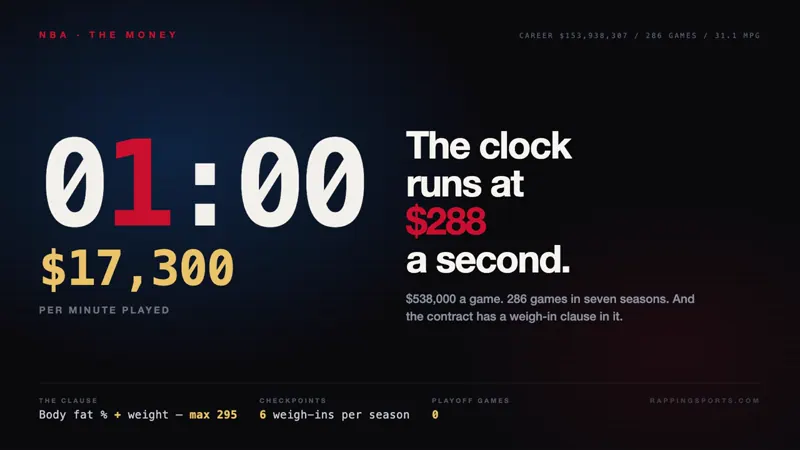
Zion Williamson has earned $153,938,307 in his NBA career. That is the figure Spotrac carried, and it covers seven seasons.
In that time he has played 286 regular-season games at a career average of 31.1 minutes. That is roughly 8,900 minutes of basketball.
Which puts his career at about $538,000 a game and $17,300 a minute — and about $288 for every second he is on the floor.
And the contract that pays it reportedly contains a scale.
The arithmetic, and what it is actually measuring
The point of that number is not that a basketball player is paid well. Everyone knows that. The point is what the Pelicans were buying, and what they protected themselves against.
The deal: signed July 5, 2022 — his 22nd birthday — five years, $197,230,450, fully guaranteed, an average of $39,446,090 a season. It is a Designated Rookie Extension carrying 30% of the cap language, and reporting at the time put the maximum reach at about $231 million with escalators.
His 2026-27 salary is $42,166,510.
Now put that next to the availability record, because that is what makes the number mean something:
2019-20: 24 games. 2020-21: 61. 2021-22: none — the entire season, after foot surgery. 2022-23: 29. 2023-24: 70. 2024-25: 30.
Seven seasons, 286 games. He has been selected to two All-Star teams. And he has never appeared in a playoff game.
The clause
This is the part that makes the contract unusual, and it has been reported consistently since the deal was signed: the guarantees are tied to weigh-ins.
Six checkpoints during the season. To pass, his body fat percentage and his weight have to add up to no more than 295.
Work that out: if he weighs in at 285 pounds, his body fat has to be 10% or lower to clear the line. At 275, he has 20% of room. The scale is not measuring weight. It is measuring the two numbers together.
The mechanism is that money can be earned back. Reporting has described it as: miss the checkpoints or the games, and guaranteed money in later years can be voided — pass them, and the guarantees return.
In December 2024, ESPN’s Tim MacMahon and Bobby Marks reported he was “on track” to satisfy the criteria. That is the most recent public status on it.
And it is worth saying plainly what this is not. It is not a punishment clause and it is not an insult. It is an insurance policy written by a team that had just watched four years of a career disappear into a foot, a knee, a hamstring and a ring finger.
When a team hands a player $197 million and then attaches a body-fat formula to it, the formula is the honest part of the document.
What $17,300 a minute actually is
Put it somewhere real.
One minute of Zion Williamson’s career, at his measured rate, is about 1,150 hours of work at $15 an hour. That is more than half a year of full-time work, for sixty seconds.
One game is $538,000. That is a house in most of the country, for forty-eight minutes of basketball, and he does not always play forty-eight.
And this season the number gets worse, because the salary goes up and the minutes do not:
At $42,166,510, if he plays 60 games at 31 minutes, that is about $22,700 a minute. At 70 games, about $19,400. He would have to play all 82 at 31 minutes — 2,542 minutes — to get it down to $16,600.
He has never played 82 games. He has never played 71.
Why the number is the story and not the punchline
There is a version of this piece that is just a list of injuries and a laugh track. This is not that.
The interesting thing is that everybody — the team, the player, the league, the contract itself — already knew. The clause exists because the risk was visible before the ink was dry.
Zion was the first pick in 2019 out of Duke, where he averaged 22.6 points on 68% shooting in one season. On February 20, 2019, thirty seconds into the North Carolina game, his shoe came apart and his knee went with it. That was before he was drafted.
Then: a knee injury nine minutes into his first Summer League game. A broken ring finger on his shooting hand that ended his third season. A foot that cost him all of 2021-22. A hamstring. A back.
And the basketball, when it happened, was never the problem. He averaged 27 points in his second season and made an All-Star team. He averaged 26 and made another. He scored 40 in a play-in game and got hurt on the fortieth.
The man can play. That is the whole tragedy of the contract.
The honest question the clause asks
A max contract with a scale in it is a very old idea wearing new clothes.
Teams have always paid for what they hoped a player would be. The weigh-in clause is the first time in this league that the hope got written down as a formula and a number of checkpoints.
And it cuts both ways, which is why it is interesting. If he clears six weigh-ins and plays seventy games, he gets every dollar and the clause looks like a formality. If he does not, the Pelicans have a documented basis to claw back money from a player they paid like a franchise and got about half of a season from, most years.
That is not cruelty. That is a team that has already been burned writing down, in advance, what it would need to see to keep believing.
He was not talking about the scale. But the scale is what the team wrote down instead of asking him.
And the arithmetic keeps running either way. At $42 million a season, every game he misses makes the next minute more expensive — and he has already missed more than half of them.
THE NUMBER THAT ISN'T ABOUT MONEY: ZERO
Here is the fact that makes the $17,300-a-minute arithmetic feel different than it did when this page was written:
In seven NBA seasons, Zion Williamson has never played a single minute of playoff basketball.
Not a bad series. Not a lost series. Zero minutes. New Orleans made the playoffs in 2022 and again in 2024, and he was unavailable for both. Every other number on this page is an average. That one is a total, and it’s zero.
WHAT HE IS DOING RIGHT NOW
Because the current season is why people are asking again.
2026–27, through 16 games: 21.7 points, 5.4 rebounds, 2.8 assists on 58.5% shooting. He is starting. He is healthy. He is playing.
On 20 November 2026 he put up 22 points, six rebounds, seven assists and two steals in 37 minutes — in a 126–120 NBA Cup loss to Oklahoma City.
Which is the strange shape of his career in one line: a player who produces every time he’s on the floor, on a team that keeps losing the games that count, in a body that has not let him be on the floor when they did count.
THE DURABILITY RECORD, SEASON BY SEASON
The numbers people cite when they argue about him:
24 games as a rookie. 61 in year two. Zero in year three. 29 in year four. 70 in year five — his best. 30 in year six. 62 in year seven. And 16 so far this year.
He has played 70 games in a season exactly once. He has averaged around 21 to 27 points per game in every season he has been available. The production was never the problem. The availability always was.
WHY HE’S STILL THERE
Because a healthy Zion is a top-fifteen player in the league, and a healthy Zion is what New Orleans is still paying for.
The trade market for him is exactly as cold as the medical file is long — a team acquiring him inherits the same risk the Pelicans already carry, and the Pelicans would be selling at the bottom of his value. So both sides stay, and the clause stays, and every season becomes a referendum on the same question: can he be available in April?
Seven years in, the answer has never been tested.
SPLASH'S READ
$17,300 a minute is an insult to a man who has been hurt, and it is also the most honest number in the file.
But the number that should be on the front of the page is the zero. Because everything else about him — the efficiency, the force, the fact that no human being that size should move like that — only matters if it shows up in a playoff series. And it has never once shown up in one.
The contract clause exists because the team already knew this. They built a trapdoor into the deal for the exact thing that has happened, and it happened again anyway.
He is 26 next season with a full season of proof still owed. Not to the fans, not to the clause — to the record. Right now the record says the most talented player New Orleans has ever drafted has never played a game that mattered.
Sources & claims: Contract: Zion Williamson signed a five-year, $197,230,450 designated rookie extension with the New Orleans Pelicans on July 5, 2022 — his 22nd birthday — fully guaranteed, average annual value $39,446,090, carrying 30% of cap language, with reporting at signing putting the maximum reach at approximately $231 million with escalators (Spotrac; Fanspo; contemporaneous reporting). 2026-27 salary: $42,166,510 (Spotrac). Career earnings: $153,938,307 as carried by Spotrac. Games and minutes: 286 regular-season games and a career average of 31.1 minutes per game (StatMuse); season totals used here are 24 (2019-20), 61 (2020-21), 0 (2021-22), 29 (2022-23), 70 (2023-24), 30 (2024-25) — note that published career game totals vary by snapshot and by whether playoffs are included (278, 283 and 286 all appear in current sources), so the per-minute figure here is an approximation and is labeled as one. Per-game, per-minute and per-second figures are our arithmetic from the earnings and minutes above: about $538,000 per game, $17,300 per minute, $288 per second. The weigh-in clause: reported as six weigh-in checkpoints during the season at which body fat percentage plus weight must total no more than 295, with guaranteed money in later years subject to being voided and earnable back by passing checkpoints and playing games (ESPN reporting; widely reported since 2022). In December 2024, ESPN’s Tim MacMahon and Bobby Marks reported Williamson was “on track” to satisfy the weigh-in criteria. Health history: knee injury 30 seconds into the North Carolina game on February 20, 2019, when his shoe failed; nine minutes into his first Summer League game; a broken ring finger on his shooting hand ending his third season; foot surgery costing the entire 2021-22 season; hamstring and back injuries; no playoff appearances. Quote: “I’m not where I want to be” is Williamson’s own answer at a press conference about his career. Not asserted here: that Williamson has failed any weigh-in — the most recent public reporting says the opposite — that he has been fined, suspended for conditioning, or that any guarantee has actually been voided; no such report was located. No medical diagnosis is made in this piece and none should be inferred from it.