HE JACKED YOU, FLEXED THE MONEY, AND YOU STILL NEED HIM.
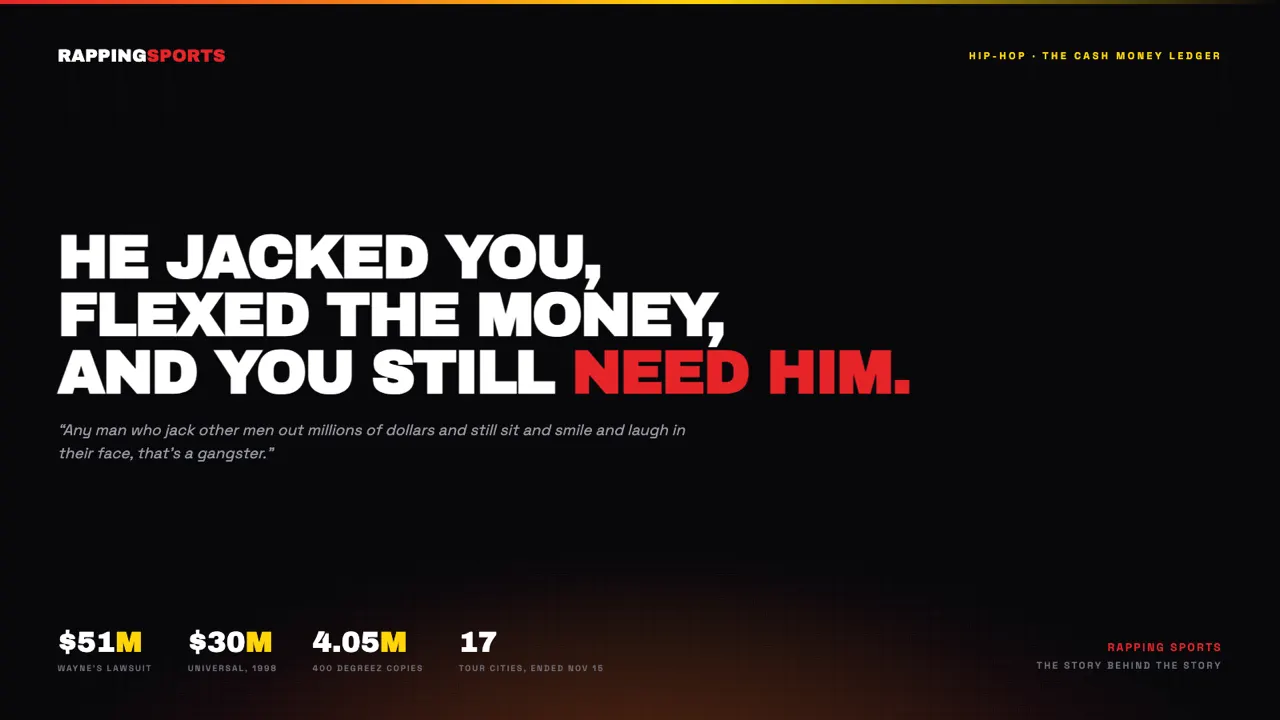
“I jacked you, and I’m gonna walk around flexing my money in front of you. You ain’t get nothing and you ain’t going to do nothing, and you still going to need me to make money.”
That is the argument. It comes from a commentator named OG Murdah, and he is not making a legal claim. He is describing a power dynamic, and he names it directly: “Any man who jack other men out millions of dollars and still sit and smile and laugh in their face, that’s a gangster.”
He says so immediately that he does not agree with Birdman’s ways. That distinction matters for everything below: this page is not an accusation and it is not a defense. It is about why nobody on that stage ever did anything about it.
The occasion
He was watching the Cash Money set, and what stopped him was not the music. It was that everybody on that stage — artists he says were mistreated — was smiling, laughing, and celebrating.
That set was real, and it just ended. The Cash Money & No Limit Tour was announced June 15, 2026 and ran seventeen arena dates: Houston on September 11 to Cleveland on November 15, 2026. It was billed as “Two Empires. One Stage. One Time,” and it followed the Verzuz battle between the two labels.
The lineup was Birdman, Juvenile, Mannie Fresh, B.G., Master P, Silkk the Shocker, Mia X, Mac, Mercedes, Fiend, Choppa Style and Mr. Serv-On, with Boosie as a guest.
Four of those names are plaintiffs in the story below, or have said on the record that the label never paid them. They were on that stage anyway, and that is the actual subject.
The ledger
Start with what is documented, because the documented part is not a rumor.
B.G. is where the label starts. He was the first Cash Money star — Chopper City in 1998, Chopper City in the Ghetto in April 1999 with “Bling Bling,” the record that put the word in the dictionary. He is the one whose run got the label noticed, and he left in 2001 over money.
Juvenile was the one who sold it. 400 Degreez came out November 3, 1998, entirely produced by Mannie Fresh, and it sold 4,050,000 copies — the album that made “Cash Money nationwide” mean something. He walked in 2001 too, and he has spent years saying out loud what he thinks he was owed.
Mannie Fresh built the sound — every track on 400 Degreez, the entire sonic identity of the label — and left in 2005. He has said he reached a point where he was pulling from his own retirement money to keep going.
Turk walked out in 2001 with the others. In 2025 he says he was pulled from the anniversary tour days before his album dropped, labeled a security risk after he rejected a reduced payment, with a termination notice arriving the same day he turned down less money. He sued the promoters; the touring company countersued him for $12 million.
And Wayne. In 2014 he sued Birdman and Cash Money for $51 million over advances and royalties, most of it tied to Tha Carter V being held for years. It settled in June 2018, not 2021 — the earlier date has been repeated on this site and it was wrong. The terms were never disclosed; reported figures ran “upwards of $10 million” and were disputed at the time.
What the label actually had
The money was real, and that is why the argument never dies.
In March 1998, Cash Money signed a three-year distribution deal with Universal Records for a reported $30 million, with a $3 million advance. Wendy Day negotiated it. It was the deal that took a New Orleans independent and put it in every store in the country, and it was signed on the strength of records B.G. and Juvenile had already made.
In 2021 Birdman said on a podcast that Cash Money still brings in $20–30 million a year off its masters. That is not a plaintiff talking. That is the person who owns the masters describing their revenue.
Why nobody retaliated
This is the part OG Murdah is actually pointing at, and it is not really about Birdman’s character.
His comparison is Gucci Mane and Pooh Shiesty — artists who, in his telling, were not treated this way. His claim is that nobody has done to a roster what Cash Money is accused of doing and kept the roster smiling in public.
The structural answer is simpler than the folklore. A label that advances money to teenagers and recoups it from their future earnings owns the thing they need to earn. Your catalogue is the collateral. Your name on that contract is the only route to the audience. Walk away and you do not just lose a paycheck — you lose the master recordings of your best work and the right to perform it freely.
So the calculation is never “is this fair.” It is “can I make a living without him,” and for most of them the answer was no for years.
Birdman’s side, which is also on the record
He borrowed money from his father in 1991 and built a label out of the Third Ward with his brother Slim. He signed Wayne when Wayne was a child, and Drake and Nicki Minaj later. And he kept ownership of his masters through a major-label distribution deal — the move that made him rich and made everyone who signed with him dependent on his goodwill at the same time.
That is not a defense of the payment complaints. It is the explanation of why the complaints never became a verdict.
The revolving door
The strangest fact in the file is that they keep coming back.
B.G. was sentenced in 2012 to fourteen years in federal prison on gun possession and witness tampering, came home on September 5, 2023 after about eleven years, and resigned with Cash Money that same year. Turk resigned in 2015. Juvenile has returned. Wayne, after a $51 million lawsuit, stayed in the family orbit.
And in 2026 four of them went out on a seventeen-city arena tour together, closing in Cleveland on November 15.
If this were a robbery, they would not be there. That is exactly OG Murdah’s point, and it cuts both ways: either the mistreatment is overstated, or the system is so complete that the only way to make a living is to keep participating in it.
The two-and-a-half-minute visit
If you want to see the method performed rather than described, there is one clip that does it better than any document — and the person who tells it best is not Birdman.
On April 22, 2016, Birdman walked into Power 105.1 in New York for an appearance on The Breakfast Club.
The tells
DJ Envy has described what the room read before a word was said, and it is a list of broken courtesies.
First: the drop. Artists walking in would record a short promo for REVOLT — this is Birdman, you’re listening to Revolt, tomorrow I’ll be on the show. He refused.
Second: the chair. Guests sit and wait for the show to finish. He didn’t sit. He paced.
Third: the room. Artists usually arrive with a publicist and a couple of people. Envy puts Birdman’s party at about twelve.
“So right then and there we’re like — something’s up.”
What happened on air
Envy says he started recording before the interview began, because he could already hear it coming.
Birdman opened by telling all three hosts to stop playing with his name. Then he sat down and consented to an interview. Then, after Charlamagne pressed him with a line of questioning, he got up and walked out. The whole appearance runs about two and a half minutes.
He never addressed the substance — not the money owed to Wayne, not the litigation, not the years of reporting. Envy’s read on the grievance is specific: he felt like Charlamagne was playing with his name, and the questioning that set it off was about the artists signed to him.
The visit was not an interview. It was a demonstration that he would walk into another man’s building, assert the name, and leave.
Why that is the whole file in one clip
The product was never the records. It was the name — and the operating principle is that questioning the name is the offense, not failing to answer the question.
The New Orleans reaction to that clip is where the “biggest gangster” framing comes from — the read being that a man who owes you money, flexes it in front of you, and still has you needing him is running a different kind of operation than a man with a gun. That is a local reading and this page labels it as one; nobody has ever put that theory in a filing.
There is one more detail worth keeping. Envy and Birdman had been cool since a tour they did together years earlier — Envy was DJing for Nelly when Cash Money was on the bill. So the two men in that room were not strangers. They were people with a history, and one of them had decided in advance that the courtesy was over.
Six years later, his version
Asked on Big Facts about the Breakfast Club appearance, Birdman’s account is different in tone from everything else in this file — and it is worth hearing because it is the only time he has addressed it at length.
He says he was not particularly bothered by the interview itself: “I wasn’t even tripping on that part of it. I just did it because it became a thing.”
He says he does not listen to the radio, does not listen to the show, and did not know what they had been saying — until his daughter started asking him why the man kept coming at him.
And on whether the hosts were just doing their job, his answer is the entire grievance in one line: “No. I think he went a little too far.”
His framing of the period is that everybody in the world was coming at him at once, and that the noise was not specific to one host. And he closes the subject without heat — he salutes anybody making money in the business and says he has no hate toward Charlamagne.
Which is the part that does not fit the meme. The clip is two and a half minutes of a man who looks like he is about to do something. Six years later the same man says he did not care, did not listen, and holds no grudge — and the grievance he does admit to is not about the questions. It is about his daughter hearing them.
What he said in 2000
There is backstage footage from 2000, at the height of the run, where Birdman is asked about the label taking over — and his answer is the whole thesis of this file in two sentences.
“It was destined, man. It was wrote. Y’all knew we was going to take over the streets and we ain’t going nowhere. Everybody that want 2,000, they can have 2,000. We going to 3,000.”
Read it as a business statement rather than a boast. He is not saying the records are good. He is saying the year belongs to him and the next one will too — which is exactly what a man says when he believes the name is the asset and the product is whatever the name is on.
Two years earlier he had signed a distribution deal that kept the masters. Four years later his flagship artist would walk out of the room saying he was going to go with the Roc. “We going to 3,000” did not survive contact with the second half of the decade.