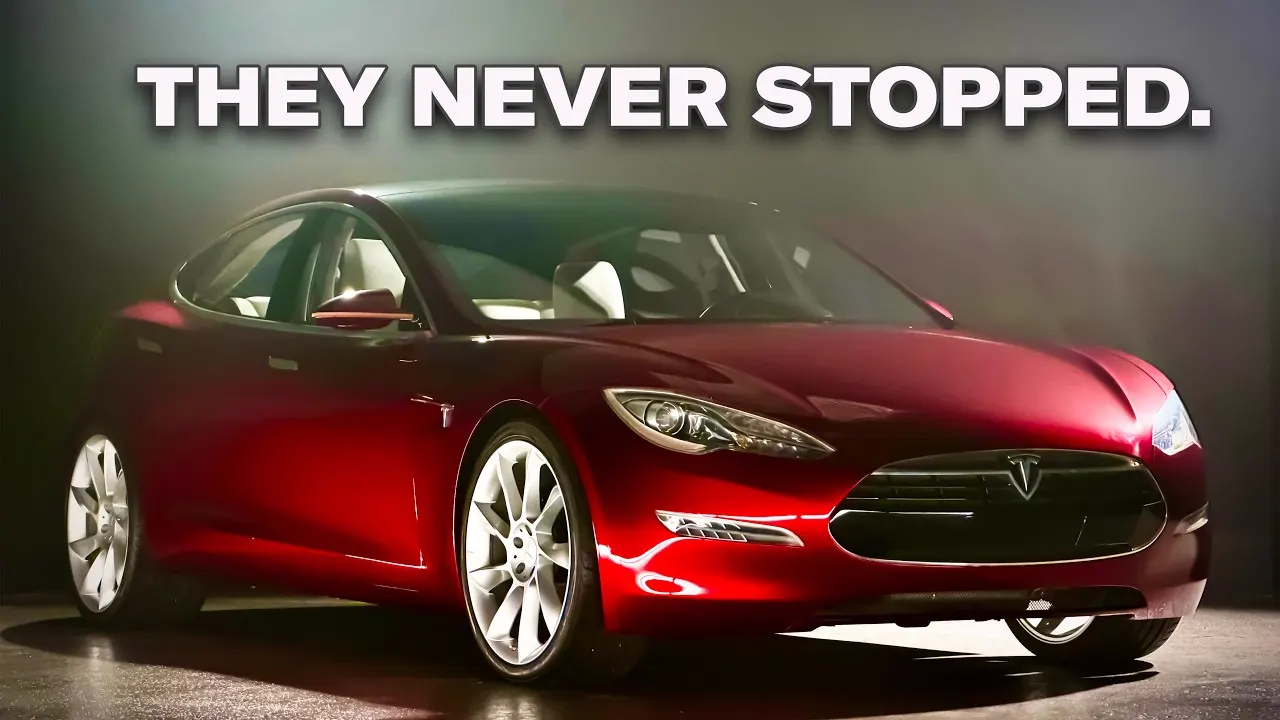
THE ENGINEER SAID SIX HOURS.
THE CEO SAID IT PUFFS ITSELF UP.

Two men described the same feature in the same week. One of them has a thermodynamics textbook and the other has a stage.
What was revealed
On October 15, 2026, at an event outside Waco, Texas, Tesla showed the production version of the second-generation Roadster. It drove up an inverted ramp using fans and used SpaceX-developed cold-gas thrusters to jump.
The hardware, per Tesla’s vice president of vehicle engineering Lars Moravy at that reveal: two carbon-overwrapped pressure vessels holding 600 litres between them, carrying about 250 kilograms of nitrogen, feeding ten nozzles.
Moravy also confirmed the thrusters are effectively one-time use — good for a few seconds, then they need filling.
What the engineer said
In Hagerty’s walkaround with Moravy, the narration is blunt:
Moravy explains the choice of propellant himself:
That is the primary source. The engineer put a number on it: six to seven hours, and not at your house.
What the CEO said
At the reveal, Elon Musk described the same system differently:
Every clause in that sentence can be checked against the engineer’s. Recharge its air tank — in six to seven hours, off-site. Not like you need special propellant — it is nitrogen, a specific gas, chosen for a specific reason. Puff itself up — the tanks are filled by equipment that was visibly present at the reveal rather than by the car.
Both men are describing a real system. Only one of them is describing it accurately.
The arithmetic
Start with the gas. Tesla gave 600 litres and 10,000 psi in one telling, which by the ideal gas law would be about 475 kilograms of nitrogen at room temperature. But Tesla said the tanks hold about 250 kilograms.
Run it backward: put 250 kilograms into a 600-litre vessel and you get roughly 5,250 psi. And the label on the storage tank visible in the Hagerty footage reads 5,500 psi. Those two numbers are close enough to be the same system measured honestly.
Now the energy. The ideal work of isothermal compression at that ratio is about 0.14 kilowatt-hours per kilogram. Across 250 kilograms, that is a theoretical floor of 35.5 kilowatt-hours.
And 35.5 kilowatt-hours is already enormous — roughly a third of a large EV battery — and it is a floor that cannot be reached in practice. Real compressor data sheets land between 60 and 100 kilowatt-hours for the same mass: about 62 kWh at 5,000 psi, 70 kWh at 6,000, and 88 kWh at 7,000.
Add the real-world losses — heat, friction, the fact that compressing a gas heats it and the heat is wasted — and the figure lands at 70 kilowatt-hours or more for one fill.
The number that closes it
Now do it in the thirty minutes Tesla says it is working toward. 35 kilowatt-hours in half an hour requires a 70-kilowatt compressor. That is a ~100-horsepower electric motor, onboard, whose only job is to fill an air tank.
Here is where Moravy’s own description becomes the argument. He says the four fans on the car are built from the same high-voltage compressor motor used in Tesla’s heat pump — and that the base compressor motor is 12 kilowatts, with each fan capable of about 20 kilowatts.
So the motor Tesla already has is 12 kilowatts. The job needs 70. You are not tuning the existing part. You are adding a component roughly six times its size.
Engineering Explained found the real-world comparison: a 75-kilowatt generator that took about 50 minutes to reach only 5,000 psi — and it was, in his description, half the size of the car.
The volume, for scale
There is an even simpler way to feel the problem. 250 kilograms of air at sea level is more than 200,000 litres of gas.
For scale: a 5.2-litre V8 turning at 8,000 rpm under full load moves that much air in about ten minutes — a giant engine at redline, breathing through the whole thing. That is the quantity the compressor has to move, and the compressor has to move it into a pressure vessel rather than out of one.
SPLASH'S READ
This is not a story about whether the Roadster is real. It was revealed, it drove up a ramp, and the thrusters are on it.
It is a story about what happens when a product is described at two levels of altitude in the same week, and both descriptions go out to the public without anyone reconciling them.
The engineer’s version is the honest one and it is still remarkable: a production car with a 5,250-psi nitrogen system and ten cold-gas nozzles that can throw itself off the ground for a few seconds. That is a real thing that exists. The CEO’s version — it puffs itself up whenever you’d like — is the version that turns a genuine engineering achievement into a thing that sounds like it cannot fail, which is exactly the version that will be remembered wrong.
And the failure mode is the interesting part. Nobody had to lie. One man rounded up at a microphone and the other answered a direct question with a number. The gap between them is 6 to 7 hours, 250 kilograms, and 70 kilowatt-hours — and it lives entirely in the difference between talking about a car and building one.
Reveal. Tesla unveiled the production second-generation Roadster on October 15, 2026 at an event outside Waco, Texas, demonstrating fans and SpaceX-developed cold-gas thrusters.
Engineering, from Tesla’s own vice president of vehicle engineering, Lars Moravy, at that reveal: two carbon-overwrapped pressure vessels, 600 litres combined, about 250 kilograms of nitrogen, ten nozzles; the thrusters described in subsequent reporting as one-time use, operating for seconds before needing a fill.
Refill time and location. Hagerty’s walkaround with Moravy states: “Refilling the nitrogen tanks isn’t something you’ll be doing at home. And at the moment it takes 6 to 7 hours to fill all 600 L, but they are working on a system to reduce that significantly down to about half an hour.” Moravy’s explanation of the propellant choice and the 12-kilowatt base compressor motor figure are quoted from that same footage.
The CEO’s description — “The car can recharge its air tank… It literally is just going to puff itself up” — is quoted from the reveal.
The thermodynamic calculation and the compressor data sheet figures — 0.14 kWh/kg, a 35.5 kWh theoretical floor for 250 kg, ~62 kWh at 5,000 psi, ~70 kWh at 6,000 psi, ~88 kWh at 7,000 psi, and 70 kWh or more with real-world losses — are from Engineering Explained’s analysis, derived from an isothermal compression model and published compressor specifications. The 75-kilowatt generator comparison, the 70-kilowatt/30-minute requirement, and the 200,000-litre volume comparison are from the same analysis.
This page treats the arithmetic as a published third-party analysis, not as an independent measurement. No claim is made that Tesla has stated these figures; the 6-to-7-hour and 12-kilowatt figures are Tesla’s own, and the energy figures are the analyst’s.
This page contains no photograph of any person.
312 mph, one direction, one run
Waymo vs Tesla
The CEO is gone. The guarantees aren’t.
Nvidia lost $440 billion in two days
China said no to Nvidia
It started as a truck engine The quota counted cars, not dollars The car barely changed. Everything under it did. They built a car for a future that bought an SUV