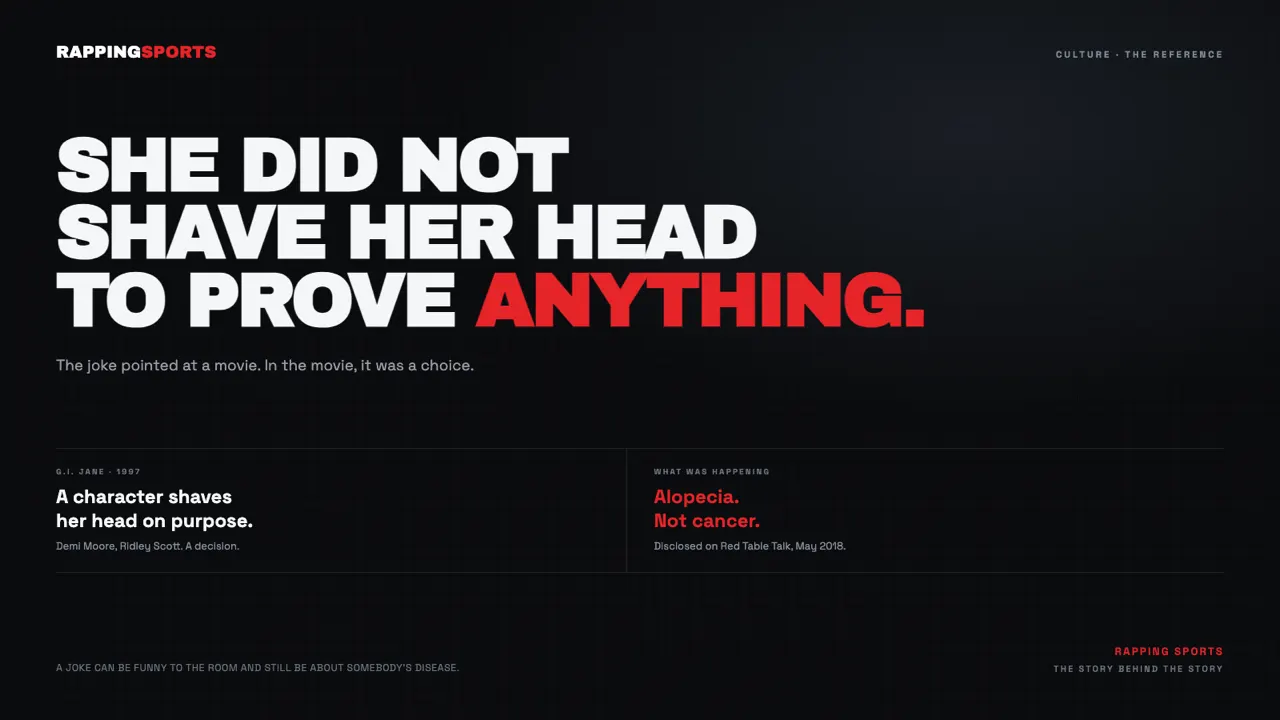
SHE DID NOT SHAVE HER HEAD TO PROVE ANYTHING.
There is a piece of context that gets left out of almost every retelling of the 2022 Oscars, and it is not the reason anyone laughed.
It is the reason two people in the front row did not.
What the reference actually was
G.I. Jane is a 1997 film directed by Ridley Scott, starring Demi Moore as Lieutenant Jordan O’Neil — the first woman admitted to a special-operations training program modeled on the Navy SEALs.
The film’s most famous scene is her shaving her head. In the story it is a deliberate act: she does it to remove the one thing her instructors can still use against her, and to prove she intends to stay.
That is the entire point of the reference. In G.I. Jane, the shaved head is a decision.
What was actually happening
In May 2018, Jada Pinkett Smith disclosed on Red Table Talk that she has alopecia.
Alopecia areata is an autoimmune condition in which the body’s immune system attacks hair follicles. It has no cure. Treatments can encourage regrowth and often do not.
She talked about it publicly — the questions she kept getting, the headscarves, what it did to her sense of herself — years before the Oscars. By 2021 she had shaved her head, and she was open about the fact that it was not a costume.
The misconception that will not die
A large number of people who saw that clip came away believing she had cancer.
She did not. The condition is alopecia — an autoimmune disorder, not a malignancy, and not a side effect of chemotherapy.
This matters for a reason beyond accuracy. Baldness in public women gets sorted into one of two categories by strangers — illness or statement — and both readings are assumptions about a body that belongs to somebody else.
She had told the public which one it was. Four years later, a sizable portion of the audience still had it wrong.
Two different questions
It is worth separating two things that get argued as one.
Why the joke was funny: because a bald woman in a gown looks like Demi Moore in a 1997 war movie. That is the whole mechanism. It is a visual comparison, it is instantly legible, and it does not require the audience to know anything about anybody’s medical history. The room laughed. That is what a joke doing its job sounds like.
Why it landed differently at that table: because the person it was about knew why she was bald, and so did her husband. The reference treated a symptom as a costume.
Both of those are true at once, and neither cancels the other. A joke can be genuinely funny to eight hundred people and still be about somebody’s disease. The laughter is not evidence that the disease was irrelevant — it is evidence that the audience did not have it in front of them.
What the page is not claiming: that the crowd was cruel, or that the alopecia is why anyone laughed. Nobody laughs at a diagnosis. They laugh at a reference. The diagnosis is what made the reference land on the two people in the front row and not on anybody else.
She was bald all night
This is the part that gets skipped, and it is the cleanest way to understand what actually happened in that room.
She had been sitting there bald for the entire evening. Hours of broadcast. No laugh. Nobody in that building found a shaved head funny, because a shaved head is not a joke — it is a fact.
What produced the laugh was the comparison. Not the hair. The mapping — the moment the audience’s brain supplied a 1997 movie and the fact became a reference.
A fact is not funny. A correspondence is. That is the entire mechanism, and it is why the same head can sit in a room for three hours with nothing happening and then get one of the loudest reactions in the history of the telecast.
It is also why the alopecia is not the explanation for the laugh — it is the explanation for who did not laugh in the same way. The correspondence landed on eight hundred people as a movie. It landed on two people as their evening.
One more thing on the tape: Will Smith laughed at the joke first. The reaction came after he looked left, not instead of looking. This page does not report what was said between them, and specifically does not rely on frame-by-frame lip-reading, which is not evidence.
Why that reference and not a rap one
There is a craft decision buried in this that almost never gets discussed, and it is the reason the moment was as large as it was.
G.I. Jane is not an inside joke. It was a wide-release studio film in 1997, directed by Ridley Scott, starring one of the biggest actresses in the world at the time. It required the audience to know nothing about hip-hop, nothing about the Smiths, and nothing about hair loss.
That is a reach decision. A reference with mass recognition gets a mass laugh. A niche reference — something only the rap room would catch — gets a partial laugh from part of the room, and the rest of the room watches.
He chose the one that everybody would get. Which meant everybody laughed.
And that is precisely what made it worse than a smaller joke would have been. The size of the laugh is a function of how many people understood the reference, and each of those people is one more person in the room looking at the same woman at the same moment.
A niche joke embarrasses you in front of your peers. A universal one embarrasses you in front of everybody at once. The reference was good. That is what the trade costs.
The check before the laugh
Watch an audience during a joke that might be too far and you will see the same thing happen in a hundred rooms.
Nobody laughs on the first beat. They look at the person beside them. Not to see if it was funny — they already know whether it was funny — but to see whether laughing is permitted.
The question in the face is not is this funny. It is can I laugh at this. And once the person beside you laughs, the answer is yes, and then you laugh, and then the row behind you laughs.
That is the whole engine of a room-scale laugh. It is not eight hundred independent decisions. It is one permission travelling through eight hundred people.
And permission travels at the speed of eye contact, which is the slowest thing in the building. Which is why the loudest part of the laugh always arrives a beat or two after the joke does.
Comics are allowed to hit each other
There is a professional norm in this that matters, and leaving it out makes the laugh look colder than it was.
Comedians roast each other as a matter of course. It is not an insult, it is the trade — the way fighters spar, or the way a pickup game gets physical without anybody calling it a fight. Taking a shot at another performer in the room is inside the rules, and laughing at a good one is the correct response rather than the disloyal one.
Which is why the laugh at that table reads as genuine instead of nervous. It was one performer appreciating another performer’s work, in public, at the ceremony where they were both working.
What this page does not claim is intent. Nobody outside that room knows what was in the joke’s design, and guessing at it would be inventing a motive to make a cleaner story. The norm explains the laugh. It does not explain the joke.
The second wave
What makes a laugh in a room that size different from a laugh on a couch is that it is not one event.
The first reaction is scattered. Some people get the reference instantly, some take a beat, and some are still working out what they just heard. Then the room checks itself — people look around, see that laughing is permitted, and the second wave is louder than the first.
That is the mechanism of a wide reference. The laugh compounds. And a compounding laugh is what turns an uncomfortable moment into a group activity.
It is also worth noting what a compounding laugh costs in time. The hesitation between the first chuckle and the full room is seconds — and seconds are the entire distance between a joke landing and someone deciding to do something about it.
What the tape actually shows
This part is observable and does not require reading anyone’s lips.
Will Smith laughs at the joke. Then he turns and looks to his left. Then his expression changes — the laugh stops and his face goes flat and hard. And Jada Pinkett Smith, throughout, is not laughing.
That sequence is on the broadcast. It is not an interpretation. What was said between them in those seconds is not on the broadcast, and this page does not assert it. Frame-by-frame lip-reading is not evidence, and a claim that cannot be proven has no business on a page with a publication date on it.
What can be said plainly: one of them found it funny and the other one did not, and the one who found it funny stopped finding it funny after looking at the one who didn’t.
What happened after
The consequences were specific and documented:
Will Smith resigned from the Academy of Motion Picture Arts and Sciences on April 1, 2022, calling his own conduct “shocking, painful and inexcusable.”
On April 8, 2022, the Academy’s Board of Governors banned him from attending the Oscars or any other Academy event for ten years.
He apologized to Rock publicly. Rock, for his part, did not press charges, and has addressed the incident on his own terms since.
And in June 2024, Bad Boys: Ride or Die — a $100 million production — grossed roughly $404 million worldwide, which is the number that tells you what the ban actually cost him commercially.
SPLASH'S READ
The reason this is worth writing down is not the slap. The slap is four years old and everybody has seen it.
The reason is that the joke’s premise was wrong, and the correction never caught up to the clip.
A reference to a woman who made a choice was aimed at a woman who had a disease. One of those is a punchline. The other one is somebody’s scalp.
And the detail that keeps getting lost — that it was alopecia and not cancer — is not a technicality. It is the difference between a person being brave and a person being sick, and strangers keep picking the version that fits the joke.
She told the truth about it in 2018. The internet is still getting it wrong in 2026, which is its own kind of answer about how far a correction travels.
Sources. Jada Pinkett Smith disclosed her alopecia on Red Table Talk in May 2018, describing hair loss and her diagnosis. Alopecia areata is an autoimmune condition; it is not cancer and is not caused by chemotherapy. She shaved her head in 2021 and has discussed the condition publicly since.
G.I. Jane (1997) was directed by Ridley Scott and stars Demi Moore as the first woman in a Navy SEAL-style training program. The head-shaving scene depicts a deliberate choice by the character.
The 94th Academy Awards took place March 27, 2022. Will Smith resigned from the Academy on April 1, 2022, and the Academy’s Board of Governors banned him from Academy events for ten years on April 8, 2022, as reported by the Associated Press and BBC News.
Bad Boys: Ride or Die was released June 7, 2024 on a reported $100 million production budget and grossed approximately $404 million worldwide, per Box Office Mojo.
This page does not reproduce the joke, does not diagnose anyone, and makes no claim about any person’s medical condition beyond what Jada Pinkett Smith has stated publicly herself. No photograph of any person involved appears on this page.