IN 2005 HE TOLD THE STREETS. IN 2026 HE TOLD THE PODCAST.
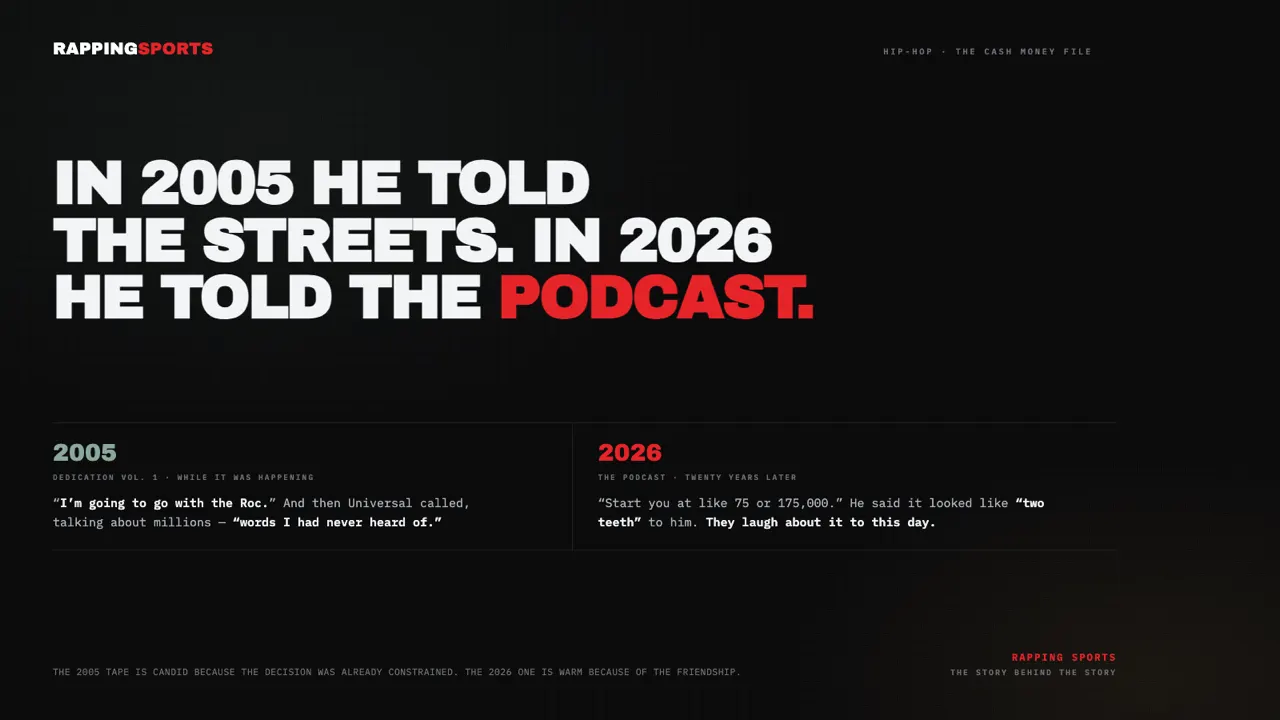
There are two versions of this story, told twenty years apart by the same man, and the gap between them is the interesting part.
The first one is on a mixtape. The second one is on a podcast. In the first he is deciding. In the second he is laughing.
2005: what the streets wanted to know
Dedication — the 2005 tape, before Katrina — carries a moment where Wayne addresses it directly, in the voice of somebody answering a question he has been asked too many times.
That is a man narrating his own rumor mill in real time. The streets had his career as a topic of conversation before he had decided anything.
What he said he was going to do
Read that twice. He had decided. On the record, in 2005, before anything was signed, Wayne said he was going to Roc-A-Fella.
And he names the constraint in the same breath: I was still under the K. He knew he was not free. He decided anyway, because deciding is free and signing is not.
What Jay-Z actually said
That is the sentence that settles the whole question. Jay-Z did not offer him a contract. Jay-Z told him he was waiting for one. And the phrase he used — “whenever you get out your situation” — is the same phrase Wayne is still using twenty years later.
Which means Wayne didn’t invent that language later. He learned it in the room.
What changed it
That is the hinge of the entire story, and it is not in any of the recent retellings. Wayne is not describing loyalty versus a rival’s offer. He is describing a phone call from a distributor that put a number in front of him that he had no frame of reference for.
He stayed. Not because he was stopped, and not because he was paid to laugh at anything. Because a distributor made the alternative look small.
Which version of the tape
There is a source problem here that has to be disclosed, because it changes how much weight the recording carries.
The Dedication is officially dated March 2005 — five months before Katrina — credited as produced and hosted by DJ Drama, and it is the first entry in both the Dedication series and the Gangsta Grillz run.
But look at what else was in that window. The Prefix was a 2004 tape, hosted by DJ Khaled. The Suffix followed on October 1, 2005. And Tha Carter II did not arrive until December 6, 2005.
Which means the city had Wayne’s material for a full year before the hosted version of The Dedication landed — and it had already moved on to the next thing by the time it did.
And there is firsthand testimony that physical copies of the earlier material were moving in New Orleans before the official dates, and that by the time Katrina hit, people were already listening to an early version of Tha Carter II rather than the tape the wider market was just receiving. That is recorded here as testimony from someone who was in the city at the time, not as a documented street date.
Which is how mixtapes worked: the verses existed, the discs got burned, the city heard it first — and the hosted, branded edition arrived afterward for an audience that had not heard any of it.
That is the whole argument in one artifact. The material was made in the city first, and the DJ’s name went on the package that traveled. The version most people know is not the version that was first.
And the tape did not circulate as one object either. There is a standard edition of roughly two dozen tracks, and a documented two-disc edition of 43 songs dated later in discographies and streaming catalogs. Two different products, same title.
This passage is on the fuller release and is not among the tracks in the commonly circulated edition — a small but real reason it never made it into the later retellings. People are working from the standard tracklist, and this isn’t on it.
And the upload itself is the receipt. The copy of this passage on YouTube is marked 18 years old — roughly 2008, and eighteen years before the podcast interview. It has about 14,000 views, on a channel with a few hundred subscribers.
Which tells you the scale. A record that moved through New Orleans by hand, uploaded off an old disc, watched by fourteen thousand people in eighteen years — in a career where the albums did a million in a week. This was not a widely circulated document. It was a regional artifact that survived because somebody kept it.
2026: what it became
Twenty-one years later, on a podcast, Wayne tells the same story as a comedy. Jay-Z at the 40/40 Club in the daytime. A conversation he wasn’t part of. Then a private word afterward: start you at “like 75 or 175,000.”
And Wayne’s reaction, in his own telling now: he looked at $175,000 like “two teeth” — two of them, the bottom two. And the two men laugh about it to this day.
Notice what changed in the telling. In 2005 the story ends with him staying because of a number he could not believe. In 2026 the story ends with him laughing at a number he could not believe. Same disbelief. Completely different feeling.
Why the two accounts differ
In 2005, Jay-Z was a rival and the decision was live. Wayne could be completely honest about what he wanted, because wanting it cost him nothing — the contract had already decided for him.
In 2026, Jay-Z is “the big homie.” They are friends, they have made records together, and both of them are on the other side of everything that happened. You do not tell a funny story about a friend’s offer the way you tell the truth about a rival’s.
Which is not dishonesty. It’s the same event viewed from a relationship that didn’t exist yet in 2005. The 2005 tape is the honest document because the stakes were all behind him. The 2026 interview is warm because the stakes are now a friendship.
If you want to know how Wayne felt while it was happening, you listen to the mixtape. If you want to know how he feels about it now, you listen to the podcast. Both are true. Neither is the whole thing.
SPLASH'S READ
The $175,000 is the part that travels, because it’s a number and numbers are funny. But it’s the least important detail in the story.
The important detail is the Universal call. A distributor put a number in front of a kid from Hollygrove that he had never conceived of, and that number is why he stayed, and that number is why Jay-Z was waiting on the other side of a contract for the next twenty years.
Wayne’s own line from 2005 is still the best summary of the whole arrangement: I was still under the K. Everything that happened after — the waiting, the friendship, the laugh, the two teeth — happened downstream of that one clause.
He wasn’t laughing at $175,000 in 2005. He was saying yes in his head to a man who told him the door would be open. The laugh is what twenty years does to a decision you never got to make.
And one last thing about who remembers it better. Wayne is not misremembering. He is telling a story to an audience, twenty years on, from memory, in a room where the goal is a good interview. The tape doesn’t have that problem — it was recorded while the decision was live and it cannot be revised.
A recording will beat anybody’s memory, including the memory of the man on it. That is the entire reason to go find the version with more tracks on it.
Sources. The primary source is Dedication Vol. 1 (2005, DJ Drama), on which Lil Wayne addresses his contractual situation directly. Quoted here from the recording: “The streets want to know what’s Wayne’s situation… rumors, speculations, that I would be going to another record company, preferably the Roc, Def Jam, Jay-Z, Sean Carter”; “I was still under the K… I’m going to go with the Roc”; Jay-Z “whenever you get out your situation, I’m here”; the Universal call “talking about millions and stuff — that was words I had never heard of”; and “I got some more time over here. I ain’t finished doing what I was doing.” Transcribed from the audio; this page treats that recording as the contemporaneous account. Provenance: The Dedication is officially dated March 2005, credited as produced and hosted by DJ Drama, and is the first entry in both the Dedication and Gangsta Grillz series. A standard edition of roughly two dozen tracks circulates alongside a documented two-disc edition of 43 songs dated later in discographies and streaming catalogs. This passage appears on the fuller release and is absent from the standard tracklist, which likely explains its absence from later retellings. Also in that window: The Prefix (2004, hosted by DJ Khaled); The Suffix (October 1, 2005, 18 tracks); and Tha Carter II, released December 6, 2005 on Cash Money / Young Money / Universal. Firsthand accounts place physical copies in New Orleans before the official dates and describe an early Tha Carter II circulating before Katrina; this page records that as testimony, not as a documented street date. The YouTube upload of this passage is marked roughly 18 years old with approximately 14,000 views.
The later account — the 40/40 Club meeting, the “like 75 or 175,000” figure, the “two teeth” comparison, and the statement that the two men still laugh about it — is Lil Wayne’s own interview account, given roughly two decades later.
Contract context. Lil Wayne was signed to Cash Money, and Cash Money had a distribution relationship with Universal. The general mechanic — that an exclusive recording contract is held by the label and cannot simply be outbid — is standard industry practice and is presented as context.
Not asserted. This page does not claim that any person paid any sum to prevent a signing. Wayne’s mixtape skits are treated as his artistic account, not as record. The reading that the 2005 account is candid because the decision was already constrained, and the 2026 account is warm because of the friendship, is this page’s analysis.
This page contains no photograph of any person.
The beef he inherited
What the ledger actually says
1997 to 2025: one vocabulary, four cities
The deal itself
The sound left before the money did
Turk and the war
The tour The tour that put New Orleans in front of New York The other founder: Ronald Slim Williams B.G.'s side: the album was in the CD player