THE CEO IS GONE. THE GUARANTEES AREN'T.
NOV 14, 2026 · SPLASH · MONEY · THE PAPERWORK
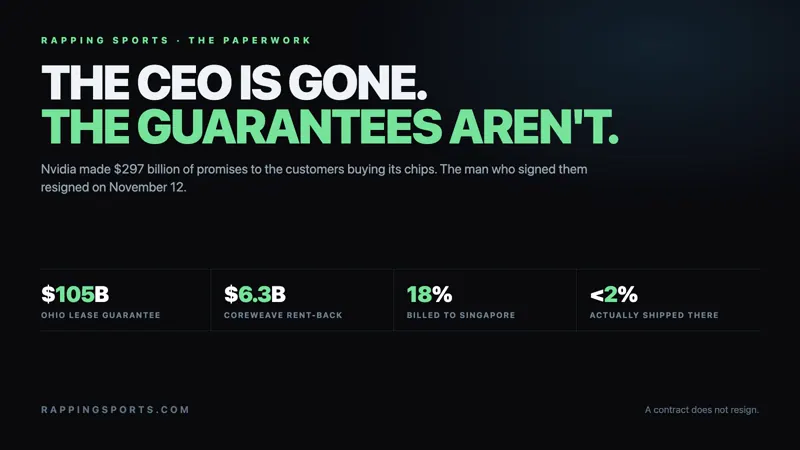
THE PAPERWORK. A man resigned on November 12. The $297 billion of guarantees, rent-backs and purchase obligations behind the AI boom did not.
THURSDAY, NOVEMBER 12, 2026. Nvidia announced that Jensen Huang had resigned as president and chief executive. The board had accepted it the day before, in a regulatory filing dated November 11.
Colette Kress, the chief financial officer since 2013, was named interim CEO. Harvey C. Jones was appointed the first chair of the board in the company's history — a title that had never existed there before, because the chief executive had always been the centre of gravity.
The reason given by the board was personal: affairs, including one with a Singapore-based executive whom U.S. officials suspect of working for Chinese intelligence. That suspicion is an allegation and is not proven. Nvidia has said the claims were investigated.
And here is the part that belongs to this site: a man resigned. Nothing he signed resigned with him.
THE NUMBER IS $297 BILLION.
That is the total one investigation reached after pulling filings from 42 companies tied to Nvidia since 2023 — roughly 3,000 documents — and adding up every investment, guarantee and purchase promise the chipmaker has made to other companies.
It is roughly a full year of Nvidia's revenue. Fiscal 2025 came in at $130.5 billion, up 114%. So the promises are about two years of sales, made to the customers buying the product.
Nvidia's own finance chief said the quiet part in public: the AI labs, she said, are "growing faster than what their balance sheets and credit profiles can support." So Nvidia supplied the balance sheet instead.
She also pre-empted the criticism on the same call: "We know some will call this circular financing. We see it differently."
LOOP ONE: THE OHIO GUARANTEE.
September 22, 2025: Nvidia and OpenAI announced a partnership to deploy at least 10 gigawatts of Nvidia systems, with Nvidia stating it "intends to invest up to $100 billion" in OpenAI as the systems come online.
Read the verb: intends. It was a letter of intent, not a contract. By March, Huang was telling people the full arrangement was "probably not in the cards." What actually happened was smaller and stickier: about $30 billion went into OpenAI's funding round.
Then came August 17, 2026 — and a securities filing that put up to $105 billion behind a single campus.
The site: Pike County, Ohio. SB Energy builds it, owns it and operates it. It starts at 4.25 gigawatts and could reach about 8. OpenAI is the tenant.
Nvidia guarantees the leases — if OpenAI can't pay, Nvidia does. And the filing says the site will host Nvidia chips, only Nvidia chips, with Nvidia as the exclusive AI compute provider.
The guarantee has a hook in it: if Nvidia ever has to pay, it "shall look solely to Tenant" to recover — and the tenant is OpenAI, not the building, not the land, not anyone else.
Worth stating plainly, because it is usually left out: the guarantee is conditional, and Nvidia has said it "does not mean Nvidia has committed $105 billion of capital." A guarantee is not a cheque. It is a promise to write one later, if someone else fails.
LOOP TWO: WHATEVER THEY CAN'T RENT, NVIDIA BUYS.
September 15, 2025: CoreWeave filed an 8-K describing a new order form with Nvidia under their existing master agreement — an initial value of $6.3 billion, in which Nvidia "is obligated to purchase the residual unsold capacity" through April 2032.
Translate it: CoreWeave builds data centres and rents out Nvidia chips. Whatever it cannot rent, Nvidia buys. CoreWeave borrows money to buy the chips; the chips are the security for the loan; and there is a customer of last resort standing behind the whole thing.
LOOP THREE: THE ONE THAT SOUNDS LIKE INSURANCE.
Here's the structure as the finance chief described it: Nvidia promises a cloud company a minimum amount of revenue, so that banks will lend money to put up the building. In return, Nvidia takes a share of the rent.
Her line: "We're not making loans. In this model, we get paid twice."
Paid twice sounds like a great business — right up until you ask who is allowed to leave the deal, and who isn't.
THE SENTENCE THAT MATTERS MOST IS IN NVIDIA'S OWN QUARTERLY FILING.
The cloud companies, it says, "can unilaterally stop providing to us and sell to third-party customers at more advantageous rates."
And Nvidia? It "agreed to purchase that capacity."
Read that again, slowly. If the market gets hot, the cloud company sells elsewhere for more and leaves Nvidia holding the contract. If the market goes cold, Nvidia is the one who has to buy.
The cloud can walk. Nvidia can't. That is the entire risk structure of the AI boom in two sentences of a 10-Q, and almost nobody reads it.
SO IF THE MONEY STOPS, WHO PAYS? The investigation built a ladder.
The customers first. Anthropic's filing reportedly lists about $900 billion of computing commitments. Microsoft is on the hook for up to $49 billion paid "regardless of actual usage" and non-cancelable unless Microsoft breaks the contract. Meta's latest filing shows $454 billion of commitments it cannot cancel.
But not all of them are locked in. Two deals in that stack — one with SpaceXAI worth up to $120 billion, another with Lambda at about $35 billion — can be cancelled on short notice. Lambda's can be ended right now, because it didn't secure the building in time.
Then the clouds. CoreWeave owes about $41 billion, and three customers brought in 72% of its revenue in the spring quarter. One late payment and the loan tests start to bite.
Then the lenders. They hold the chips themselves as security — and a chip loses value fast when a better one ships every year. The Bank of England warned about exactly this in July: AI data centres "can quickly become outdated" when they can't run the latest chips, which could "reduce collateral values."
Then the guarantors. Meta has guaranteed up to $41.5 billion on data centre projects in Louisiana and Texas.
Then Nvidia. Per the investigation's tally: $108 billion in guarantees, $36 billion in promises to rent back capacity, and $279 billion promised to its own suppliers — up from $119 billion one quarter earlier — against about $56 billion in cash and securities.
Then the people at the bottom of every ladder: shareholders, and the pension and private credit funds that bought the loans. The IMF looked at 14 of these deals last month: of $650 billion of debt, about $320 billion was "taken on by investees in circular financing deals."
NOW THE OTHER SIDE, BECAUSE IT'S REAL.
Nvidia's answer is that the risk is limited: in the finance chief's words, "the NVIDIA Compute platform is fungible and durable." If one customer fails, the chips get moved to another.
CoreWeave says customers will pay it about $9 billion up front in the next three months, and that rental prices for older Nvidia chips went up this year, not down — which is the single best data point against the depreciation thesis.
And Nvidia is one of the most profitable companies on earth. If AI keeps growing the way the industry expects, every one of these promises gets paid and the structure looks like genius.
BUT THE NUMBER THAT WOULD SETTLE IT IS NO LONGER PUBLISHED.
In fiscal 2025, Nvidia billed $23.7 billion to Singapore — 18% of its $130.5 billion in revenue, its second-largest market by billing location.
Nvidia's own footnote said those products are "almost always shipped elsewhere." Shipments to Singapore were less than 2%.
Then, about a year ago, Nvidia stopped publishing the country breakdown. The line that tells you where the money comes from disappeared from the filings — at the moment when questions about where the chips actually go became the central question in the industry.
And a new sentence appeared: once the chips are sold, Nvidia "must also rely on the compliance programs of our customers and partners."
SPLASH'S READ: This is the shoe series at $300 billion scale, and the lesson is identical.
A brand is the name. The name is the paperwork. New Balance kept the factories and got to $9.2 billion. Yeezy never owned a mold and watched €1.2 billion of his own product sell without his name on it. Shaq spent $60 on a trademark and ended up running the division of the company that dropped him.
Now do it with guarantees. The person at the centre of Nvidia is gone in a news cycle. The leases, the rent-backs and the purchase obligations are held by a corporation, and they run to 2032.
Nvidia's position is that it holds a valuable option and somebody else holds the risk — that the chips are fungible, the demand is real, and the cloud can walk away from a deal that is only ever exercised against them.
The filings say the opposite: when the capacity can't be rented, Nvidia buys it. When the tenant can't pay, Nvidia pays. The cloud kept the right to leave; Nvidia kept the bill for staying.
And if you own an index fund, you already have a seat at this table. The risk doesn't vanish because the man who signed the papers did.
THE LETTER THAT CAME FIRST. On November 5, 2026 — a week before the resignation — three House Republican committee chairmen sent Jensen Huang a letter: Mast of Foreign Affairs, Moolenaar of the Select Committee on China, and Crawford of the Permanent Select Committee on Intelligence. They requested a closed-door briefing on November 18 and asked him to accept that date or offer an alternative by November 11. The subject was his interactions with an executive at Megaspeed and whether the company had security protocols against foreign adversary espionage. He was gone before the answer was due.
So the sequence was not: scandal, then resignation. It was: relationship becomes a counterintelligence question, the question becomes a congressional letter with a deadline of November 11, the board meets that night, and the filing lands. The resignation is the last domino, not the first.
THE POLITICS, IN ORDER.
29 October: the affair and the suspected intelligence link are reported. The same day, reporting says the president had been briefed on the concern and stayed publicly behind Huang, who had become his closest adviser on AI.
8 November: asked about it, Trump tells reporters that Huang said he "had absolutely no idea that the person in question was a spy."
10 November: the FBI is reported to be looking into the affair, and the Justice Department takes over a related probe into whether the woman’s company was smuggling.
12 November: Huang resigns. That same day the president posts that Tim Cook is "the only one man" to replace him — a line the press reported as a float rather than a nomination, which is the careful word for a suggestion nobody in the company acted on. And, asked by Stephen A. Smith whether Huang was right to step down, he hedges on whether she was a spy at all. Also on the 12th, US intelligence officials are reported to be not sure that she spied.
17 November: Huang agrees to testify to Congress.
One caution, because it belongs on the page: a post is not a policy. The Tim Cook line went out on social media and was reported as a suggestion; no board moved, and a CEO cannot be installed by a post. What matters here is not whether he meant it, but that the same day produced the resignation, the suggestion and the doubt.
Now read the order. The allegation is a national-security finding on 29 October. On 12 November the same day produces three things: a resignation, a presidential suggestion for who should run the company, and a public doubt about the finding itself.
Whether that is conviction or arithmetic is not something this page can settle, and it will not pretend to. What can be said is that the doubt arrived after the market had already taken $1.7 trillion off the company, and that the person expressing it had spent two weeks insisting the chief executive was fine.
That is not a spy story. That is a price story — and it is the same mechanism as the $297 billion: when the number gets big enough, the facts around it start getting negotiated.
WHAT THE MARKET DID.
The guarantees did not move. The valuation did.
Nvidia's shares hit a record on 6 October 2026. By the second week of November the company had given back roughly $1.7 trillion in market value.
The week ending 13 November was the sixth consecutive weekly decline — the longest losing streak since 2012 — with the stock down 13% in five sessions. On 5 November alone it closed more than 9% lower, wiping out close to $450 billion in a single day and leaving the company worth about $4.4 trillion.
Twelve weeks earlier the same company had been the most valuable business on earth. The filing that carried the $105 billion Ohio guarantee did not change. Only the price of believing it did.
WHAT HAPPENS NEXT.
Congress.
House Republicans raised concerns about the affair and the intelligence question, and Huang agreed to testify — a commitment reported on 17 November 2026. That puts the man who ran the AI build-out under oath in front of a committee, months after he left the job.
Which is the thing worth watching, and it is not the affair. A hearing is where the guarantees, the rent-backs and the customer investments get read into a public record by people who can compel answers.
The resignation ended his employment. It did not end the questions, and it did not end the obligations.
Sources & claims: SOURCES, CLAIM BY CLAIM — The resignation: Nvidia's Form 8-K dated 11 November 2026 records that the board accepted the resignation of Jen-Hsun Huang as president and chief executive, and the company's announcement of 12 November 2026 appointed Colette Kress, executive vice president and chief financial officer, as interim CEO and Harvey C. Jones as the board's first chair. The circumstances — reported affairs, including one with a Singapore-based executive whom U.S. officials suspect of working for Chinese intelligence — were reported by the Guardian, the New York Times, the Wall Street Journal, NPR, NBC News, CBS News and others; the espionage suspicion is an allegation that has not been proven, and Nvidia has said the claims were investigated. This article does not report the personal allegations beyond what the company's own announcement and the major outlets put on the record. The financing figures: the $297 billion total, the six-rung ladder of exposure, the $900 billion of Anthropic commitments, Microsoft's $49 billion paid regardless of usage, Meta's $454 billion of non-cancelable commitments and $41.5 billion of guarantees, CoreWeave's $41 billion of debt and 72% customer concentration, Nvidia's $108 billion of guarantees, $36 billion of rent-back promises, $279 billion of supplier commitments against $119 billion a quarter earlier and $56 billion of cash, and the IMF's review of 14 deals covering $650 billion of debt with about $320 billion taken on by investees — are the tallies of the investigation published by Business on Trial, which states it reviewed filings from 42 companies since 2023. They are reported here as its count, not independently recomputed by this site. The primary documents independently confirmed for this article: Nvidia and OpenAI's announcement of 22 September 2025 stating Nvidia 'intends to invest up to $100 billion' in OpenAI alongside at least 10 gigawatts of Nvidia systems, which is a letter of intent rather than a binding contract; the securities filing disclosed on 17 August 2026 under which Nvidia guarantees up to $105 billion of conditional lease obligations for OpenAI's Pike County, Ohio campus, built, owned and operated by SB Energy, beginning at 4.25 gigawatts and potentially reaching about 8, with Nvidia as exclusive AI compute provider and language stating that if Nvidia pays it 'shall look solely to Tenant' — reporting also notes Nvidia's statement that the guarantee 'does not mean Nvidia has committed $105 billion of capital'; CoreWeave's Form 8-K of 15 September 2025 recording a $6.3 billion initial order form under its master services agreement with Nvidia, under which Nvidia 'is obligated to purchase the residual unsold capacity' through April 2032; Nvidia's fiscal 2025 results showing $130.5 billion of revenue, with $23.7 billion, 18%, billed to Singapore, and shipment-to-Singapore below 2% per the company's own disclosure and Singapore's trade ministry; and Nvidia's subsequent removal of the country revenue breakdown from its filings. Nvidia's position — that the platform is 'fungible and durable', that the arrangement is not circular financing in its view, and that the leases are conditional — is stated in the text, as are CoreWeave's reported $9 billion of near-term customer payments and its statement that rental prices for older Nvidia chips rose this year. The argument that the guarantees transfer optionality away from Nvidia while leaving it the obligation is this piece's own reading of the filing language. Politics: the president's remarks of 8 November (that Huang said he “had absolutely no idea” the person was a spy) and of 12 November — calling Tim Cook “the only one man” to replace Huang and, in the same appearance, hedging on whether the woman was a spy — are as reported by political press coverage of those dates; the FBI's reported involvement (10 November), the Justice Department's takeover of a related smuggling probe, and the 29 October report that the president had been briefed and remained publicly supportive are likewise attributed to reporting on those dates. That US intelligence officials were unsure she had spied was reported on 12 November. Market figures: Nvidia's record close of 6 October 2026 and roughly $1.7 trillion of market value lost by mid-November; a 13% decline in the week to 13 November, a sixth straight weekly loss and the longest such streak since 2012; and a fall of more than 9% on 5 November, close to $450 billion in one session, leaving a valuation near $4.4 trillion (market reporting, 5–13 November 2026). The congressional hearing: Huang's agreement to testify as House Republicans raised concerns, reported 17 November 2026 (CBS News). Source video: We Investigated Nvidia's Circular Financing. Follow the $297 Billion (Business on Trial, 11 November 2026) — used as the prompt; the company announcement, offer terms, lease guarantee, order form and geographic revenue figures above were checked against Nvidia's and CoreWeave's filings and press coverage. Nothing here is a prediction that Nvidia will fail, and nothing here is a legal allegation against any person or company.