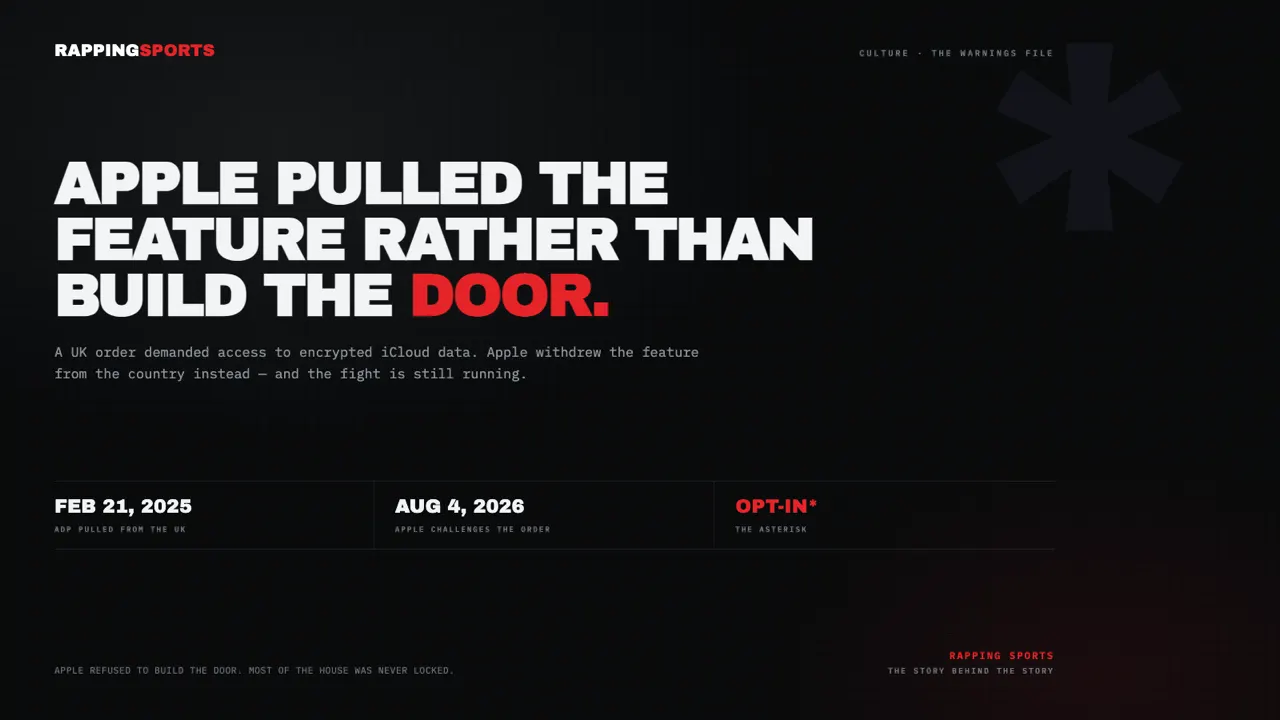
APPLE PULLED THE FEATURE RATHER THAN BUILD THE DOOR.
This is the rare case where a company’s marketing and its conduct line up. It is also the rare case where the asterisk matters more than the headline.
What Advanced Data Protection is
Apple introduced Advanced Data Protection in December 2022. It extends end-to-end encryption to iCloud categories that were not end-to-end encrypted before — device backups, Photos, Notes and more.
End-to-end means Apple does not hold the key. If Apple cannot read it, Apple cannot hand it over.
And the important word is opt-in. It was never on by default. A user had to go into settings, turn it on, and set a recovery method.
The order
In early 2025 the UK Home Office issued a Technical Capability Notice under the Investigatory Powers Act 2016, demanding access to user data.
The reported scope was not limited to UK users — the concern was that complying would require weakening encryption worldwide.
And the order came with secrecy provisions that prevented Apple from even confirming it existed.
What Apple did instead
On February 21, 2025, Apple withdrew Advanced Data Protection for new users in the United Kingdom rather than build the capability.
The company said it was “deeply disappointed,” and that ADP had been designed to protect users from “the most sophisticated threats, including those from government agencies.”
Existing UK users were not cut off automatically — Apple gave them a window in which to disable the feature themselves.
Read that carefully. Apple’s response to an order it could not legally acknowledge was to remove its own product from a country rather than make a version it could not honestly call encrypted.
The asterisk
Now the part the marketing leaves out, and the part the skeptics get right.
Advanced Data Protection was opt-in. Which means that before February 2025, the overwhelming majority of iCloud users were not covered by it — including most users in the UK. Their backups sat in a category Apple could access, because they never turned the stronger setting on.
So the fight was over a feature most people did not have enabled.
That does not make Apple’s refusal meaningless — the people who did enable it lost real protection, and the principle being defended is the one that matters. But “Apple protects your data” and “Apple protects the data of users who changed a setting” are different claims, and only the second one is true.
The other half of the asterisk
There is a second piece of this history that belongs on the same page, because it cuts the opposite way and it is the reason the December 2022 announcement matters.
In August 2021, Apple announced a system that would scan photos stored in iCloud for child sexual abuse material — running the matching on the user’s own device before anything was uploaded.
The company presented it as privacy-preserving: the scanning happened locally, and Apple said it would not see the images of users who were not flagged.
The backlash was immediate and came from the people Apple expected to support it. Privacy researchers and organizations including the Electronic Frontier Foundation argued that client-side scanning is a backdoor architecture regardless of what it is pointed at in version one — because the mechanism, once built, is available for any list.
In September 2021 Apple delayed the feature indefinitely. And in December 2022, in a single announcement, the company abandoned the scanning plan and launched Advanced Data Protection — fully encrypted iCloud backups — instead. The EFF called it a victory and applauded both halves.
That is the same month and the same announcement that produced the feature the UK would later order Apple to weaken. The company chose encryption over scanning in 2022, and it chose to withdraw encryption rather than weaken it in 2025.
Where it stands
On August 4, 2026, Apple filed a new challenge against the UK order, saying it remained “gravely disappointed” that it still could not offer Advanced Data Protection to new UK users.
A later assertion from the US side claimed access to Americans’ data had been dropped from the demand.
As of late 2026 the situation is best described as an unresolved legal and technical confrontation — an order whose scope was never confirmed publicly, a feature withdrawn from a market, and litigation still running.
Apple has not built the backdoor. That is the fact that survives every version of this story.
SPLASH'S READ
The natural read is that Apple sells privacy as a brand and this is the proof it will not go far enough. The record here does not support that read.
Apple took a real hit: it removed a marketed feature from a major market, told customers to turn it off, and has been in litigation for well over a year — rather than comply with something it could have complied with quietly and never disclosed. That is not a company protecting a slogan. That is a company paying for a position.
But the serpent read has a point too, and it is about framing rather than conduct. Privacy is the product here. It is a differentiator that sells hardware, which means the company is incentivized to be as private as is commercially useful and no more. The proof is the asterisk: the strongest protection was opt-in, buried in settings, off by default, for three years.
Both things are true. Apple refused to build the door. And most of the house was never locked.
The honest version of the story is not “Apple is the good guy” or “Apple is Big Brother.” It is that a company drew a line in the one place where drawing it cost something — and that the line was drawn around a room most customers had never entered.
Sources. Apple introduced Advanced Data Protection in December 2022, extending end-to-end encryption to additional iCloud categories including device backups. It is opt-in and is not enabled by default.
In early 2025 the UK Home Office issued a Technical Capability Notice under the Investigatory Powers Act 2016 seeking access to encrypted user data, with reported scope extending beyond UK users and with secrecy provisions. On February 21, 2025, Apple withdrew Advanced Data Protection for new UK users, stating it was “deeply disappointed” and that ADP was designed to protect against “the most sophisticated threats, including those from government agencies.” Existing users were given a window to disable it themselves. Reported by BBC News and others.
On August 4, 2026, Apple filed a new challenge against the UK order, stating it remained “gravely disappointed” that ADP could not be offered to new UK users. A later US-side assertion claimed access to Americans’ data had been removed from the demand. The matter remained unresolved as of late 2026.
The 2021 scanning episode. In August 2021 Apple announced a system to detect child sexual abuse material in iCloud Photos using on-device matching, and in September 2021 delayed it indefinitely after criticism from privacy researchers and organizations including the Electronic Frontier Foundation, who argued that client-side scanning is a backdoor architecture. In December 2022 Apple abandoned the scanning plan and launched Advanced Data Protection in the same announcement; the EFF described it as a victory.
Analysis, labeled as such. The reading that Apple’s conduct here cost it something real, and the counter-reading that privacy functions as a commercial differentiator, are both this page’s analysis. This page makes no claim about any company’s internal motives.
This page contains no photograph of any person.