THEY GOT IN. THERE WAS NOTHING SIGNIFICANT ON IT.
This is the case that started the whole decade-long fight over encryption, and almost everyone remembers the first half and forgets the ending.
The ending is the part that tells you what the fight was actually about.
The device
After the attack in San Bernardino, California on December 2, 2015, the FBI recovered an iPhone 5c belonging to one of the attackers. It was running iOS 9, and it was locked.
The phone was not owned by the attacker. It was issued by the county health department where he worked, which meant it was technically government property — and the government still could not get into it.
What the government asked for
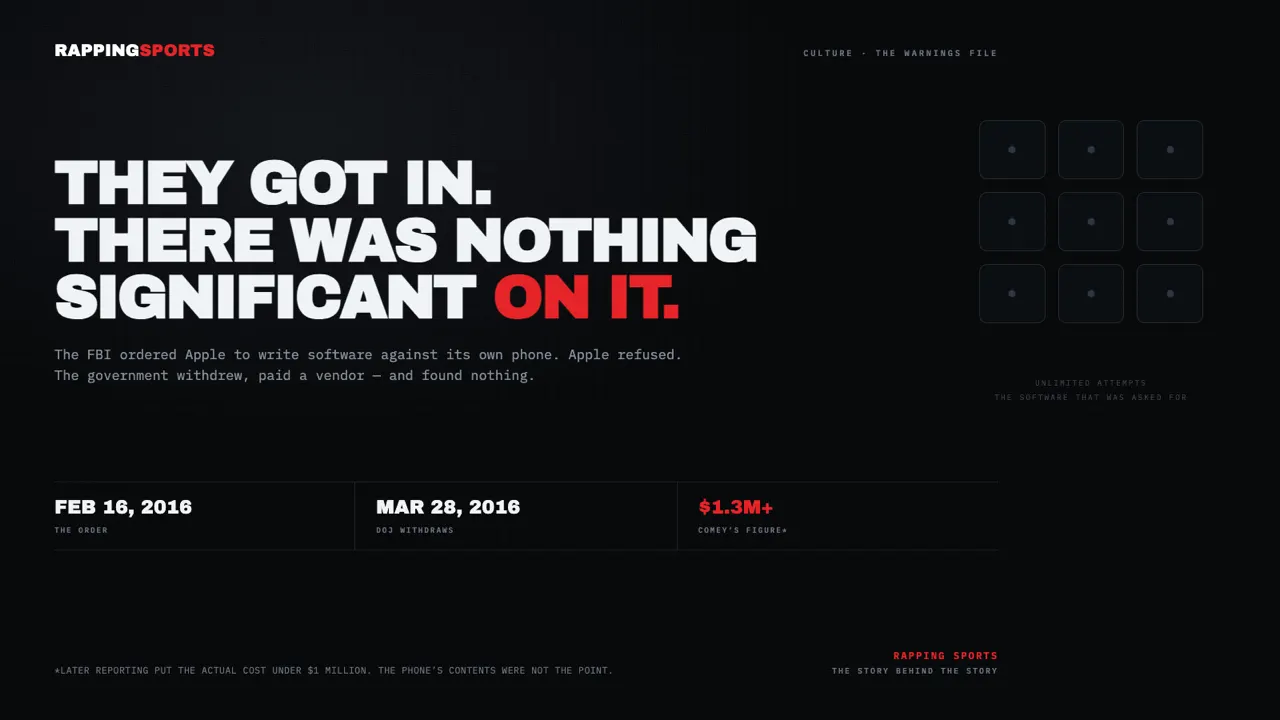
On February 16, 2016, the Department of Justice obtained a court order requiring Apple to assist.
Not to hand over a key — Apple did not have one. The order required Apple to write new software: a version of iOS that would bypass the passcode protections and allow unlimited attempts to guess the PIN electronically.
Apple was being compelled to build a tool against its own product.
Why Apple refused
Tim Cook published an open letter the same day, and the argument in it was not about this phone.
The argument was that the tool, once written, could not be kept to one device. It would be a key that opens every lock in the building, and once it exists it exists. Apple’s phrasing was that the government was asking it to make a version of its operating system that would create a backdoor — and that no such thing can be guaranteed safe.
The case was not a dispute about whether the FBI could search the phone. It was a dispute about whether a company can be compelled to write code that weakens its own security for the state.
What happened next
On March 28, 2016, the Justice Department withdrew its motion.
Prosecutors said an “outside party” had demonstrated a method to unlock the phone, and that they no longer needed Apple’s assistance.
The vendor was never confirmed by the government. Reporting pointed repeatedly at Cellebrite, an Israeli forensics firm, and it has become the accepted version of the story, but it was an unnamed outside party in the filings.
The money
The cost is genuinely disputed, and the dispute is instructive.
FBI Director James Comey publicly indicated the bureau paid more than $1.3 million to get into the phone.
Subsequent reporting, citing government sources, put the figure under $1 million — and specifically noted it was smaller than the number Comey had initially indicated.
So the most quoted number in this story comes from the FBI director himself, and later sourcing suggests it was too high.
The part everyone forgets
In April 2016, the FBI got into the phone.
And a law enforcement source told CBS News that, so far, nothing of real significance had been found on it.
Read that against the urgency of the court filing. The government argued in federal court that Apple’s cooperation was essential to an active terrorism investigation. It got what it wanted from a third party. And the phone turned out to hold nothing of significance.
Which does not mean the FBI was lying about wanting in. It means the value of the phone was never the point.
The precedent was the point
The Department of Justice was not only trying to open a phone. It was trying to establish that a court could order a technology company to defeat its own encryption.
That is the thing that would have mattered past this case, on this phone, in this investigation. A ruling in that case would apply to the next phone, and the next company, and every device with a passcode.
When the FBI found another way in, the case went away without the precedent being set. The government got the data, and lost the ruling.
The inspector general looked at the statements
There is one more layer to this, and it is the one that turns a technology dispute into a question about what the government told Congress.
The Justice Department’s Office of the Inspector General conducted a special inquiry into the accuracy of FBI statements concerning its capabilities to exploit that iPhone. The office published findings examining whether FBI testimony to Congress was accurate, in light of allegations about the bureau’s capability to unlock the device.
Read that scope carefully. The question was not whether the FBI could get in. It was whether the FBI had accurately described, under oath and to Congress, what it could and could not do — while simultaneously telling a federal court that Apple’s help was essential.
That is the sharpest turn in the whole story, and it is the one that gets left out of the documentary versions: a surveillance case ended up producing an oversight inquiry into the surveillance agency’s own statements.
SPLASH'S READ
This case gets told as a story about a terrorist’s phone. It is a story about a courthouse.
If the phone had contained a plan, the story would be about the plan. It contained nothing significant, so the story is about the order — and the order asked for a capability that could not be limited to one device.
Apple said no. The government went around, spent somewhere between seven figures and just under one, got in, and found nothing. And the legal question — can a court make a company weaken its own product — is still open, because the case was withdrawn instead of decided.
The argument survived the phone. That was always the point of both sides.
Sources. The attack in San Bernardino, California occurred December 2, 2015. The phone at issue was an iPhone 5c running iOS 9, issued by the county health department.
On February 16, 2016, the Department of Justice obtained a court order requiring Apple to provide technical assistance, which would have required Apple to create new software to bypass passcode protections. Tim Cook published an open letter the same day explaining Apple’s refusal.
On March 28, 2016, the Justice Department withdrew its motion, stating that an outside party had demonstrated a method to unlock the phone. The vendor was not officially confirmed; reporting identified Cellebrite.
Cost. FBI Director James Comey publicly indicated the bureau paid more than $1.3 million for the technique; later reporting citing government sources put the figure under $1 million and noted it was lower than Comey had indicated, per Reuters.
Findings. The FBI accessed the phone in April 2016. A law enforcement source told CBS News in April 2016 that nothing of real significance had been found on it. The Justice Department’s Office of the Inspector General later examined the accuracy of FBI statements in this matter.
Analysis, labeled as such. The reading that the case functioned as an attempt to establish a precedent, and that the data on the device was incidental, is this page’s analysis rather than a finding in any filing.
This page contains no photograph of any person and does not describe the attack itself.