IT WOULD HAVE NEEDED
TWO MILLION A CAR
TO BREAK EVEN.
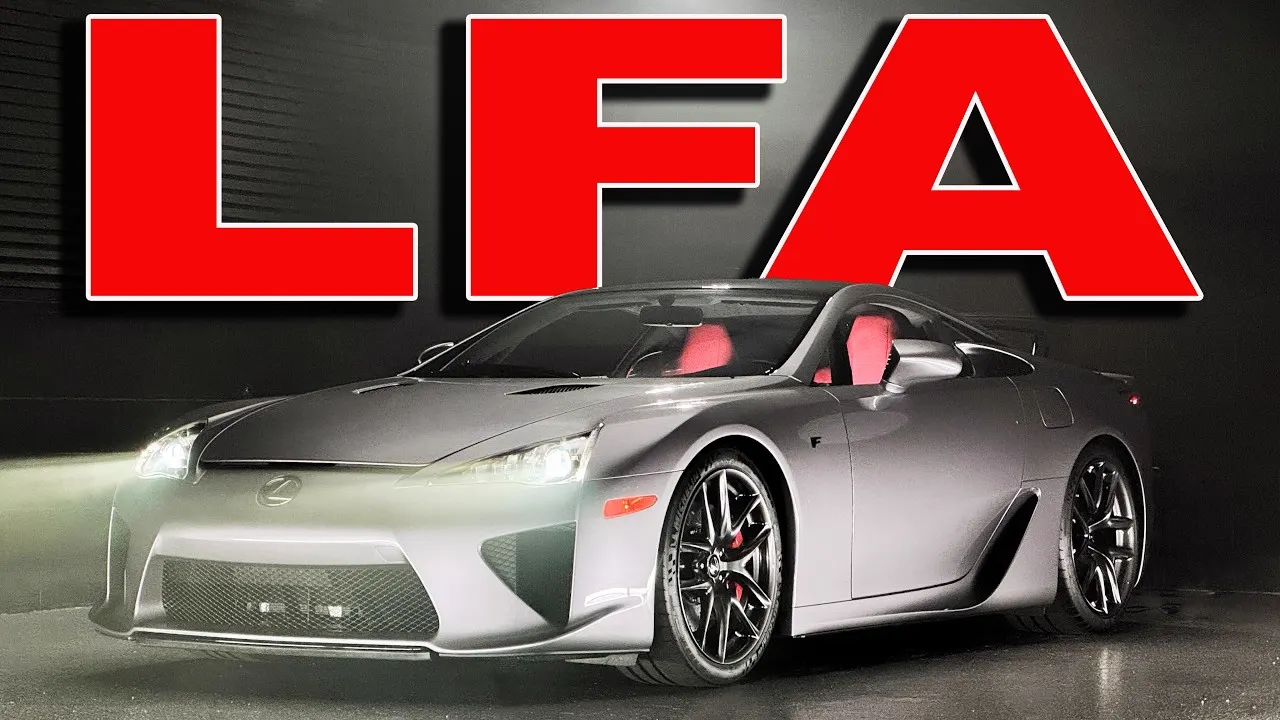
There is a version of this story where the LFA is a punchline. The letter F stands for failure, ha ha. That version is everywhere and it is wrong in an interesting way.
The arithmetic of the loss
The LFA went on sale in the United States at a base price of $375,000, announced in March 2010. The Nürburgring Package pushed it toward $445,000.
Production was capped at 500 cars worldwide, hand-built to customer specification at a rate of about 20 a month, from December 2010 to December 2012.
And the number that explains everything: Lexus would likely have needed to charge around $2 million per car to break even on the program.
Two million. Against a sticker of three hundred and seventy-five thousand. That is not a product with a margin problem. That is a car that was never priced to be a business.
What the money actually bought
Here is where the failure story collapses.
During roughly the same years, Toyota was also racing in Formula 1 — and spending many times what the LFA cost to develop. Toyota never won a single Formula 1 race.
The LFA did not win races either. But it produced two things that are still here: Gazoo Racing and Morizo.
The name is better than people realize. When Toyota entered LFA prototypes in the 2008 Nürburgring 24 Hours, it was not officially allowed to use the term “Toyota Works Racing.” So the team borrowed its name from gazoo.com — a Japanese website that aggregated photographs of cars available at dealerships, where “gazoo” means photo or image. Gazoo Racing is named after a car-listing site.
And Morizo is the racing pseudonym of Akio Toyoda — taken from the mascot of the 2005 World Expo, a green forest grandfather described as having seen many things and knowing everything but never having lost his curiosity.
In May 2009 Akio Toyoda raced an LFA at the Nürburgring as Mr. Morizo and finished 87th overall and 4th in class.
And that line runs straight to the showroom. The GR badge on a modern Toyota descends from a car that lost money.
The engine, which is the actual achievement
The LFA was going to be a V10 from the start — partly because Formula 1 cars of the era were V10s, and partly because Toyota decided a V12 would be too big and heavy while a V8 would not rev quickly enough.
Toyota hired Yamaha to develop it, which was not a strange choice: Yamaha had developed the entire 2000GT for Toyota decades earlier.
The result was a 4.8-litre, 72-degree V10 with ten individual throttle bodies, titanium valves and connecting rods, a 9,500 rpm redline — and it was dry-sumped, which let Toyota mount it absurdly low in the chassis.
The engine is smaller in every external dimension than Lexus’s own 3.5-litre V6, and makes twice the power. And it sits so low that the top of the engine is below the top of the tyres.
That is not marketing. That is a crankshaft near the ground and a center of gravity to match, bought with an oil system that has to work upside down.
The carbon, which nobody had done
The first prototypes and show cars were built in aluminum. Toyota threw the whole thing out and started over, because the LFA needed to be carbon fiber.
And Toyota had never worked with carbon fiber before. The normal move — the move almost everyone makes — is to outsource it to a specialist, the way Ford did with the GT. Toyota did not. It built the capability itself.
There is a reason for that instinct and it is old: Toyota began as a textile loom manufacturer. Weaving is the company’s original trade.
The record, and the unsold cars
The Nürburgring Package set the record for the fastest lap ever recorded by a street-legal production car at the time.
And then there is the other half. A quarter of the LFAs brought to America were still unsold a year after the last one had been built.
The very last LFA was sold in June 2023 — ten years after production ended — and only because the Australian dealership holding it had to buy it or it could never be registered. After July 1 it no longer conformed to the Road Vehicle Standards Act.
A car so unwanted that the final example was moved by a change in legislation.
One myth, corrected
The LFA’s digital tachometer is usually explained as necessary because no mechanical needle could track the engine. That is not true. Mechanical tachometers in other cars handle engines that rev two to four times as quickly — the Cosworth V12 and the GMA T50 among them. The digital dash was a design decision, not a physical limit.
SPLASH'S READ
Accountants would call the LFA a failure and they would be answering a question nobody asked. Toyota did not build it to make money. Toyota built it to find out whether it could.
And the answer was yes: a V10 that revs to 9,500 rpm, sits below the axle line and sounds like nothing else; a carbon chassis built in-house by a company that had never touched the material; a production car that held a lap record at the Nürburgring.
What came back from that was not profit. It was capability and a culture — a racing team named after a photo website and a chairman who races under the name of an expo mascot, and a GR badge on cars people can actually afford.
The comparison that settles it is the Formula 1 program. Toyota spent more on F1 and won nothing — no wins, no badge, no culture, nothing you can buy. The LFA lost money and left something behind.
Two million a car to break even is a scandal only if you think the point of a halo car is the car. The point was never the car. The car was the receipt.
Price and production. Lexus announced a US base price of $375,000 in March 2010; the Nürburgring Package ran toward $445,000. Global production was capped at 500 cars, hand-built to customer specification at roughly 20 per month, from December 2010 to December 2012; the final car, finished 14 December 2012, was white with the Nürburgring Package.
The economics. The assessment that Lexus would have needed roughly $2 million per car to break even on the program, the comparison with Toyota’s Formula 1 expenditure (many times greater, with no race wins), and the observation that a quarter of US-market LFAs remained unsold a year after production ended, are from Jason Cammisa’s Hagerty Revelations episode on the LFA, which prompted this page. Toyota’s Formula 1 program did not win a race.
The engine. 4.8-litre 72-degree V10 developed with Yamaha — which had developed the 2000GT for Toyota decades earlier — with ten individual throttle bodies, titanium valves and connecting rods, a 9,500 rpm redline and dry-sump lubrication. The engine is externally smaller than Lexus’s own 3.5-litre V6 and produces twice the power, and is mounted low enough that the top of the engine sits below the top of the tyres.
Carbon fiber. Early prototypes and show cars were aluminum; Toyota discarded them and developed carbon-fiber construction in-house rather than outsourcing it — the approach taken by Ford with the GT.
Gazoo Racing and Morizo. The team entered LFA prototypes at the 2008 Nürburgring 24 Hours and could not use “Toyota Works Racing,” so it took the name from gazoo.com, a Japanese site aggregating dealership car photographs (“gazoo” = photo/image). Morizo is Akio Toyoda’s racing pseudonym, taken from the mascot of the 2005 World Expo. In May 2009 he raced an LFA as Morizo, finishing 87th overall and 4th in class.
The last car. The final LFA was sold in June 2023, ten years after production ended, when an Australian dealership was required to purchase it because it would no longer conform to the Road Vehicle Standards Act after July 1.
The tachometer myth, corrected. The claim that the LFA’s digital tachometer was necessary because no mechanical needle could keep up is not supported: mechanical tachometers handle engines revving two to four times as quickly, including the Cosworth V12 and the GMA T50. This page corrects that claim, which it made in an earlier article on the V10 engine.
Labeled as analysis. The reading that the LFA should be judged on capability and culture rather than profit, and the comparison to the Formula 1 program, are this page’s interpretation.
This page contains no photograph of any person.
It started as a truck engine
The quota counted cars, not dollars
The man who made I Feel Love put his money into a V16
They built a car for a future that bought an SUV
The car barely changed Sixty percent sold in two years Twenty years earlier: Americans stopped seeing Japanese cars as curiosities The GT40 wasn't really a Ford The E30 M3 sat unsold for years The gullwing doors were a math problem The engine was designed by Lotus and built by a boat company