IT DID 261 MPG.
THEY BUILT ABOUT 250.
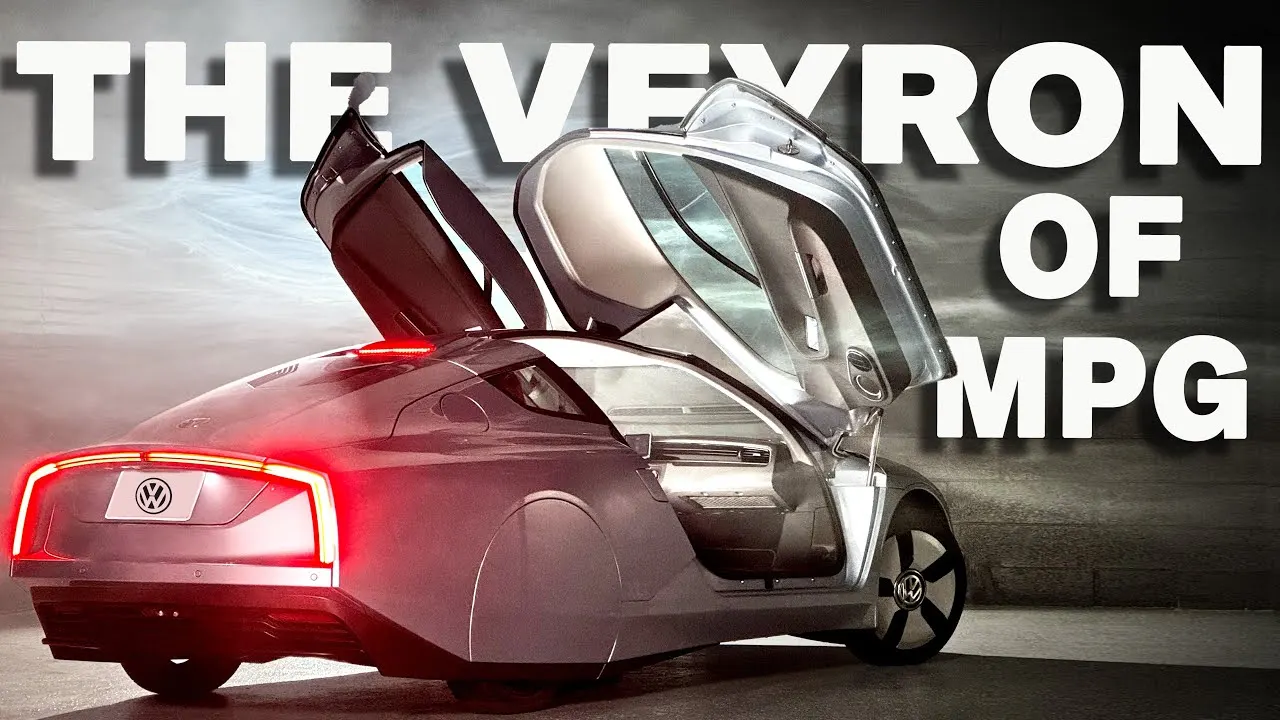
This is the cleanest example in this file of a car that was never a product. It was an argument, built in metal, and then put in a museum.
The numbers
Volkswagen’s own figure: 0.9 litres per 100 kilometres. That is roughly 261 miles per gallon on the European combined cycle, and about 240 mpg in US terms.
Drag coefficient: 0.189 — the lowest of any production car ever built. For context, a contemporary Prius was around 0.25 and a Ferrari 458 was 0.33.
Weight: 795 kilograms — about 1,750 pounds, for a car with a battery, a diesel engine and an electric motor.
How you get there
The body is a carbon-fibre monocoque, and the add-on panels are carbon too. That is the only way to be that light.
The shape is a teardrop on a very narrow track, with the rear wheels covered, the rear track narrower than the front, and camera mirrors instead of door mirrors. Every one of those decisions is there to move air.
The two seats are staggered rather than side by side, so the cabin can be narrow enough to keep the frontal area down.
The powertrain
An 800cc two-cylinder common-rail turbodiesel making 35 kW — 48 PS — and 120 Nm, joined by an electric motor producing 20 kW / 27 PS and 140 Nm from standstill.
Between them: a 5.5 kWh lithium-ion battery and a seven-speed dual-clutch gearbox, driving the rear wheels.
It could run as a pure EV for about 31 miles, and emitted 39 g/km of CO2 on the combined cycle.
Read the specification again. A two-cylinder diesel, in a carbon monocoque, with a dual-clutch gearbox and a plug. There is no other car like it and there never will be.
The price
€111,000 in Germany — roughly $146,000 at the time.
For a Volkswagen. With two cylinders. And no boot to speak of.
The scarcity, which was deliberate
Volkswagen built roughly 250. Some sources reported the plan as 200. It was hand-assembled, and the demand was so far beyond the supply that Volkswagen analysed applicants and chose who was allowed to buy one.
It was, in the description that fits best, a Ferrari for the eco-conscious — not because of what it did, but because you had to be selected.
The part that matters most
It was never sold in the United States. Volkswagen brought one to New York for a promotional tour and did not offer it for sale.
So the most efficient production car ever built was unavailable in the market that buys the most cars.
Why it existed
The XL1 was not a business. It was a technology demonstrator — a way for Wolfsburg to prove that a car could hit one litre per hundred kilometres and still be roadworthy and usable.
And that is exactly what it was: roadworthy, practical, and utterly unaffordable to manufacture at a profit. The carbon monocoque alone guaranteed that.
What it produced was not sales. It was knowledge — about lightweight structures, about aerodynamics, about packaging a plug-in hybrid into a very small footprint. That knowledge went into the mass-market platforms that followed, which is the only way a car like this ever pays for itself.
SPLASH'S READ
The XL1 is the mirror image of everything else in this machines file.
The GT40 sold because it was a racing legend. The E30 M3 sold badly because it was too pure. The ZR-1 failed because it cost twice a Corvette. The XL1 failed because it was physically impossible to build cheaply, so Volkswagen priced it like a Porsche, built 250, and selected the buyers by hand.
And unlike all of those, nobody is going to argue about whether the XL1 was a success. It was never trying to be one.
The number is the achievement. 0.189. 795 kilograms. 0.9 litres per 100 kilometres. Those are not marketing figures, they are engineering results, and no manufacturer has beaten them in the decade since.
But here is the honest part: the car that proved it could be done was never the car that did it. The efficiency arrived in the market years later, in heavier, taller, cheaper cars that got the aerodynamics and the batteries and none of the carbon fibre.
A demonstrator is a promise. Whether it gets kept is somebody else’s job.
Note on sourcing. The video that prompted this page has captions disabled, so no transcript was available. Every figure below is taken from Volkswagen’s own published material or from contemporaneous reporting, not from the video.
Volkswagen’s newsroom (21 February 2013) gives the XL1’s combined consumption as 0.9 l/100 km, the powertrain as a two-cylinder TDI (35 kW / 48 PS) plus an electric motor (20 kW / 27 PS), a seven-speed DSG and a lithium-ion battery, and the construction as a carbon-fibre monocoque and add-on parts with a drag coefficient of Cd 0.189. Kerb weight 795 kg.
Additional specification from the same and related VW material: 800 cc twin-cylinder common-rail turbodiesel, 120 Nm; electric motor 140 Nm from standstill; 5.5 kWh battery; 39 g/km CO2; approximately 31 miles of electric-only range; rear-wheel drive.
Price and production. €111,000 in Germany (reported variously as €110,000–€111,000), equivalent to roughly $146,000 at the time. Production was approximately 250 units, with some reporting the plan as 200; the cars were hand-assembled and Volkswagen selected buyers from applicants. Contemporaneous US reporting states the XL1 would not be sold in the United States.
US-cycle figure. Volkswagen’s US release cited 261 mpg on the European combined cycle and up to 31 miles of electric operation.
Labeled as analysis. The reading that the XL1 functioned as a technology demonstrator rather than a product, and the observation that its efficiency reached the market in heavier mass-produced cars, are this page’s interpretation.
This page contains no photograph of any person.