THEY BUILT A CAR FOR A FUTURE
THAT BOUGHT AN SUV.
This is not a story about a bad car. It is a story about a correct prediction that produced the wrong product.
The premise
Two hundred years ago, about 3% of the world’s population lived in cities. In 2007, the number crossed 50%. By 2050, the projection is that two-thirds of humanity will live in them.
And not just cities — megacities, the United Nations term for a metropolis of more than 10 million people.
Read that data in 2007 and the conclusion writes itself: the car of the future is small, electric, and urban. Every one of those premises was correct.
The man and the money
The executive who acted on it was Norbert Reithofer — not a car guy by background but a production engineer, whose cost-cutting record made him CEO of BMW in 2006, at the moment the company was on top of the world.
A year into the job he decided BMW needed to throw out every convention that had gotten it there and start from a blank sheet. He formed a group that named itself Project i — i for intelligent, innovative, and international.
The budget was roughly €2 billion — a figure reported at the time as a conservative estimate, in dollars about $2.77 billion. Of that, around £400 million went into the Leipzig plant alone, where the cars would be built. An entirely new supply chain had to be created for the material.
What they actually built
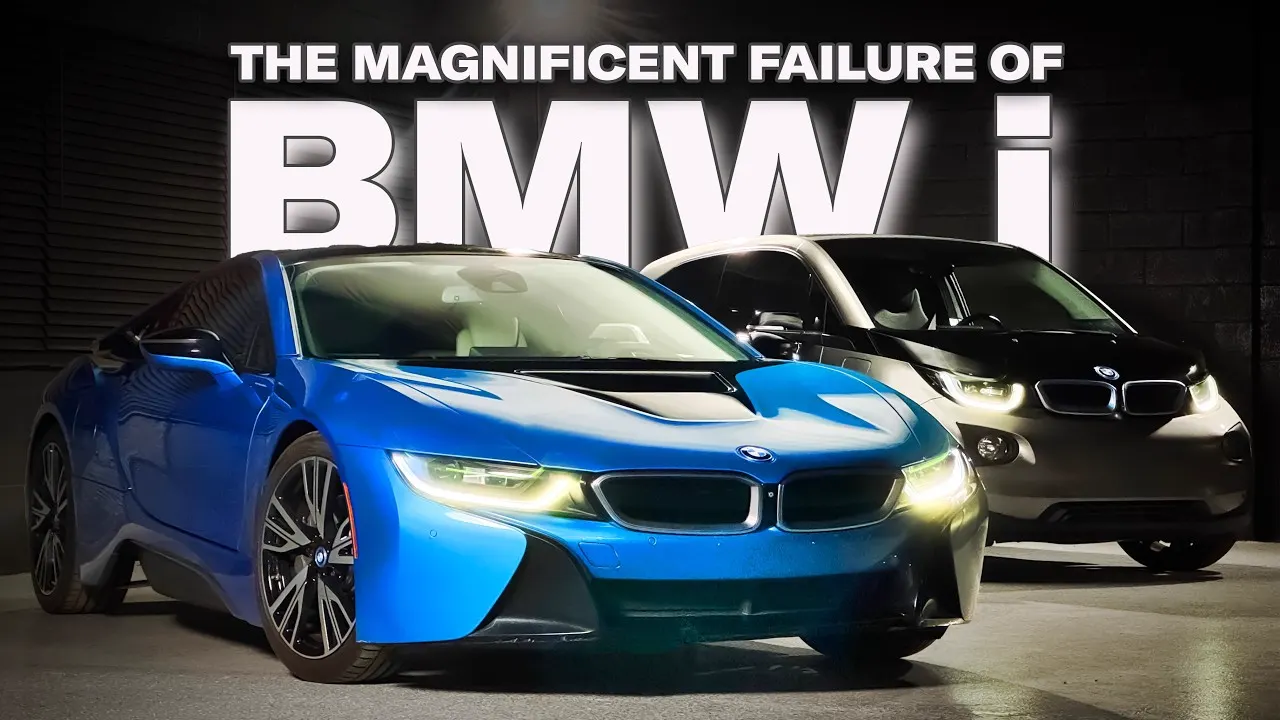
The i3 was the world’s first high-volume regular-production carbon-fiber car. Not a hypercar. Not a limited run. A production hatchback with a carbon passenger cell.
The architecture was called LifeDrive, and it was two pieces: a life module in carbon fiber, and a drive module — an aluminum skateboard holding the drivetrain and the battery. That is the layout essentially every electric car uses today. BMW got there first, in carbon, at enormous cost.
The compromise nobody remembers
The i3 was offered with a range extender — a small gasoline engine that would generate electricity when the battery ran low. In principle, the obvious fix for range anxiety.
In practice it was a scooter motor. Choked down to roughly 34 horsepower, it did not make enough power for sustained highway cruising — which is precisely the situation in which a driver needs extra range. And from outside the car, it did not sound premium.
There was also a regulatory constraint shaping the design: to be classified by the California Air Resources Board as a range-extended EV rather than a plug-in hybrid, the engine could not switch on until the battery reached a specified low state of charge. The car was engineered around a rulebook as much as around a customer.
The result
The i3 went on sale in 2014 in the United States, and production ran nine years, ending in July 2022 with roughly 250,000 vehicles built.
Two hundred and fifty thousand is not a failure. It is a real car that real people bought. But set it against the number at the top of this page: €2 billion, mostly spent before the first car was sold, on a supply chain and a factory and a material that no other manufacturer had attempted at that scale.
The i8 — the mid-engine, butterfly-door sports car from the same program — ended its run in 2020, and whatever it did for the brand, it did not establish a business.
The actual mistake
The prediction was right. The customer was wrong.
BMW built a small urban pod for people who would be living in dense megacities and driving short distances at low speeds. What those customers actually bought, in the years the i3 was on sale, was crossovers and SUVs — the format the industry could not build fast enough.
And look at what BMW sells now. The electric cars that followed the i3 are built on the same skateboard architecture the i3 pioneered — in taller, larger, SUV-shaped bodies. The technology won. The packaging lost.
SPLASH'S READ
The standard reading of Project i is that BMW wasted two billion euros on an ugly little car. That reading is comfortable and mostly wrong.
The carbon fiber was expensive and did not become the industry standard — that part is a genuine miss. But the aluminum skateboard, the dedicated EV platform, the decision to build electric cars as their own product line rather than conversions of existing sedans: every serious electric car on the road today is downstream of that decision.
The failure was not engineering. It was a category error about who the customer would be. BMW trusted a demographic projection over what people were actually walking into showrooms and buying, and the projection lost to the parking lot.
And there is a lesson in this file's own territory. A company can be right about the decade and wrong about the decade's customer, and the balance sheet does not care which one you got right. The i3 was the correct answer to a question nobody was asking at the till.
The car was not ahead of its time. It was ahead of its customer, which is a much more expensive place to be.
The spend. Roughly €2 billion — described by The Wall Street Journal in 2014 as a conservative estimate of what BMW spent to create the “i” brand from scratch, about $2.77 billion. Reporting on the i8’s development puts the carbon-chassis productionisation at €2 billion, of which roughly £400 million went into the Leipzig plant where the i3 and i8 were built.
The program. Project i — “i” for intelligent, innovative, international — was formed under CEO Norbert Reithofer, a production engineer by background who became CEO in 2006. The urbanization figures cited (3% in cities two centuries ago, 50% by 2007, two-thirds projected by 2050; UN “megacity” defined as over 10 million inhabitants) are the program’s stated premise.
The engineering. The i3 was the first high-volume regular-production carbon-fiber car, built on the LifeDrive architecture: a carbon-fiber life module over an aluminum drive module skateboard. The range extender was a small engine of roughly 34 hp, and CARB classification as a range-extended EV required it not to engage until the battery reached a specified low state of charge.
The outcome. The i3 went on sale in the US in 2014 and production ended in July 2022 after nine years, with approximately 250,000 units built at Leipzig. The i8 ended production in 2020.
The framing of Project i as a cautionary tale about executives leaning on consultants and academics rather than car people, and the account of the program’s origins and internal reasoning, are from Jason Cammisa’s Revelations episode for Hagerty, which prompted this page.
Labeled as analysis. The reading that the failure was a category error about the customer rather than an engineering failure — and the observation that BMW’s later electric models apply the same architecture in larger bodies — is this page’s interpretation. This page does not assert a per-vehicle loss figure; the €2 billion is a program investment, not a unit cost, and the two are not the same number.
This page contains no photograph of any person.
The car barely changed
The quota counted cars, not dollars
The engineer said six hours
It started as a truck engine
Waymo vs Tesla The man who made I Feel Love put his money into a V16 It would have needed two million a car to break even Sixty percent sold in two years Twenty years earlier: Americans stopped seeing Japanese cars as curiosities The GT40 wasn't really a Ford The E30 M3 sat unsold for years It did 261 mpg, they built about 250