HE FILLED IT WITH DRUGS AND DROVE TO VEGAS.
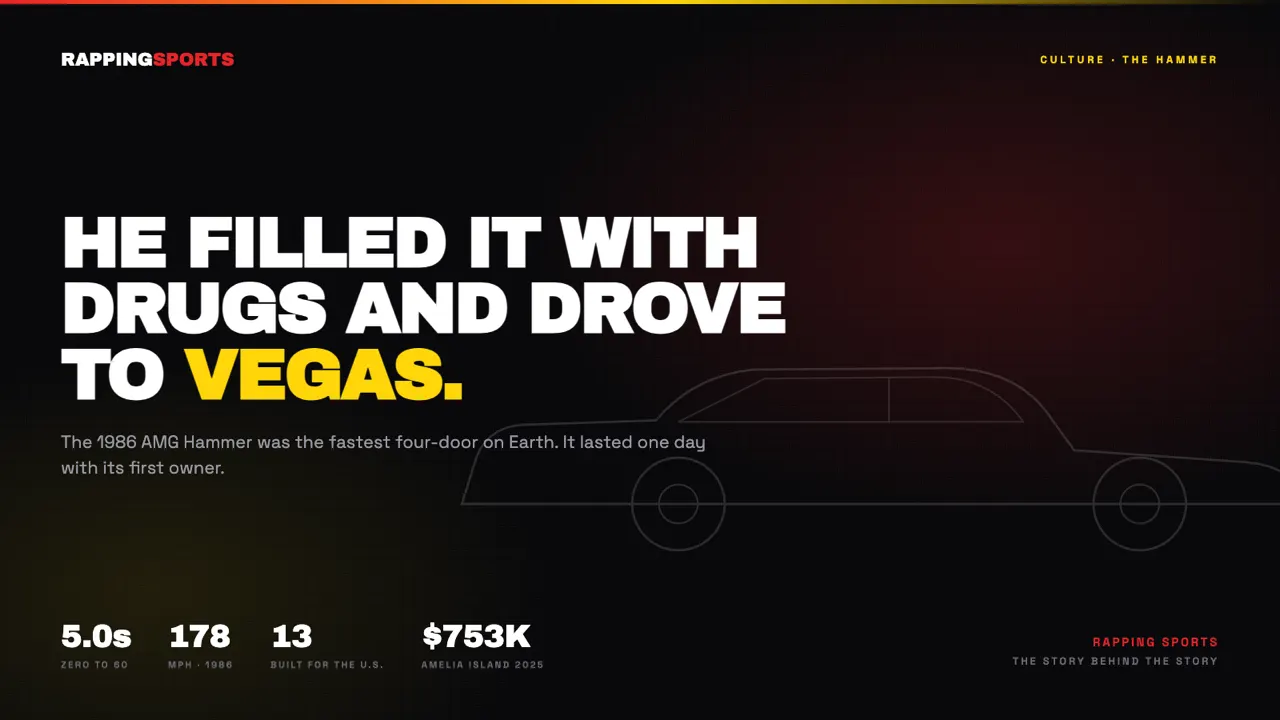
In 1986 the fastest sedan on Earth looked like a taxi. No wing, no flares worth mentioning, no badge on the trunk that meant anything to anyone — a quiet, boxy Mercedes family car of the kind a bank manager drove to work.
Point it at an open road and it would outrun almost anything Italy could build.
And the first one sold in America was, within twenty-four hours, in the hands of the Drug Enforcement Administration.
The car in the showroom
Start with the ordinary version, because the ordinary version is the point.
The 300E was the middle of the Mercedes range when it launched in late 1984 — the W124 generation, premiered in Seville that November. Under the hood sat a 3.0-liter straight-six making 177 horsepower. Smooth, refined, and about as exciting as a well-made filing cabinet.
Car and Driver put the price at $33,900 in 1986 — serious money for a family sedan, and people paid it gladly, because what Mercedes was selling was not speed. It was engineering.
The details are still absurd. The W124 had a single windshield wiper on an eccentric mechanism that stretched and shrank as it swept, reaching into the top corners of the glass and clearing 86 percent of the windshield — the largest wiped area of any production car at the time. The body was shaped in a wind tunnel with plastic paneling smoothing the airflow underneath, reaching a drag coefficient as low as 0.28, slippery as a sports car. Each rear wheel was located by five separate links. And the safety cell was engineered to survive a 35 mph offset crash with the cabin intact — a test so tough it later became the basis of the European offset crash procedure.
AMG did not start with a weak car. Mercedes had already built one of the safest, quietest, best-planted sedans on Earth.
Who AMG was in 1986
Not a Mercedes department.
AMG was founded in 1967 by Hans Werner Aufrecht and Erhard Melcher, two former Daimler-Benz engineers, in Grossaspach, Germany — the initials are the founders' names and the town. By the 1980s the company was building in Affalterbach and selling through authorized agents: AMG North America, Stratton in the UK, AMG Japan.
Mercedes did not own AMG in 1986. It did not control it, and it could not ignore it. That distance is the whole reason the Hammer exists — a factory would never have built it, because a factory had a warranty department and a product plan.
Aufrecht had one ambition that explains everything that follows: he wanted a sedan that could do 300 kilometers an hour.
How they got there
The W124 was never designed to hold a V8. That was the first problem, and it was a chassis problem before it was an engine problem.
AMG started with Mercedes' 5.0-liter M117 V8 and added their own four-valve cylinder heads, taking it past 335 horsepower. Then they bored it to 5.4 liters around late 1985. Then Mercedes itself unveiled a 5.6-liter M117 with 295 horsepower in the S-Class, and AMG took that block, bolted their four-valve heads onto it, and by the end of 1986 had the car everyone remembers: 355 horsepower, good for roughly 180 mph.
American magazines named it. The word was the same in English and German, and AMG put it in the marketing.
They did not stop. The next move was boring the engine out again, and the 6.0-liter Hammer was ready for the summer of 1987 — around 380 horsepower and 417 pound-feet of torque, which finally broke the 300 km/h barrier: 186 mph, the original goal of the whole project.
Everything else got touched too. The valve body of the four-speed automatic was modified. S-class driveline parts went in, along with a limited-slip differential. The car was lowered on stiffer springs and Bilstein dampers. The rear subframe was reinforced and the inner fender wells widened for bigger wheels.
What the magazines measured
Car and Driver tested the car in December 1986 and called it the most exciting sedan they had ever tested.
The numbers were these: zero to 60 mph in 5.0 seconds. The quarter mile in 13.5 seconds at 107 mph. A top speed of 178 mph. And the one that mattered more than any of them: from 60 to 120 mph, it was quicker than a Lamborghini Countach.
A four-door family Mercedes was faster in the mid-range than the poster car on every boy's wall.
The price was $125,000 base, $137,000 as tested. Some retellings inflate that to $160,000; the period figures are the lower ones. Either way it was Countach money for a car that looked like a taxi with nicer wheels.
Westmont, Illinois
Every real North American Hammer was built at AMG Chicago, in Westmont, Illinois.
From there this one shipped to Beverly Hills Motoring — Andy Cohen's shop, a major AMG retailer who did some of the conversion and then, in the phrase of one owner, "just threw on tons and tons of accessories." Buy an AMG in Newport Beach in 1986 and it might arrive with twenty, thirty, forty thousand dollars of add-on equipment. Sheepskin seat covers. All of it.
This car was a black coupe on monoblock AMG chrome wheels. Quintessential.
The first twenty-four hours
Here is where the story stops being a car review.
The original owner took delivery and did what, in the telling, anybody in the 1980s would do: he filled it with drugs and drove to Vegas.
He drew attention along the way. Multiple police officers tailed him most of the distance — and could not close, because he was driving the fastest sedan of the day and was, in the words of the man who later bought the car:
He got to his destination and stopped. A few minutes later, the cops caught up.
They arrested him. They searched the car. They found cocaine, and they found quaaludes — the sedative that defined the decade's recreational pharmacology. And they took the car.
The government's Hammer
The DEA kept it and drove it.
Reporting on the car puts the mileage the government added at around 1,500 miles before it went to auction. Which means the federal government of the United States, for a period in the late 1980s, was commuting in the fastest sedan in the world.
Then they sold it, at a federal auction, and the buyer was a professional baseball player.
Rob Deer
Rob Deer was a major-league outfielder, born in 1960, and one of the purest examples of what statisticians call the three true outcomes — the walk, the strikeout, and the home run, and very little in between. He hit 230 home runs in an eleven-year career.
He bought the Hammer at the government sale and owned it for a while, and by one account had been in contact with the man the car was eventually being sold for, at one point interested in getting it back.
He loved the idea of having the ultimate 1980s car. Then he traded it back in at Symbolic, in San Diego.
The broker's friend
What happened next is the most ordinary part of the story and the reason the car survived.
Sometime in the mid-1990s a car broker got a request from a friend: find me the most interesting car you can buy. He said: buy this Hammer. The friend did, and owned it for a little over a decade.
When he decided to sell, the first person he mentioned it to was the friend who had found it. That man said he would just buy it himself.
He has owned it for about fifteen years. And he parked it.
Why they all get parked
That is not a quirk of this owner. It is the pattern, and it is the thing that makes the market strange.
Almost nobody drives a Hammer, and there are two reasons.
The first is that they are finicky in ways that are expensive to fix. The fuel systems are complicated. The heads are porous and leak inherently. They were built at the ragged edge of what was possible in the 1980s — that is how you make the fastest car in the world, and it also makes them a liability. Only a handful of people know how to rehabilitate one properly, and fewer still will actually drive it afterward.
The second is that the value went somewhere nobody planned for.
Nobody knows what it's worth
For most of their lives these cars were worth less than a hundred thousand dollars.
Then the collector market found them, and the price stopped being a number and became an argument. An RM sale of a car with the wrong engine — not really a Hammer, and not running — brought $100,000, and the people who know these cars say flatly that it is not a comparable. There are rumors of cars in the United States and abroad tickling seven figures.
In 2025 a 1988 300 E 6.0 Hammer crossed the block at Gooding Christie's Amelia Island auction against an estimate of $1.25 million to $1.75 million. It sold for $753,000. That is a miss against the estimate, and it is still the fourth-highest price ever paid for a pre-merger AMG.
Which tells you where the market actually is: not at the estimate, and nowhere near the old hundred thousand either.
The owner's own summary is the most honest line in any of this:
How many exist
Nobody can tell you exactly, and that is part of the value.
There is no consummate VIN list. The cars have never been fully canonized. Thirteen were built by AMG of North America. Counting sedans, coupes, and the single station wagon, the worldwide total is somewhere around thirty to thirty-five cars based on current knowledge — though an AMG magazine in 2010 quoted fifty-four, which is why there is always an air of mystery and always someone claiming more are out there.
You will also meet cars called Hammers that are not. Later M119-engined cars, wide-body six-liter conversions, ordinary AMG cars their owners believe are Hammers. A proper Hammer, in the strictest telling, is a 300 CE or 300 E converted with the M117 four-cam six-liter.
What the car actually proved
The Hammer's argument was not about speed. It was about category.
Before it, a fast four-door was a contradiction in terms — the sedan was where you put the family, and the sports car was where you put the ego. AMG put both in the same body and made the family car the faster one.
Every quick sedan since — the M5, the E55, the RS6, the Hellcat Charger — is downstream of a small independent shop in Grossaspach deciding that a bank manager's car should be able to outrun a Countach.
And the first one sold here went to a drug dealer, then to the DEA, then to a ballplayer, then to a garage for fifteen years.
The car was never the point of the story. It just kept being the thing that happened to.
SPLASH'S READ
The reason the Hammer matters is not that it was fast. It is that it was fast in a body that had no business being fast, built by a company that had no business building it, sold to a man who had no business owning it.
Every institution that should have prevented it — the factory, the product plan, the warranty department, the law — got there too late, and the car was already gone.
$753,000 against a $1.75 million estimate is the same story in one line: the market knows what it is, and still cannot agree on what it is worth.
Sources. Vehicle specification, AMG company history, production figures and the technical account of the conversion are drawn from period and collector reporting, including Car and Driver's December 1986 test (0–60 in 5.0 s, quarter mile 13.5 s at 107 mph, 178 mph top speed, $125,000 base / $137,000 as tested), and from the W124 and AMG histories published by Mercedes-Benz and Hemmings.
The base 300E price of $33,900 is Car and Driver's own 1986 figure for the car as tested. The 6.0-liter output and the 300 km/h result are from AMG's own period materials as reported in collector coverage.
The seizure story — the drugs, the drive to Las Vegas, the DEA taking possession, the ~1,500 miles added, the federal auction, and Rob Deer as the buyer — is documented in collector-market reporting on this specific car (notably MBWorld, August 2022) and corroborated by the seller's own account in VINwiki. It is a first-person account of an event with no court record attached; the page reports it as the owner's and the seller's telling, not as an adjudicated fact.
The $753,000 result is the Gooding Christie's Amelia Island 2025 sale of a 1988 300 E 6.0 Hammer, against a published estimate of $1,250,000–$1,750,000; the fourth-highest price paid for a pre-merger AMG, per Hagerty. The production range of 30–35 cars, the figure of 13 North American cars, and the 2010 AMG magazine figure of 54 are all reported as competing counts, because no authoritative register exists.
Rob Deer is a real major-league outfielder (b. 1960); the purchase at federal auction is reported in the same collector coverage, not in a court or auction document this page has seen.
Corrections against retellings: the price is $125,000/$137,000 in period sources, not the $160,000 that circulates; the tested top speed of the 5.6 is 178 mph, not 180; the 300E listed at $33,900, not $39,000.