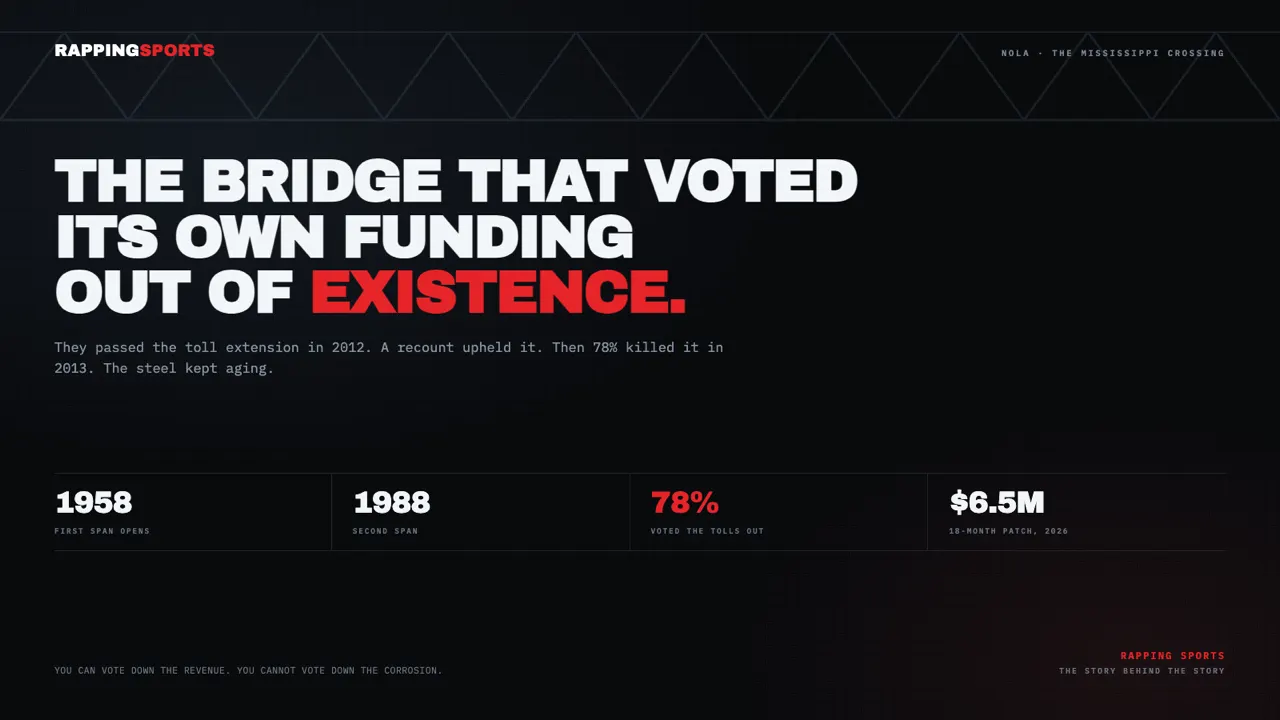
THE BRIDGE THAT VOTED ITS OWN FUNDING OUT OF EXISTENCE.
Every city has a piece of infrastructure it cannot afford. New Orleans has one that held a vote about it.
Two bridges, sixty-eight years apart
The Crescent City Connection is a pair of cantilever bridges carrying US 90 Business across the Mississippi, connecting the east bank to the west bank.
The first span opened in April 1958 as the Greater New Orleans Bridge, after construction began in November 1954. It was designed by Modjeski and Masters, the firm commissioned in 1951 to study how to cross the river at all — including a tunnel, which was rejected on cost and complexity.
The second span was built from 1983 to 1988, with its main spans completed in 1985, and also designed by Modjeski and Masters. In 1989, the pair was renamed the Crescent City Connection.
The engineering problem was never the width. It was the clearance — the river underneath is one of the busiest commercial waterways in the country, and anything crossing it had to sit high enough for ships bound for the Port of New Orleans while carrying everything that moves between two halves of one city.
The tolls
The bridges were paid for the way most American bridges were: a toll on the people crossing them.
Which worked for decades, and then came up for renewal.
The vote, then the recount, then the do-over
This is the part that makes the Crescent City Connection a story rather than a structure.
In November 2012, a referendum to extend the tolls for another twenty years appeared to pass — narrowly. It was close enough that it went to a partial recount, and in February 2013, a recount of nearly 4,000 paper ballots in Orleans Parish upheld the result.
The tolls were, as of February 2013, going to continue for two more decades.
Then the public got another vote.
On May 4, 2013, a second referendum defeated the toll extension outright. The final count was 73,656 votes to eliminate the tolls, a margin of more than 50,000. In Orleans, Jefferson and Plaquemines parishes, roughly 78 percent voted to end them.
That is not a close election. That is a repudiation.
What actually ended
The tolls stopped. The bridge did not.
What the vote ended was not a fee. It was a revenue stream dedicated to a specific piece of steel. Bridges are not paid for once; they are paid for continuously, in inspections, in deck replacements, in the endless war against water and salt and traffic.
And for thirteen years, that work has had to come out of a general transportation budget competing with every other road, bridge and project in a state that has no shortage of them.
This month
Which brings us to November 2026.
On November 3, 2026, the Louisiana Department of Transportation and Development began an 18-month repair project on the city-bound US 90B span — GNO No. 2.
The cost is approximately $6.5 million. The work rehabilitates the vertical steel components that support the bridge’s framework. DOTD describes it as preventative maintenance.
Six and a half million dollars. Eighteen months. And the closures began at 8 p.m. on election night, after the polls closed.
Read those numbers against the others. Two bridges, sixty-eight years of service, a metro of more than a million people, and the current investment in keeping one of them standing is $6.5 million spread across a year and a half.
SPLASH'S READ
The Crescent City Connection vote is usually told as a story about taxes — people rejecting a fee, politicians learning a lesson.
It is a better story than that, and a worse one.
The people who voted in 2013 were not wrong about the toll. It is a regressive way to fund a bridge — the people who cross it most are the ones who live on the wrong side of it, and a toll is a tax on the commute that already costs them the most.
What the vote could not do was make the steel stop aging. The bridge did not get cheaper when the tolls came off. The bill just moved somewhere less visible, and got spread across everybody instead of the people who use it.
That is the trade nobody puts on a ballot: you can vote down the revenue, but you cannot vote down the corrosion.
And this is a New Orleans story in the most literal way. The city is shaped by that river, the river is why the city exists, and the two bridges are the only reason the east bank and the west bank are one place instead of two. The thing holding them together is now getting a $6.5 million patch, in eighteen months of lane closures, thirteen years after everybody agreed to stop paying for it on purpose.
Sources. The Crescent City Connection is a pair of cantilever bridges carrying US 90 Business over the Mississippi River at New Orleans. The first span opened in April 1958 as the Greater New Orleans Bridge, with construction beginning November 1954; the second span was built 1983–1988 with main spans completed in 1985. Both were designed by Modjeski and Masters, commissioned in 1951 to study crossing designs including a tunnel. The pair was renamed the Crescent City Connection in 1989.
The November 2012 toll-extension referendum appeared to pass narrowly and was upheld after a partial recount of nearly 4,000 paper ballots in Orleans Parish in February 2013. A second referendum on May 4, 2013 defeated the 20-year toll extension, with a final count of 73,656 votes to eliminate the tolls and a margin exceeding 50,000; roughly 78 percent of voters in Orleans, Jefferson and Plaquemines parishes supported elimination.
The current project. The Louisiana Department of Transportation and Development announced a $6.5 million preventative maintenance project on the city-bound US 90B / Crescent City Connection, GNO No. 2, rehabilitating the vertical steel components supporting the bridge’s framework, with lane closures beginning November 3, 2026 at 8 p.m. and a duration of approximately 18 months.
The characterization of the 2013 vote as regressive and the framing of the trade-off are this page’s analysis, not findings of any agency. The population figure for the metro area is approximate.
This page contains no photograph of any person.