DESIGNED TO LAST 24 YEARS.
IT RAN FOR THIRTY-SEVEN.
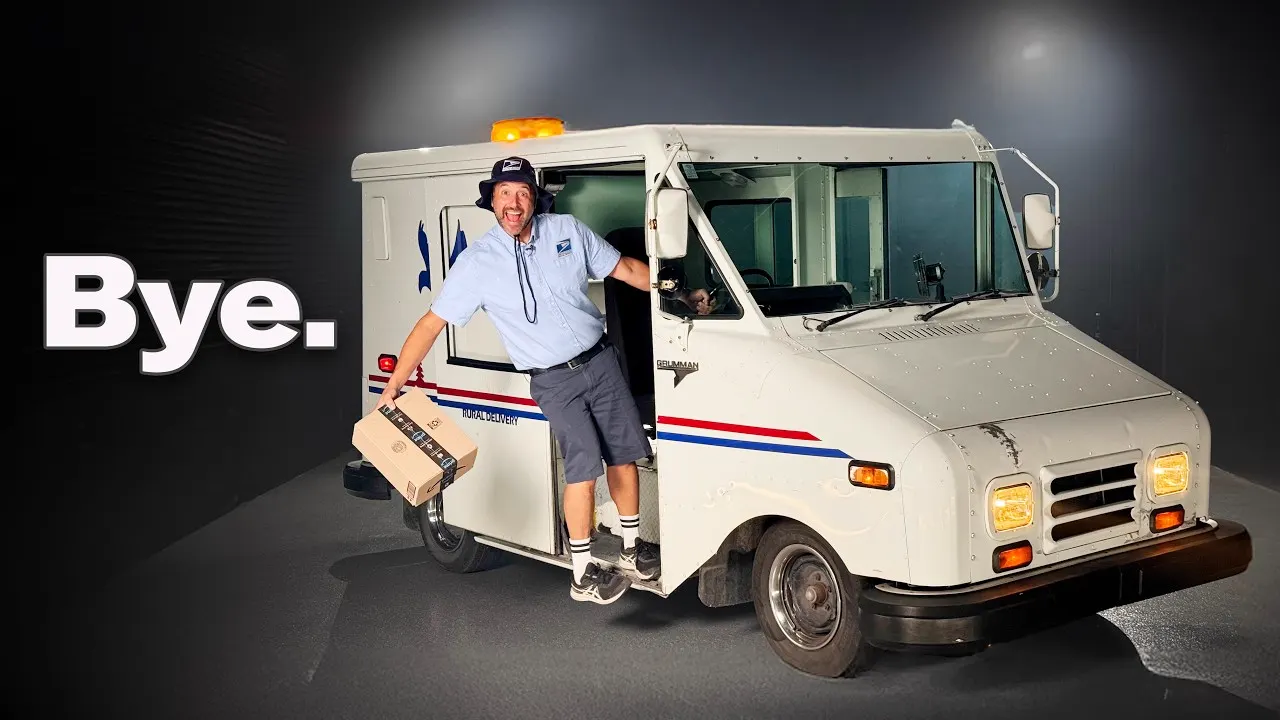
Only one crewed vehicle has ever landed on another world. The company that built it made something with far more reach.
Grumman
The Apollo Lunar Module was built by Grumman, a defense contractor that also built canoes, fire trucks and the F-14 Tomcat.
A decade and a half later, the same company built the LLV — the Long Life Vehicle — and it touched more American lives every single day for four decades than the lunar module ever did.
It is the most-seen vehicle on American roads that nobody can name.
The requirement
By the early 1980s the postal fleet was a museum: Jeeps, AMC products, Pontiacs, Audis, Ford Pintos, Chrysler K-cars. Half of them had already passed their eight-year replacement criteria.
In 1984 the Postal Service did something rare for a government agency: it wrote a purpose-built specification instead of adapting somebody else’s car.
The requirements:
Aluminum skin, to fight corrosion. An expected service life of 24 years — three to four times the existing fleet. Panels simple to manufacture, no complex curves, individually replaceable. A powertrain that would last 12 years and be easy to swap when it did not.
The arithmetic that sold it
Postal accountants calculated the program would save $5.7 billion in repair, maintenance and fuel costs over the vehicle’s 24-year life.
That saving alone would eliminate the need for a seven-cent stamp increase, at a time when a stamp cost 22 cents.
That is the entire case. Not safety, not comfort, not modernity. A stamp.
Three finalists emerged in 1985, and Grumman won, in partnership with General Motors, at $11,651 per vehicle — a contract of more than $1.1 billion in 1986 money.
What it actually was
The steering wheel says Chevrolet, and that is the most honest thing about it. Underneath is the frame of a Chevy S-10 pickup, with beefed-up suspension and a wheelbase chopped to 100.5 inches for maneuverability.
Under the hood: Pontiac’s 2.5-litre Iron Duke — a pushrod four dating to the 1970s making under 100 horsepower and 130 pound-feet. Not fast. But the torque arrived low in the rev range, which is exactly what you want when the payload is a few tons of junk mail.
Right-hand drive, so the carrier could reach the mailbox. A garage-style roll-up door. A sliding side door.
Grumman built over 140,000 of them, peaking at nearly 100 a day — one rolling off the line every five minutes. Total production reached 142,655.
What it did not have
Here is the list, and it is not short:
No air conditioning, which made summer misery. No ABS, so it was poor at stopping. No airbags, so it was poor in a crash. No rear visibility, so backing up was guesswork. A cargo floor too low to stand up in. Rear-wheel drive only, so winter was bad — and the low front bumper turned into a snowplow. And 8.2 miles per gallon in delivery use.
The carriers loved them anyway, at least at first — because before the LLV they were driving whatever the government had left over.
The decision that made it a 37-year vehicle
Production ended in 1994. And the Postal Service had no unified plan for a replacement.
So it went back to the old non-strategy: a stratified fleet of minivans, Mercedes Metris vans, and Ford Transits that looked a great deal like the Grumman.
And the LLVs kept running. The USPS was replacing 1,500 rusted-out frames a year at $5,000 each — and still keeping the trucks on the road.
In the second half of 2024 alone, more than 11,000 were retired and disposed of. The youngest LLVs in service were 11 years past their intended 24-year life.
The fires
There is a part of this story that is not charming, and it belongs here.
An investigation by Motherboard reviewed 3,954 pages of documents on LLV fires and found that more than 400 Postal Service delivery trucks had been damaged or destroyed by fire since May 2014 — roughly one every few days, over a fleet that was supposed to have been retired.
In July 2026, federal workplace safety investigators opened a probe into the on-duty death of a mail carrier in Little Elm, Texas. This page does not assert what caused that death; the investigation was open.
What can be said without speculation is the arithmetic: a vehicle specified for 24 years was being run for more than three decades, and the cost of that was not only measured in rusted frames and fuel.
The one that went the distance
You can measure a 24-year design life in specifications. USPS measured it in one truck.
In 2007 the Postal Bulletin ran a short item on a Kansas City, Kansas, LLV with 402,000 miles on the odometer — the highest in the Western Area, and possibly in the entire Postal Service. It had been in service since 1994. The vehicle maintenance staff had a name for it.
Allen Knoll, the Shawnee Mission vehicle maintenance supervisor, put the longevity where it belonged:
The clerk who put most of those miles on it was Chuck Woods, an Express Mail clerk at the Kansas City Post Office. The truck was built for 24 years. In 2007 it already had 13 years on it and a target of half a million miles.
The replacement
The Postal Service allocated $9.6 billion for 106,480 new vehicles. The contract for the NGDV — Next Generation Delivery Vehicle — went to Oshkosh, another defense contractor, this time with Ford.
Its intended lifespan is 20 years — making it, as the joke goes, a slightly less long life vehicle.
But it has air conditioning, modern safety systems, backup cameras and intermittent wipers. And it is tall enough to stand up in.
The plan is to recycle 95,000 of the roughly 110,000 remaining LLVs by 2029.
SPLASH'S READ
This is the purest example in this file of a vehicle that was engineered correctly and then failed by not being replaced.
The LLV is a genuinely good piece of design work. Aluminum for corrosion. Flat panels because curves cost money and dent. Individually replaceable body parts on a truck that would be crashed into mailboxes for twenty years. A torque-rich engine from the parts bin. A 24-year life specified in writing.
And the math worked. It saved the money. That is why nobody bought a new one. The truck was so cheap to keep that replacing it never became urgent — until the frames rusted through and the fleet started catching fire.
A 24-year vehicle ran for 37 because the alternative cost $9.6 billion, and every year the $9.6 billion could be deferred was a year the deferral looked like a saving.
And there is one more thing worth keeping. The machine that took humans to the Moon and the machine that brought you a coupon for mattress closeouts were built by the same company, and only one of them was in your driveway every day.
Impact is not the same thing as importance. The Lunar Module is in the history books. The LLV was in the street.
Manufacture. The Grumman LLV was assembled in Montgomery, Pennsylvania, with production from 1986–1994 under the initial contract; 142,655 vehicles were purchased under the 1986 contract, worth more than $1.1 billion, at $11,651 each. Peak output was roughly 100 per day — one every five minutes.
The specification. In 1984 the USPS issued requirements for a purpose-built delivery vehicle: aluminum skin, a 24-year expected service life (three to four times the existing fleet), simple individually replaceable panels, and a 12-year powertrain designed for easy replacement. Projected savings of $5.7 billion over the vehicle’s life were calculated to be equivalent to avoiding a seven-cent stamp increase at a time when stamps cost 22 cents.
The hardware. Chevrolet S-10 frame with uprated suspension and a 100.5-inch wheelbase, right-hand drive, roll-up cargo door; Pontiac 2.5-litre Iron Duke pushrod four, under 100 hp and 130 lb-ft.
Deficiencies. No air conditioning, no ABS, no airbags, no rearward visibility, insufficient cargo height to stand, rear-wheel drive only, and approximately 8.2 mpg in delivery service — as catalogued in Jason Cammisa’s Hagerty Revelations episode, which prompted this page.
Attrition. Production ended in 1994 without a unified replacement plan. The USPS was replacing about 1,500 rusted frames annually at $5,000 each, and more than 11,000 LLVs were retired in the second half of 2024 alone. The youngest in service were about 11 years past the 24-year design life.
Fires. A Motherboard (Vice) investigation reviewed 3,954 pages of documents and reported that more than 400 USPS delivery trucks had been damaged or destroyed by fire since May 2014. In July 2026 federal workplace safety officials were investigating the on-duty death of a carrier in Little Elm, Texas. This page does not attribute that death to a vehicle defect; the investigation was open at the time of writing.
The replacement. The USPS allocated $9.6 billion for 106,480 NGDV units, awarded to Oshkosh in partnership with Ford, with an intended 20-year lifespan and air conditioning, modern safety systems and backup cameras. Roughly 95,000 of the remaining 110,000 LLVs are to be recycled by 2029.
Labeled as analysis. The reading that the LLV was well-designed and failed through non-replacement, and the contrast between impact and importance, are this page’s interpretation.
This page contains no photograph of any person.
USPS, Postal Bulletin 22207, “Going the distance: This LLV puts long into life,” 2007 — about.usps.com.