THE GT40 WASN’T REALLY A FORD.
The movie is good. It also skips the part that makes the story more interesting than the version you saw.
The car under the badge
The GT40 was not designed in Dearborn. It was a British car — a Lola GT — with styling influenced by a 1962 Ford concept car called the Mustang.
The chassis was designed and built in England. That is why the car was right-hand drive — a detail that is hard to miss once you know it, and which the film does not dwell on.
The engine was Ford’s. The rest of it was not. At the end of the day the GT40 was a race car commissioned by Ford and built by people who were not Ford people.
Even after Carroll Shelby got involved, that did not change. All four of the Le Mans–winning GT40s from 1966 to 1969 ran the original right-hand drive layout — including the Mk IV, which was built in Michigan on a brand-new chassis.
What Ferrari was actually doing
The film sets up Ferrari as the giant. The record is worse than that.
Ferrari had won Le Mans six years in a row. And in each of those six years Ferrari did not merely win — it took first, second and third, with the sole exception of 1960, the first year of the streak.
And in 1963, Ferrari finished first, second, third, fourth, fifth and sixth.
That is not a racing team. That is a demonstration.
1966, and the backlash
In 1966 Ford finished first, second and third at Le Mans — three Mk IIs, driven by Amon and McLaren, Hulme and Miles, and Hutcherson and Bucknum.
And the reaction was not the one Ford wanted. Because the GT40 was not really a Ford and not really American, the win was not received as an American win. People who knew what the car was said so out loud, and it stung.
There is a harder fact attached to that podium that the film does treat seriously and this page will not skate past. Ken Miles, in the second car, did not win. He died testing two months later, and never won Le Mans.
1967, when it was actually American
So Ford came back the next year with the GT40 Mk IV — and this time it was genuinely American: designed and built in the United States, powered by an American V8, driven by two American drivers, Dan Gurney and A.J. Foyt.
And it won by 32 miles over the second-place car, which was a Ferrari.
That was the American win. It just happened a year after the one everybody remembers.
Ford won the next two years as well, making four consecutive Le Mans victories from 1966 to 1969. “Win on Sunday, sell on Monday” was the saying. So Ford should have built a GT40 road car immediately.
Seven attempts, thirty-seven years
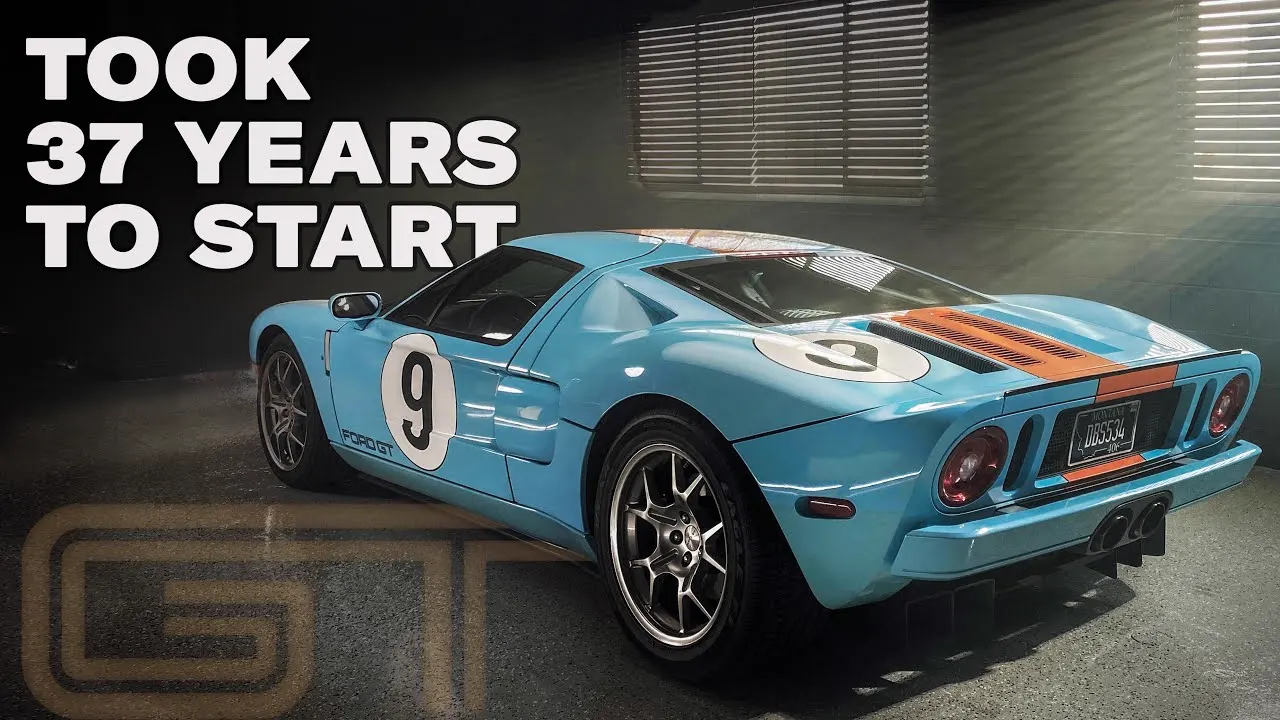
It did not. Ford tried seven times to turn the GT40 into something it could sell, and it took 37 years before one of them worked.
The Mach 2 — part Ranchero pickup, part Mustang, comprehensively bizarre — was killed when Lee Iacocca chose instead to sell the Ford-powered De Tomaso Pantera through US dealers. That was an attempt.
The GT-70 was built for the World Rally Championship with a V6 in the middle. Six cylinders, six cars built. Had it gone well there might have been a street car. It did not, and there was not.
The GN34 was killed in favor of an SUV that was allegedly going to make Ford a great deal of money. You may have heard of it. It was called the Explorer.
The GT90 was named to celebrate the 1990s, not for being ninety inches tall, and packed a 720-horsepower quad-turbocharged Roush V12. Ford brought out A.J. Foyt for it, and then killed it.
The Indigo concept looked like a front-engined Plymouth Prowler. It went the same way as the others.
What finally worked
In 2005, for Ford’s centenary, the company finally built the car: the Ford GT, a retro-styled mid-engine supercar at $139,995. 4,038 were built across 2005 and 2006.
And in 2017 Ford did it again with a carbon-fiber EcoBoost car — 1,350 built through 2022, plus a run of 67 track-only Mk IVs.
Thirty-seven years of cranking, as the film puts it, before the thing finally caught.
SPLASH'S READ
Here is why the correction matters more than the trivia. The GT40 is the most famous American racing car in history and it was a British car with an American engine, driven in its most famous victory by a New Zealander and a Scot.
None of that diminishes the achievement. It sharpens it. Ford did not beat Ferrari by being more American. Ford beat Ferrari by hiring the best people it could find — Lola for the chassis, Shelby for the program, Gurney and Foyt for the win — and then paying for all of it.
That is the actual lesson: the empire was assembled, not inherited.
And the second lesson is about the 37 years. Ford had the most famous race car on earth and could not figure out how to sell one for nearly four decades. It kept killing the wrong projects for the wrong reasons — a rally car that built six units, a supercar sacrificed for the Explorer.
Winning the race was the easy part. Understanding what the win was worth took thirty-seven years.
And there is the part that does not flatter anybody. Ken Miles finished second in a Ford 1-2-3 and was dead within two months, and the car that beat him is now remembered as an American triumph that it was not.
The GT40’s origin. The car derived from the Lola GT; its chassis was designed and built in England, with styling influenced by Ford’s 1962 Mustang concept. It was right-hand drive, and all four Le Mans–winning GT40s from 1966 to 1969 retained that layout, including the Mk IV built in Michigan. The engine was Ford’s.
Ferrari’s record. Ferrari won Le Mans six consecutive years, taking first, second and third in each year except 1960, and finished first through sixth in 1963.
1966. Three Ford GT40 Mk IIs finished first, second and third: Amon/McLaren, Hulme/Miles, and Hutcherson/Bucknum. Ken Miles, who finished second, died testing two months later and never won Le Mans.
1967. The GT40 Mk IV — designed and built in the United States with an American V8 — won with Dan Gurney and A.J. Foyt, 32 miles ahead of the second-place Ferrari. Ford won again the following two years, for four consecutive victories 1966–1969.
The seven attempts. Including the Mach 2 (Ranchero/Mustang hybrid, dropped when Lee Iacocca instead pursued selling the Ford-powered De Tomaso Pantera), the GT-70 rally car (V6, six cars built), the GN34 cancelled in favor of the Explorer, the GT90 (720 hp quad-turbo Roush V12, 1990s tribute), and the Indigo concept. The count of seven attempts over 37 years, and the framing of the GT40 as commissioned by Ford rather than built by Ford, are from Jason Cammisa’s Hagerty Revelations episode, which prompted this page.
What finally worked. The 2005–2006 Ford GT: 4,038 units at $139,995. The 2017–2022 GT: 1,350 EcoBoost cars, plus 67 Mk IV track cars.
Labeled as analysis. The reading that Ford’s achievement was assembled rather than inherited, and the conclusion that Ford failed for decades to understand what the win was worth, are this page’s interpretation.
This page contains no photograph of any person.
Americans stopped seeing Japanese cars as curiosities
The quota counted cars, not dollars
Sixty percent sold in two years
Two million a car to break even
They built a car for a future that bought an SUV The E30 M3 sat unsold for years The gullwing doors were a math problem The engine was designed by Lotus and built by a boat company The 924 was a Volkswagen consulting gig Designed to last 24 years, it ran for 37 Four brands, one car