FOUR SONGS. TWENTY-EIGHT YEARS. ONE CITY.
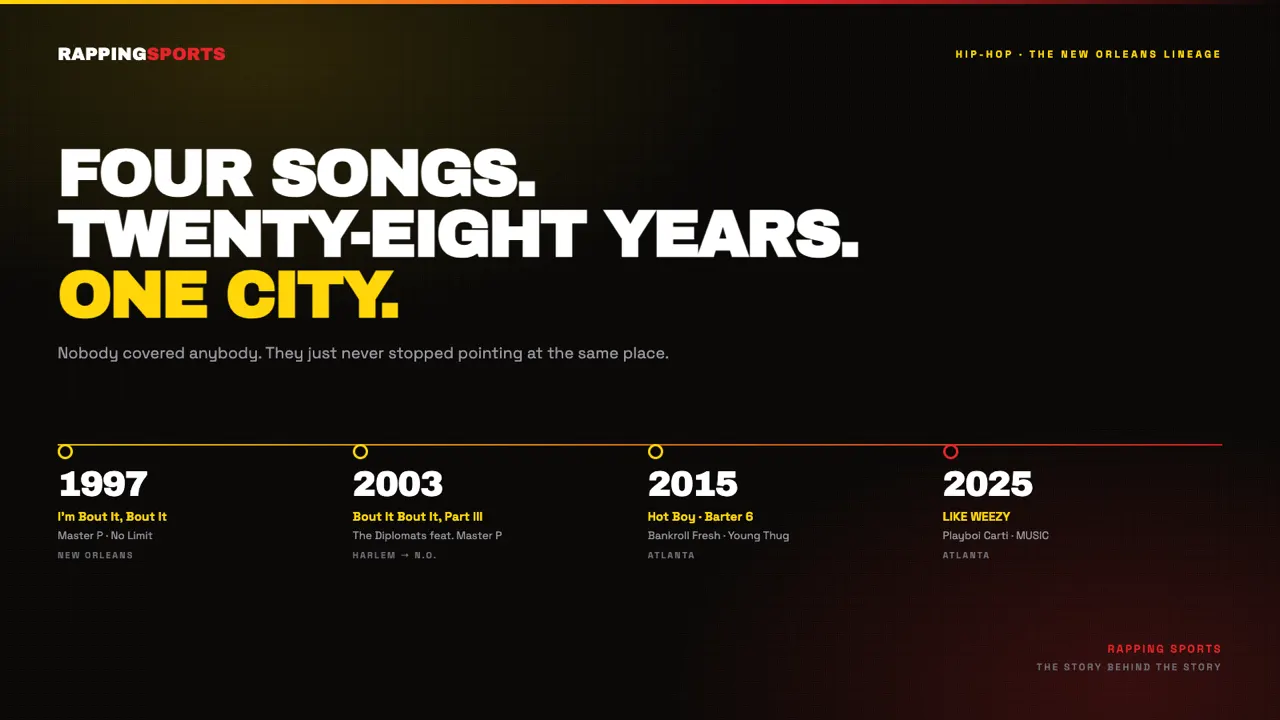
In 1997 a rapper from the Calliope projects put a phrase on a soundtrack and it never left.
In 2003 the biggest crew in Harlem repeated that phrase, and the man who wrote it was on the track with them.
In 2015 a rapper in Atlanta named himself after a group from New Orleans that broke up before he turned twenty.
In 2025 the most-streamed rapper alive put a song called “LIKE WEEZY” at track twenty-five of his album.
Four records. Four artists at their commercial peak. Twenty-eight years. All four are pointing at the same city, and three of them are pointing at it from somewhere else.
1997 — the phrase
Master P released “I’m Bout It, Bout It” in 1997 through No Limit and Priority, tied to the film I’m Bout It and its soundtrack. Percy Miller was running the most prolific label in the country out of New Orleans, and the phrase worked as a slogan: it meant you were serious, you were from it, and you were not to be tested.
What made it portable was not the words. It was the cadence. New Orleans rappers had been rapping in a staggered, syncopated, slightly behind-the-beat pocket that came out of bounce and the brass band tradition. You could say anything in that pocket and it read as Southern.
That is the thing that left home first, and it never came back.
2003 — Harlem repeats it, and the author shows up
The Diplomats put “Bout It Bout It… Part III” on the second disc of Diplomatic Immunity, as the tenth track.
It does not just reference the original. It samples it heavily, and Master P is featured on the record. Cam’ron opens by saying so out loud —
— and then does exactly that.
That is the moment worth putting on a wall. A Harlem crew at the height of its influence went south for a cadence and a slogan, and brought the author along to bless it. There is no version of this where New York was taking from a regional curiosity. They were licensing the sound of the thing that had already beaten them.
2015 — Atlanta names itself after the Hot Boys
Bankroll Fresh — Trentavious White, born in Atlanta in 1987 — released “Hot Boy” on Life of a Hot Boy in 2015.
Read the title again. He did not name himself after a song. He named himself after a group — the Hot Boys, the Cash Money roster of B.G., Juvenile, Turk and Lil Wayne, whose run peaked when he was eleven years old and who had already fractured by the time he was a teenager.
He was twenty-eight when he was shot and killed at Street Execs Studios in Atlanta on March 4, 2016. That is the whole arc in one sentence: a man who named his career after New Orleans never got to see what the next decade did with it.
The same year, the album that had to be renamed
If Bankroll Fresh was the polite version, Young Thug was the one that got a lawyer involved.
Thug announced his project as Carter 6 — not a reference to Wayne’s series, but an explicit claim on it, framed as a spiritual successor. Wayne had not even released Tha Carter V yet.
Three days before release, the C became a B. The mixtape came out as Barter 6 on April 17, 2015 through 300 Entertainment and Atlantic. Wayne’s legal team had filed to demand the title change.
And here is the detail that belongs on a wall: Birdman is a featured guest on Barter 6 — the man whose label was suing over the name is on the record that had to be renamed.
Thug said years later that he was not trolling Wayne; he meant it as reverence. That is the whole problem with influence in one sentence. The most sincere tribute in the room was the one that required a court to referee it.
Ten years later, Wayne released Tha Carter VI on June 6, 2025, through Young Money and Republic. The name came back. It just took a decade and belonged to the man who first had it.
2025 — the title is the argument
By 2025 nobody was fighting over a title anymore.
“LIKE WEEZY” is the twenty-fifth track on Playboi Carti’s album MUSIC, released March 14, 2025 on AWGE and Interscope. It runs one minute and fifty-five seconds. It was previously titled “Buddha Man.”
There is no sample to point at and no interpolation credit to check. The citation is the title.
Carti built his whole delivery — the pitch-shifted baby voice, the clipped repetitions, the ad-libs doing the work a verse used to do — inside a vocabulary that Lil Wayne established between roughly 2005 and 2012. Every rapper who came up in that window is downstream of that run, whether they say so or not. Carti said so in the tracklist.
What actually got passed down
Not samples. Three other things.
The pocket. The behind-the-beat, syncopated Southern cadence that came out of bounce is now the default delivery for a huge share of rap, including records with no Southern artist on them at all.
The group model. Cash Money sold a roster before it sold individuals — the Hot Boys as a unit, then the solo records as a consequence. That structure shows up again in every crew that has mattered since.
The ad-lib as instrument. Wayne turned background noise into a lead vocal. Carti’s records are largely built out of that idea.
None of those three things is copyrightable. That is precisely why they traveled.
What the Hot Boys actually did
Strip the nostalgia out and the mechanism is simple enough to name.
Cash Money sold four rappers as one product. B.G., Juvenile, Turk and Wayne were a group on the records and separate artists on the shelves, and the group made the solo records legible. You did not have to know who B.G. was to buy a B.G. album — you had already been sold the Hot Boys.
One producer made the sound. Mannie Fresh built nearly everything in the early catalogue, which meant the label had a single, instantly recognizable sonic identity instead of four unrelated ones. That is a marketing decision disguised as a production credit, and it worked.
And then a teenager outgrew all of it. Wayne spent roughly 2005 to 2012 releasing an album or a mixtape roughly every time someone looked away, and the volume is the point. No other rapper of that era produced that much usable material, and the generation behind him learned to work at that rate because he made it look normal.
The scale nobody argues about
The complaints are contests of memory. The numbers are not.
Cash Money hit one billion units sold and was given a plaque for it in April 2017. Forbes at one point put the label’s gross revenue at roughly $1.8 billion. Drake, Nicki Minaj and Lil Wayne all came through the building.
And the mechanism that got them there was a contract. The March 1998 Universal distribution deal — three years, a reported $30 million, a $3 million advance — is the moment a New Orleans independent could suddenly reach every store in the country. Everything downstream of that deal is downstream of a piece of paper signed in a New York office by two brothers from the Third Ward.
Which is why the export was never only musical.
The debt nobody itemizes
There is a version of this story that is purely musical and it is the one that gets told.
The other version is that New Orleans exported a sound and a business model at the same time, and the business model is the one that stuck hardest. A label that owns the masters, advances money to artists, and controls the only door to the audience — that structure has been rebuilt hundreds of times since 1998 by people who may never have listened to a Hot Boys record.
The city’s biggest export was never a song. It was a way of holding the deed.
SPLASH'S READ
Four records, four peak moments, and not one of them is a cover. That is what actual cultural influence looks like: it does not get performed as tribute, it gets absorbed until nobody remembers where they got it.
Master P put a phrase in the language. Dipset repeated it and brought him along. Bankroll Fresh named himself after the group. Carti named a song after the man.
And the last one is the biggest artist in the world, twenty-eight years later, on a record that samples nothing and still could not exist without the first three.
That is not nostalgia. That is a city still being paid in percentages nobody agreed to.
Sources. “I’m Bout It, Bout It” — Master P, 1997, No Limit/Priority, from the I’m Bout It soundtrack released May 13, 1997 and the film of the same year.
“Bout It Bout It… Part III” — The Diplomats, tenth track of the second disc of Diplomatic Immunity; it samples Master P’s original and features him. Track position and sample credit per Genius and the album’s own credits.
“Hot Boy” — Bankroll Fresh, Life of a Hot Boy, 2015. Trentavious Zamon White, born August 2, 1987, was shot and killed at Street Execs Studios in Atlanta on March 4, 2016, per Pitchfork and the Atlanta Journal-Constitution.
“LIKE WEEZY” — Playboi Carti, track twenty-five on MUSIC, released March 14, 2025 on AWGE/Interscope, runtime 1:55, formerly titled “Buddha Man.”
The label’s scale — one billion units sold with a plaque in April 2017, and Forbes’ figure of roughly $1.8 billion in gross revenue — is per HipHop History’s Cash Money documentary and the reporting it draws on.
The $300 million figure that circulates as the total Cash Money’s artists say they were shorted does not appear in any court filing — the documentary says so itself, and this page does not use it as a total.
Wayne’s $51 million suit is dated to January 2015 by that documentary; some reporting places the filing in late 2014. This page uses 2015 and notes the discrepancy rather than picking the more dramatic year.
Turk filed in 2015 seeking more than $1 million in unpaid royalties, per the same reporting. Tyga’s 2018 suit is reported there as well; this page does not characterize its outcome.
Most of these cases settled or were dropped, and no judge ruled on the merits of the payment claims.
Barter 6 — Young Thug, released April 17, 2015 on 300 Entertainment and Atlantic; originally announced as Carter 6 and renamed three days before release after Lil Wayne’s legal team filed to demand the change. Birdman is a featured guest on the project. Tracklist, title history and credits per Genius and the release’s own credits; Thug’s 2022 comments that he was not trolling Wayne are from published interviews.
Tha Carter VI — Lil Wayne, released June 6, 2025 on Young Money and Republic.
A note on the two 2015 records: Bankroll Fresh and Young Thug are separate artists with separate projects. They are grouped here because they are the same year and the same move — Atlanta naming itself after New Orleans — not because they are connected personally.
What this page does not claim: it does not claim Carti’s record samples or interpolates a Lil Wayne song — the citation is the title, and no sample credit is asserted here. The descriptions of cadence and influence are editorial analysis, not credited facts. The Hot Boys breakup timeline is general history; no specific date is asserted. “Most-streamed rapper alive” is a characterization of Carti’s commercial position, not a cited chart record.
Two bosses, two rosters, one grudge · The ledger — six artists, one label · The $30 million Universal deal · B.G. calls Mannie Fresh “washed” · Mannie Fresh got a quarter of the show money · Turk: “I don’t need them” Jay-Z offered him $175,000 and he laughed The tour that put New Orleans in front of New York The other founder: Ronald Slim Williams B.G.'s side: the album was in the CD player Cash Money vs No Limit: the same deal