THE 924 WASN’T BORN A PORSCHE. IT WAS A VOLKSWAGEN CONSULTING GIG.
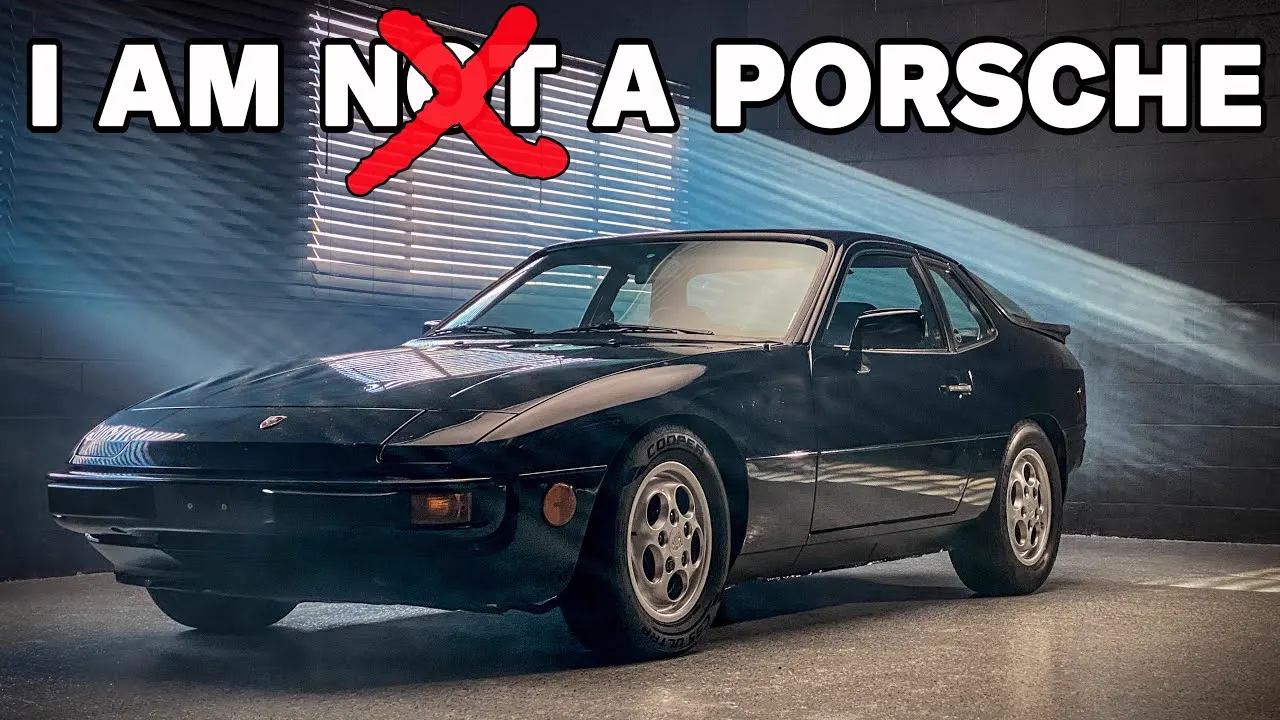
The popular claim is that the 924 is a Volkswagen with a Porsche badge. That is correct. It is also completely wrong.
What Porsche actually was
German companies used to put what they did in their legal name, and Porsche’s was not Porsche Cars Inc. It was, in effect:
Porsche was an engineering consultancy that occasionally built its own cars. That distinction is the whole story, and it is the difference between Porsche and a car company.
And its biggest client was Volkswagen.
Project EA425
Volkswagen hired Porsche to develop a sports coupe. It had not yet decided whether the car would be sold as a Volkswagen or an Audi.
One thing was certain: it had to be inexpensive. Which meant it had to be a parts-bin special — engineered out of components already in the Volkswagen catalogue.
So this is what it got:
A front-engine, rear-drive layout. A 2.0-litre four-cylinder from the Volkswagen LT cargo van — itself an Audi-engineered overhead-cam conversion of an old Daimler design from the 1960s. And because of Audi’s longitudinal layout, Porsche could take the Audi 100’s front suspension wholesale.
An Audi van engine. An Audi sedan’s front end. Built to a Volkswagen budget.
Then Volkswagen cancelled it
Volkswagen had paid for the entire project, so Volkswagen owned it. That left Porsche with a fully developed sports coupe and no car.
So Porsche bought it back.
The deal: Audi would build the car at its Neckarsulm plant, agreeing to supply up to 100,000 of the 2.0-litre engines, and over time Porsche would reimburse 40 of the 50 million Deutsche Marks that Volkswagen had spent developing it.
The name has no meaning
Porsche put its own badges on the car and invented the number 924.
Unlike every other Porsche model name, 924 means nothing. It was not an internal code, because it was never a Porsche product.
It was chosen because Porsche was simultaneously developing the 928 — a V8 transaxle car — and 924 seemed like a sensible number for a four-cylinder car sitting next to it.
Two front-engine, water-cooled cars, meant as a two-pronged replacement for the 911.
95 horsepower
It went on sale with 95 horsepower from that Audi van engine.
Porsche’s first order of business was fixing what should never have shipped: the ride, four-wheel disc brakes, and the five-speed manual it should have had from the start.
Then came the real problem. The Volkswagen contract specified up to 100,000 Audi engines — and the 924 was about to reach that number. Porsche needed an engine of its own.
The interim answer was a turbo, and the 924 Turbo stopped the complaints.
The car that was actually a hit
Porsche’s engineers considered chopping two cylinders off the 928’s V8. That became a 2.5-litre four — and it was fast enough to match the 924 Turbo.
Porsche wanted to make a splash, so it put the new engine in a widebody 924 for the debut and called it something else: the 944.
It was not a new car. The 944 was a facelifted 924 with a new engine and box-flared fenders to cover a much wider track.
And it set the world on fire. It sold out. There was a waiting list. It won Car and Driver’s award for the best-handling car in the world.
It also still had Beetle-derived suspension.
The one that proved the point
Later, with the Deutschmark strengthening and the 944 getting expensive by the second, Porsche put the 2.5-litre engine into the old narrow-body 924 and sold it as the 924 S.
The cheap one with the narrow body was only three tenths of a second behind the 944 around Willow Springs — and quicker in a straight line at higher speeds.
How it ended
The line continued through the 968, which arrived criminally expensive for a car of its age at a moment when the dollar was at record strength against the Mark. It was killed after four unprofitable years.
And that was the right call — it freed the money and people to develop the water-cooled 986 and 996.
Across its life the 924 accounted for roughly 150,000 cars between 1976 and 1988 — the highest-volume Porsche of its era, and the foundation the entire transaxle family was built on.
SPLASH'S READ
The joke is right and the conclusion people draw from it is wrong.
Yes, the 924 is a Volkswagen with a Porsche badge. It was designed on a Volkswagen contract, from a Volkswagen parts catalogue, with an Audi van engine, and built in an Audi factory. Porsche did literally not design it as a Porsche.
And that is exactly what the company did for a living. Porsche was a consultancy. The 924 is the purest evidence of the thing that made the company great, not a stain on it.
What Porsche did with EA425 is what it did for everyone: take a parts-bin brief, apply real engineering judgment, and produce something that should not work and does. Then, when VW walked away, it bought its own work back and sold 150,000 of them.
And the punchline is the 944. The car everybody loves is the 924 with a new engine and wider fenders. The same structure that “wasn’t a real Porsche” became the best-handling car in the world the moment it got one.
The badge was never the engineering. The engineering was the engineering.
Porsche’s legal identity was an engineering consultancy rather than an automobile manufacturer — the distinction between Porsche as a design and consulting firm and Porsche as a car company — and Volkswagen was its largest client.
Project EA425. Volkswagen commissioned Porsche to develop a sports coupe without deciding whether it would be marketed as a Volkswagen or an Audi. The car was engineered around existing Volkswagen Group components: a front-engine, rear-drive transaxle layout, the 2.0-litre four from the Volkswagen LT van — an Audi-engineered overhead-cam derivative of a 1960s Daimler design — and the Audi 100’s front suspension.
The buy-back. Volkswagen, having funded the project, cancelled it and retained ownership. Porsche bought it back under terms in which Audi would build the car at Neckarsulm, supply up to 100,000 engines, and Porsche would reimburse 40 of the 50 million Deutsche Marks of development cost.
Production and naming. The 924 was built at Neckarsulm from 1976 to 1988, with roughly 150,000 examples produced across the 924, 924 Turbo, 924 Carrera GT and 924 S — the highest-volume Porsche of its era. It replaced the 912E and 914 as the entry model and was Porsche’s first water-cooled, front-engine, transaxle sports car. The number 924 carries no model-code meaning and was chosen to sit alongside the V8 928 as a two-pronged front-engine replacement strategy for the 911.
The development story. The 95 hp output, the subsequent fixes (ride, four-wheel disc brakes, five-speed manual), the turbo as interim solution, the 100,000-engine contract limit forcing a Porsche-designed engine, the two-cylinders-off-the-928 V8 origin of the 2.5-litre four, and the 944 as a facelifted widebody 924 are from Jason Cammisa’s Hagerty Revelations episode on the 924, which prompted this page. The 924 S’s three-tenths deficit to the 944 at Willow Springs, its advantage in high-speed straight-line acceleration, and the 968’s four unprofitable years are from the same episode.
Labeled as analysis. The reading that the 924’s Volkswagen origin is evidence of Porsche’s core competence rather than an embarrassment, and the observation that the 944 is the same structure validated by a proper engine, are this page’s interpretation.
This page contains no photograph of any person.
The GT40 wasn’t really a Ford
The E30 M3 sat unsold for years
The gullwing doors were a math problem
The engine was designed by Lotus and built by a boat company
Sixty percent sold in two years Designed to last 24 years, it ran for 37 Four brands, one car It did 261 mpg, they built about 250