SIXTY PERCENT OF THEM SOLD
IN TWO YEARS.
THEN IT STOPPED.
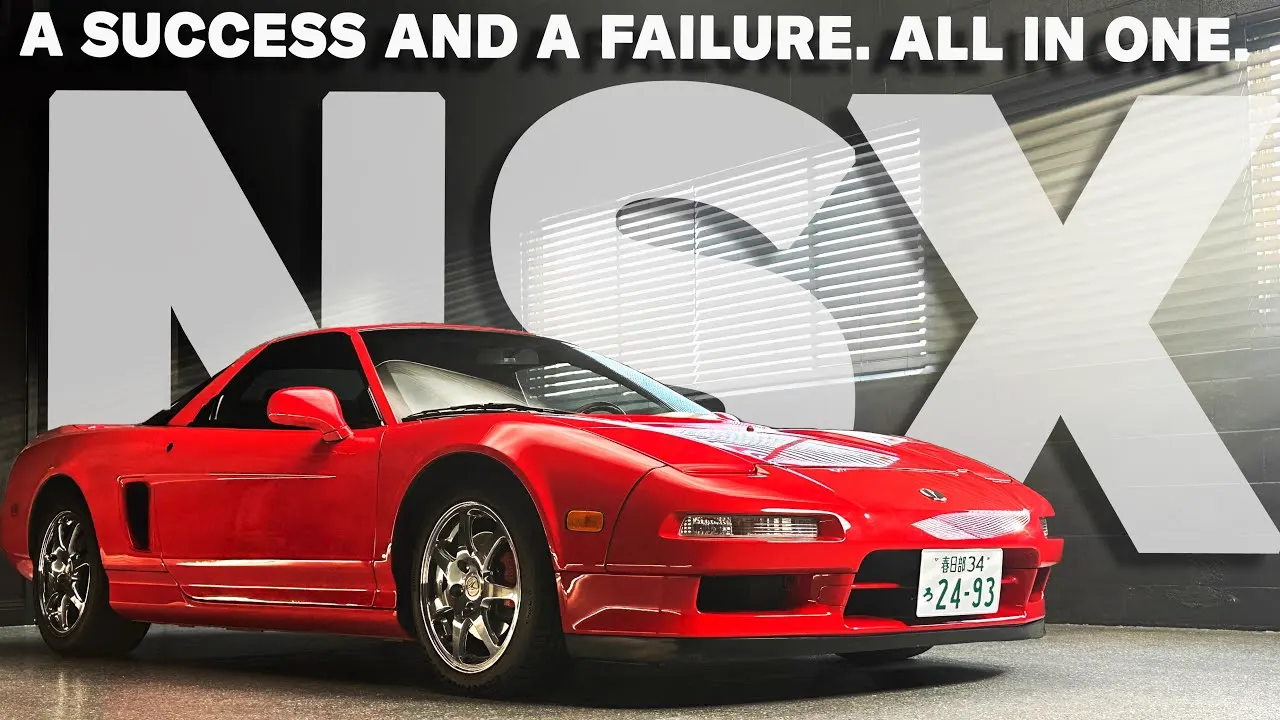
This is the other half of the halo-car story. The LFA lost money and was worth it. The NSX made all the right moves and still did not sell.
The setup
By 1989 Honda was in an unfamiliar position: it could do no wrong. The Accord was the bestselling car in America, and Honda engines had won the Formula 1 championship in 1986, 1987, 1988, 1989, 1990 and 1991.
And Honda had a philosophy that came straight out of racing: lightweight above everything, no gimmicks, no styling tricks. The brief for the NSX was written in those terms. Top speed of 270 km/h, a quarter mile under 14 seconds, handling and braking equal to any Ferrari or Porsche.
And one requirement that no supercar had ever been given: it had to be practical and easy to use.
Honda also called Ferrari’s design house Pininfarina to style it. It was not a friendly gesture.
The engineering, which is genuinely historic
The NSX was the world’s first all-aluminum monocoque production car — the same basic construction method as Honda’s first Formula 1 car.
Honda used the Cray 2 — then the world’s fastest supercomputer — to optimize the chassis for stiffness. It produced a design that was as rigid as the computer said it needed to be.
Then they handed the keys to Ayrton Senna. He drove it and told them the chassis felt “a little fragile.”
A world champion told Honda its supercomputer was wrong, and Honda believed him. The company set up a development base 2 km from the Nürburgring — the circuit where it had made its F1 debut 25 years earlier — and got to work.
The result was a 50% increase in rigidity over the original design — which made the finished car 50% stiffer than a Porsche 911 or a Ferrari 328.
And the weight was the point. The entire aluminum body shell weighed only about 20 pounds more than the little steel-bodied Mazda Miata being developed at the same time. The whole car came in under 3,000 pounds — so light that the five-speed models did not need power steering.
The VTEC that almost wasn't
Here is a detail that shows how close the NSX came to being ordinary. VTEC had only ever been planned for Honda’s four-cylinder engines. The V6 was going to use a single overhead cam per bank — no variable valve timing at all.
The car was unveiled, and the head of Honda asked the question: “Where is the VTEC?”
The most famous engine technology Honda ever put in a road car was nearly left off its flagship, and only the boss noticing saved it.
The numbers, and they are brutal
The production NSX made 270 horsepower and 210 pound-feet from a 3.0-litre, 24-valve V6, through a five-speed manual. It hit 60 mph in 5.2 seconds and ran the quarter mile in 13.8 — beating the brand-new Ferrari 348 by half a second or more on both measures.
In the corners it out-gripped Lotuses and 911s. Put the individual numbers together and it had no peer: the press called it untouchable, and it won nearly every award going.
It was priced at about $60,000 in 1991.
What actually happened
The NSX stayed in production for 15 years — and 60% of every NSX ever built was built in the first two years.
The plant was designed to produce 25 cars a day. By the end of year three it was operating at less than 10% of that capacity.
By the middle of the run, the car that every American magazine had said would put Ferrari out of business was being outsold 10 to 1 by Ferrari.
Total production, 1990 to 2005: 18,685 cars. Fifteen years of a car that stopped selling in three.
The diagnosis
Honda’s own head of R&D said it in one sentence, and it is the reason this page exists: the NSX was boring — by design.
That was not an insult. It was the brief. The car was engineered to have no engineering problems, no handling vices, and no personality flaws — to start every morning, to be usable, to be comfortable, to never surprise you.
And that is exactly what it did. It was a supercar you could drive to work, and the people who buy supercars did not want to drive to work in one.
SPLASH'S READ
The NSX is usually filed as the car that embarrassed Ferrari into building better cars — and that is true. But it never got to enjoy it, because its sales evaporated before Ferrari even responded.
What killed it was not a flaw. It was the absence of flaws. Ferrari sells a story about danger and heritage and the possibility that the car might kill you. Honda sold a car that was objectively better and told you it would never let you down. One of those is a fantasy and the other is an appliance, and people pay supercar money for the fantasy.
That is the hardest lesson in this whole machines file. The NSX lost to the Ferrari not on performance but on feeling — and Honda had the fastest supercomputer in the world and a three-time world champion giving feedback, and neither of them could compute desire.
Senna made it stiffer. The Cray made it lighter. Nobody in the building could make it feel like it might bite.
Production and price. 18,685 first-generation NSXs were built between 1990 and 2005; the car was priced at about $60,000 in 1991. The plant was designed for 25 cars per day and was reported to be running at under 10% of that capacity by the end of year three. 60% of all examples were produced in the first two years.
Engineering. The NSX was the first all-aluminum monocoque production car; Honda used the Cray 2 supercomputer for chassis optimization. Ayrton Senna drove the prototype and described the chassis as feeling “a little fragile,” prompting a Nürburgring development program that produced a 50% increase in rigidity — making the finished car stiffer than a Porsche 911 or Ferrari 328. The aluminum body shell weighed roughly 20 lb more than the steel-bodied Mazda Miata of the same period.
Drivetrain. 3.0-litre, DOHC, 24-valve V6, 270 hp and 210 lb-ft, five-speed manual. VTEC was originally planned only for Honda’s four-cylinder engines, with the V6 set for a single overhead cam per bank; the omission was raised at the unveiling and VTEC was subsequently fitted.
Performance and sales. 0–60 mph in 5.2 seconds and a 13.8-second quarter mile, beating the Ferrari 348 by half a second or more on both measures. Honda engines won the Formula 1 championship in 1986–1991, and the Accord was America’s bestselling car in 1989.
The assessment that the NSX was outsold roughly 10 to 1 by Ferrari mid-run, and that its defining quality was being “boring — by design” in the words attributed to Honda’s head of R&D, are from Jason Cammisa’s Hagerty Revelations episode on the NSX, which prompted this page. The same episode is the source for the characterization of the NSX as Honda’s “most successful failure.”
Labeled as analysis. The reading that the NSX lost on feeling rather than performance, and the contrast drawn with Ferrari’s appeal, are this page’s interpretation.
This page contains no photograph of any person.
It would have needed two million a car
It started as a truck engine
The quota counted cars, not dollars
They built a car for a future that bought an SUV
The man who made I Feel Love put his money into a V16 Twenty years earlier: Americans stopped seeing Japanese cars as curiosities The GT40 wasn't really a Ford The E30 M3 sat unsold for years The gullwing doors were a math problem The engine was designed by Lotus and built by a boat company The 924 was a Volkswagen consulting gig Designed to last 24 years, it ran for 37 It did 261 mpg, they built about 250