THE WORLD’S FASTEST FRONT-DRIVE SEDANS WERE THE SAME CAR.
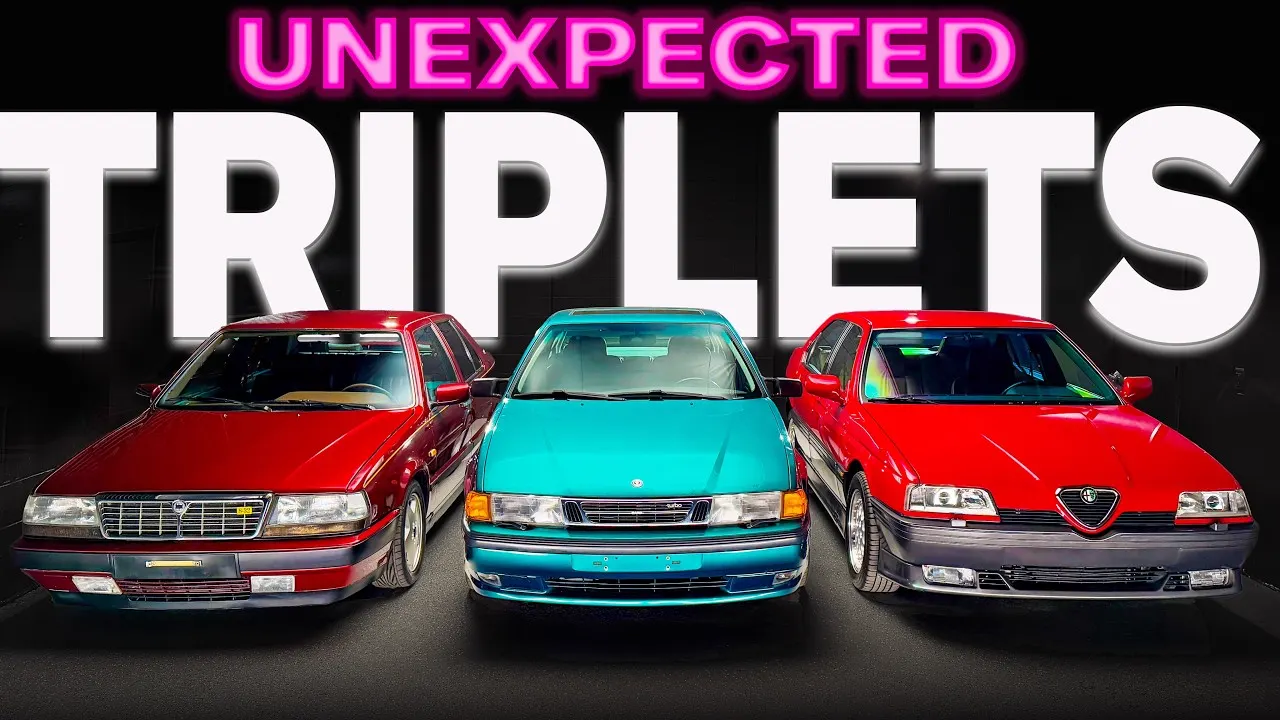
Four cars. Four badges. Four completely different reputations. One floorpan.
The lineup
Lancia Thema 8.32 — a Ferrari V8, 215 horsepower, and front-wheel-drive burnouts.
Saab 9000 Aero — a turbocharged four making 225 horsepower.
Alfa Romeo 164 Q — the 24-valve Busso V6, 230 horsepower.
Fiat Croma — the entry-level one, and the reason most people do not know any of this.
These were the quickest, fastest and most powerful front-wheel-drive sport sedans of their moment, and they are the same car underneath.
How it happened
Lancia had three talents: pioneering new technology, going comprehensively bankrupt, and oscillating violently between the two. It was taken over by Fiat just in time for the 1970s to happen.
Saab, meanwhile, had barely survived and desperately needed an all-new large car it could not afford to develop alone.
So in 1978 the two met, and agreed to build a large front-wheel-drive sedan and hatchback together.
Then Italian politics intervened. Strikes and union action in Italy literally pushed Saab out of the development process. Fiat took the program over and created the platform itself, naming it Tipo Quattro — Type Four — because it came after Types 0, 1, 2 and 3.
The arrangement was brutally simple: Fiat would sell it as the Croma at the entry level, Lancia would sell it as the Thema as the luxury version — and Saab was handed the same platform and told to do whatever it wanted.
What Saab did with it
Saab’s engineers found a problem immediately. At the first crash test, the Lancia people squealed with delight while Saab’s safety-obsessed engineers held their heads in their hands.
So Saab rebuilt the front of the car. And the doors — the Lancia and Saab doors are effectively interchangeable, because they are the same part — but the Saab has side-impact beams and the Lancia does not.
Same door. Different car.
The engine that won an award in a month
The 9000’s four was genuinely exotic for 1984: double overhead camshafts, four valves per cylinder — which, in that year, was Ferrari levels of specification.
On top of that it was turbocharged, intercooled, and used Saab’s APC boost management system.
Car and Driver gave it a Best Engine award one month after experiencing it.
And then Saab took it to Talladega and set 21 international and two world speed records — covering 100,000 kilometres over 20 days and nights flat out, averaging over 132 mph including pit stops.
Displacement later grew to 2.3 litres and output to 200 horsepower, at which point one writer observed that the Saab’s front tires were doing “a reasonable impersonation of Chernobyl.”
The one with the Ferrari engine
The Lancia Thema 8.32 is named with total Italian directness: 8 cylinders, 32 valves.
It is a Ferrari V8 in a front-wheel-drive luxury sedan, making 215 horsepower — and it would spin the front tires.
Lancia is not a name that means much to most Americans. In Italy it is a deeply prestigious marque, and the 8.32 exists because Fiat owned both Lancia and Ferrari and saw no reason not to.
The yardstick
Here is the number that matters. If you wanted a sedan quicker than this in 1984, you had exactly one option: spend twice as much and buy a BMW M5.
That is the whole argument for the Type Four cars, and it is also the reason they are forgotten. They were faster than the thing you were supposed to want, and they cost half as much, and almost nobody bought them.
The architecture
All of them shared a 2.67-metre wheelbase and a transverse front-engine, front-wheel-drive layout.
The Croma and the 9000 were five-door hatchbacks. The Thema and the 164 were four-door saloons. Same bones, different bodies, and in the Saab’s case, a completely different set of priorities bolted on top.
The Thema ran from 1984 to 1994.
SPLASH'S READ
This is the best kind of badge-engineering story, because the badge turned out to matter enormously even though the metal did not.
Four companies took one platform and produced four genuinely different cars. Fiat made a family hatchback. Lancia put a Ferrari engine in it. Alfa put the Busso V6 in it and made it sound like nothing else. Saab rebuilt the front end for crash safety, added side-impact beams, and went to Talladega.
That is not badge engineering in the pejorative sense. That is four engineering cultures given the same starting point and asked what they cared about.
And the answer is the whole page: Lancia cared about prestige and speed. Alfa cared about the engine note. Saab cared about whether you survived. The doors are identical. The priorities are not.
The tragedy is that all of it was invisible to buyers, because the cars wore four different badges in four different markets and none of them said “this is faster than an M5 for half the money” loudly enough.
The platform was the least interesting thing about these cars. It is also the only reason any of them exist.
The platform. Tipo Quattro (Type Four) was a front-wheel-drive platform developed in the 1980s and shared by the Saab 9000, Fiat Croma, Lancia Thema and Alfa Romeo 164. All shared a 2.67 m wheelbase and a transverse front-engine, front-wheel-drive layout; the Croma and 9000 were five-door hatchbacks and the Thema and 164 four-door saloons. The Lancia Thema (Type 834) was produced from 1984 to 1994.
The origin. Saab and Lancia agreed a joint venture in 1978 for a large front-wheel-drive sedan and hatchback neither could fund alone; industrial action in Italy removed Saab from the development process, and Fiat completed the platform, naming it chronologically after Types 0–3.
The cars. Lancia Thema 8.32 — the name denoting 8 cylinders and 32 valves — used a Ferrari V8 producing 215 hp through the front wheels. Saab 9000 Aero: turbocharged four, 225 hp. Alfa Romeo 164 Q: 24-valve Busso V6, 230 hp.
The Saab. DOHC four-valve heads in 1984, turbocharged and intercooled with Saab’s APC boost management; Car and Driver Best Engine award; 21 international and two world speed records at Talladega, covering 100,000 km over 20 days and nights at an average above 132 mph including stops. Later 2.3 litres and 200 hp. The comparison of the front tires to Chernobyl is John Phillips’s, quoted as written.
Crash structure. At the first crash test Saab’s engineers were dissatisfied with the results and reworked the front structure; the Saab and Lancia doors are effectively interchangeable, but the Saab carries side-impact beams and the Lancia does not.
The account of the program’s history, the Lancia/Fiat/Ferrari relationship, the crash-test anecdote, and the observation that a quicker 1984 sedan required spending twice as much on a BMW M5 are from Jason Cammisa’s Hagerty Revelations episode, which prompted this page.
Labeled as analysis. The reading that the badge carried real engineering difference rather than marketing, and the conclusion that the shared platform was simultaneously the least interesting and most necessary part of the story, are this page’s interpretation.
This page contains no photograph of any person.