THE ENGINE WAS DESIGNED BY LOTUS
AND BUILT BY A BOAT COMPANY.
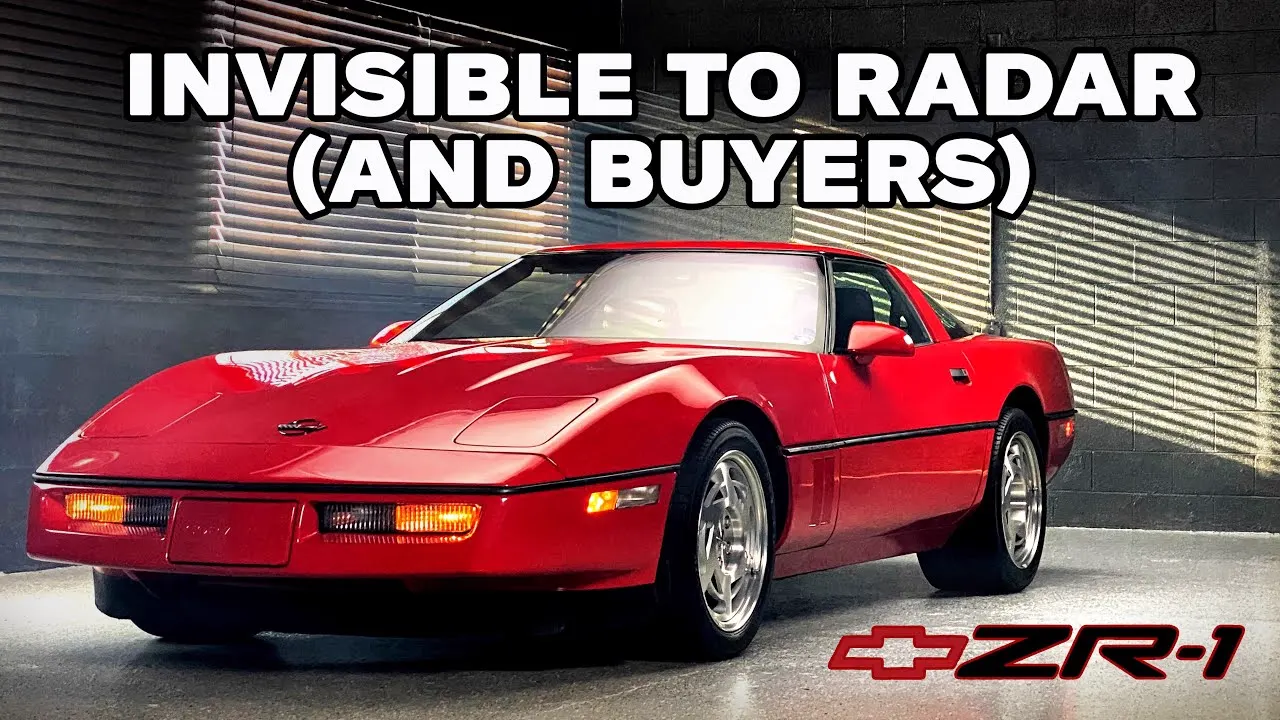
Start with the owner’s manual. It is a real quote from the book that came with the car.
What GM printed and handed to buyers
That is not marketing. That is the manufacturer warning you that its product is antisocial — in writing, in the glovebox, in the manual.
What was actually under the hood
Before the flat-plane-crank Z06, the ZR-1 was the only Corvette ever to have more than one camshaft. It had four.
Four camshafts, 32 valves, 16 fuel injectors, eleven throttles, and 5.7 litres of displacement — which makes it bigger than any overhead-cam V8 in production today.
This was not a modified small block. It shared no parts with the small block. It made 50% more power from the same displacement and 30 more pound-feet of torque.
Those sixteen individual intake runners are the tell. But it is not VTEC — those were separate injectors, there because the engine had to deliver four hundred horsepower’s worth of fuel.
Who built it, and this is the good part
Lotus — which GM owned at the time — was working on a new four-cam, 32-valve V8 for its Etna show car. GM asked Lotus to put those four-valve heads on the old small block. At the factory the C4’s engine was installed from underneath, and the wide Lotus-headed small block would not fit.
So the Corvette team talked GM management into something extraordinary: let Lotus build an entirely new V8 from the ground up.
Then came the practical problem. Lotus did not have the capacity to manufacture it. Neither did GM.
So Chevrolet contracted Mercruiser — a division of Mercury Marine, which built inboard engines and stern drives — and chose them for one reason: their experience with complicated aluminum castings.
Lotus did the engineering and the durability testing while Mercury Marine was simultaneously setting up a special factory to build the engine, while the Corvette team engineered the rest of the car.
Running all three in parallel took the LT5 from discussion to production in three years — half the time it would normally have taken.
The heresy
There was one number in the design that offended people: the bore spacing was 4.55 inches.
Small-block Chevys must have a bore spacing of 4.40 inches. That is not engineering, it is tradition — and bore spacing has no effect whatsoever on the experience of driving an engine.
The wider spacing meant a smaller bore, which meant smaller valves, which meant the engine could “only” make 375 horsepower. It also meant it avoided the gas-guzzler penalty, which is why the number was acceptable.
What it did
It was the quickest-accelerating car you could buy. It was the fastest too, with the exception of one twelve-cylinder Ferrari. It recorded the highest skid-pad grip ever measured and the second-best slalom figures the world had ever seen.
It was called the most capable handling car on the planet. It decimated a Porsche 911 Turbo around a racetrack — and it cost half the money.
What it cost, and what that did
$58,995. That was $27,016 more than a base Corvette — roughly double the price of the car it was built from. It was the single most expensive option in the history of Detroit.
The world lost its mind. One of these cars sold for $90,000. And then, within about a year, ZR-1s were selling below sticker.
Three reasons, and only one of them is the car’s fault:
One: there was a recession in 1991. Two: the C4’s interior was barely acceptable in a $30,000 car, and therefore completely unacceptable in a $60,000 one. Three: in 1992 the new LT1 small block dropped with 300 pushrod horsepower — which made the base Corvette lighter and almost as quick as the ZR-1, at half the price.
That last one is fatal. The ZR-1’s reason for existing was that nothing else in the lineup could do what it did. The LT1 took that away.
Lotus eventually got it to 405 horsepower and was working on a 475-horsepower version when the program ended. Between 1990 and 1995, 6,939 were built.
What it caused
And here is the part that makes the failure worth studying. The existence of the ZR-1 and its Lotus motor enraged the small-block engineers.
There is no fury like a pushrod engineer told that his engine is not good enough. That anger produced an all-new, all-aluminum V8 from the ground up — and that engine is the one that went on to power everything GM built for the next thirty years.
SPLASH'S READ
The ZR-1 is the cleanest example in this whole file of a car that was too good to succeed, and the reason is arithmetic rather than romance.
It beat a 911 Turbo around a track at half the price and nobody bought it, because the buyer at $60,000 was comparing it to a Mercedes or a Porsche — and it was still a Corvette interior with a Corvette badge. The people who could afford it did not want it, and the people who wanted it could not afford it.
But the real lesson is what it provoked. GM learned that a $60,000 Corvette does not sell. It also learned, from its own engineers’ fury, that the small block could be made to do the job for less.
The ZR-1 was the most expensive engineering exercise in Corvette history, and its actual product was not a car. It was an argument inside the company that the small block could be better.
And the manual warning is the part worth keeping. Somewhere in Detroit, a lawyer signed off on telling customers that their new car might disturb passers-by, and the engineers got to build exactly the car they wanted at least once.
It failed at the till and won the argument. That is a better outcome than most cars get.
Production and price. The C4 Corvette ZR-1 was built from 1990 to 1995, with 6,939 produced. Its 1990 price of $58,995 was $27,016 above the base Corvette — roughly double, and the most expensive option in Detroit history at the time.
The engine. The LT5: 5.7 litres, four camshafts, 32 valves, 16 fuel injectors, eleven throttles, sharing no parts with the small block, making 50% more power than the small block from the same displacement. Bore spacing of 4.55 inches against the small block’s traditional 4.40; the resulting smaller bore and valves limited output to 375 hp initially, which also avoided the US gas-guzzler tax. Later versions reached 405 hp, with a 475 hp variant under development.
Who built it. Engineering and durability testing by Lotus, then owned by GM; manufacture by Mercruiser, a division of Mercury Marine, selected for its experience with complex aluminum castings — in a dedicated facility built in parallel with development, bringing the engine from discussion to production in three years.
Performance. Quickest-accelerating car on sale at the time; fastest with the exception of one twelve-cylinder Ferrari; highest skid-pad grip and second-best slalom figures recorded; described as the most capable handling car on the planet, and faster around a track than a Porsche 911 Turbo at half the price.
Why it did not sell. The 1991 recession; a C4 interior judged unacceptable at the price; and the 1992 LT1 small block at 300 hp, which made the base Corvette lighter and nearly as quick for half the money.
The owner’s-manual warnings about disturbing other motorists and passers-by, and about other cars being unable to stop as quickly, are quoted from the ZR-1’s factory manual as presented in Jason Cammisa’s Hagerty Revelations episode, which prompted this page. The account of the internal reaction among small-block engineers, and the link between that reaction and the subsequent all-aluminum V8 program, are from the same episode.
Labeled as analysis. The reading that the ZR-1’s lasting product was an internal argument rather than a car, and the observation that it failed because its buyers and its admirers were different people, are this page’s interpretation.
This page contains no photograph of any person.