THE MAN WHO MADE “I FEEL LOVE” PUT HIS MONEY INTO A V16.
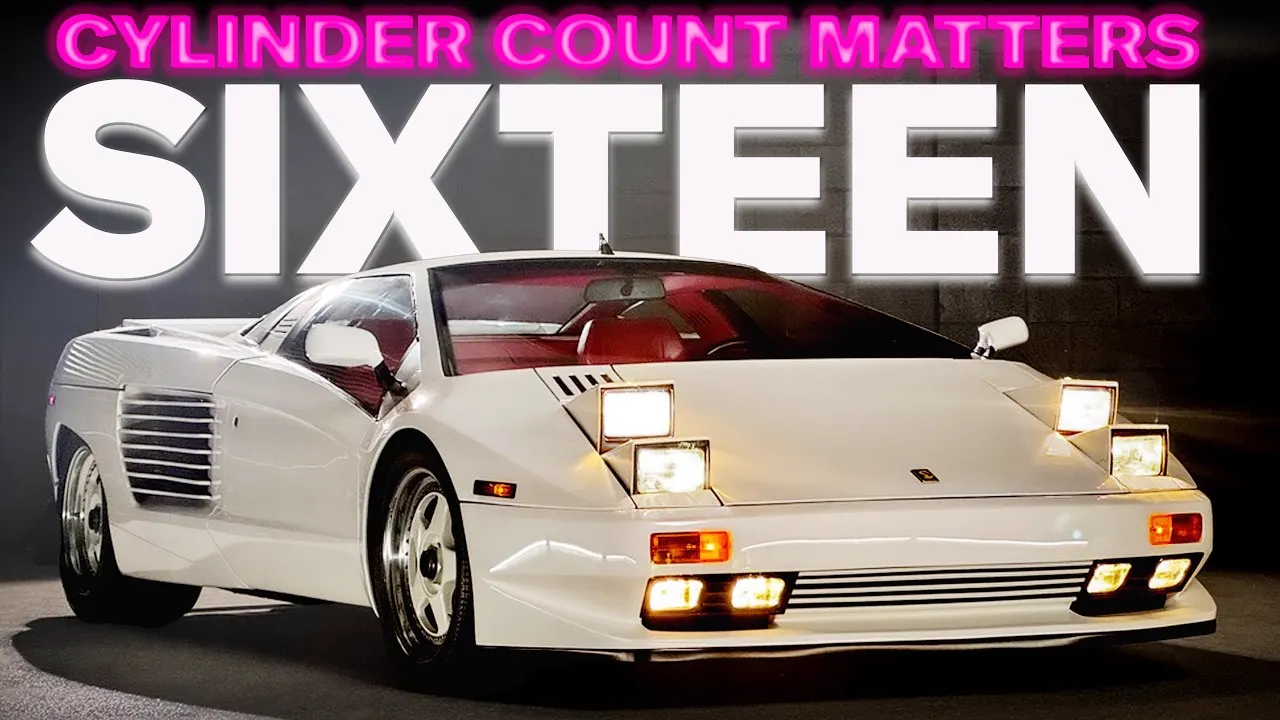
This file is usually about music money going into a label or a catalogue. This is the time it went into a car.
The name on the car
Giorgio Moroder is on the badge because he paid for the car. He is an Academy Award winner, the producer behind Scarface, and the man who made “I Feel Love” — the Donna Summer record that is generally credited as the moment electronic dance music became possible.
The other half of the name is Cizeta — which is just the letters CZ, the initials of Claudio Zampolli.
Zampolli was an Italian engineer who had spent eight years at Lamborghini. He decided to build his own supercar, and to fund the beginning of it he sold off his personal car collection between 1982 and 1984.
Those cars, had he kept them, would be worth more than $55 million today. That is the first fact of this story and it is the one that sets the tone for everything after it.
The engineering, which was not the problem
The car was designed by Marcello Gandini — the man who drew the Countach — and engineered by people who had worked on the Countach. The V16 itself was designed by Oliviero Pedrazzi at Tecnostile, a firm that did work for both Ferrari and Lamborghini.
The specification: 6.0 litres, four cylinder heads, eight camshafts, 64 valves, two crankshafts, 8,000 rpm. All sixteen cylinders sit in one cast block — which is what makes it a true V16 rather than two V8s bolted together.
And it had to be mounted transversely — sideways, across the car. The longer a crankshaft gets the weaker it is, and with a transmission at one end, the cylinders three and four feet away put a twisting load through it. That is the reason nobody had built a road-going V16 in over fifty years.
The result was the first road-going sports car ever to use a 16-cylinder engine — before Bugatti’s Veyron existed. Output: roughly 560 horsepower, 0–60 in about 4 seconds, and a top speed over 200 mph. The engine alone cost $1 million to develop.
And it worked. The prototype was impressive enough that it nearly won a comparison test against a Ferrari F40, a Porsche 959 and a Lamborghini Countach — three of the most significant cars ever built.
The business, which was
The car was priced at roughly $650,000 in 1991, and the plan was to build one a month.
At the launch, the reaction to the car was awe. The reaction to the price was shock. And then the timing broke. The market for high-end supercars collapsed in the first half of the 1990s, and the car arrived directly into it.
A year and a half after a Hollywood launch event, seven cars had been sold — and the car was still not actually ready for series production.
Moroder tried to rescue it. He went to the Porsche tuner Gemballa, who proposed turning the prototype into a production car in six months — with a fiberglass body and the V12 from the then-new BMW 850i. Which would have removed the only reason the car existed.
Between 1991 and 1995, roughly eight cars were built, including the prototype. Predictions had been one a month.
The company moved from Modena, Italy to Fountain Valley, California, and in 1994 it went bankrupt.
The part with Jay Leno
After the bankruptcy, Zampolli’s finances became a matter for the courts. In November 1999 he filed suit against Jay Leno in Los Angeles Superior Court — case number BC219542 — seeking $150 million in damages and an injunction over disparaging remarks Leno had allegedly made about him at a car show.
Leno prevailed. The dispute grew out of Zampolli’s attempt to sell Leno a Lamborghini Miura SV that Zampolli did not own, and from there the two men had an argument in public.
There is a detail that says everything about the ending: Zampolli built a version of the car badged the TTJ — for Take That, Jay. A supercar badge as a grudge.
Claudio Zampolli died in July 2021, at 82.
SPLASH'S READ
The textbook version of this story is that the Cizeta failed because it was too expensive and too late. Both true, and both boring.
The interesting version is that the engineering was never the problem. Gandini drew it. Countach engineers built it. The V16 was one block, eight cams, 64 valves, 8,000 rpm, and it went sideways into the car because that was the only way to fit it. It very nearly beat an F40 in a comparison test.
What killed it was the oldest thing in this whole file: a product with no customer base, launched into a market that had just stopped buying. Supercar money evaporated in 1991–93 and the Cizeta was a $650,000 car with no dealer network, no service footprint and no brand — sold against Ferrari, which had all three.
And the human cost is the number at the top. A man sold a collection now worth $55 million to build eight cars. He did not lose the money on a bad engine. He lost it on a good engine attached to a business that was never going to work.
Moroder, meanwhile, is the part this site cares about. The man who produced the record that made dance music possible wrote a check for a V16 supercar, and the car did not survive him. The record did. That is the difference between an asset and an artifact.
The people. Giorgio Moroder — Academy Award winner, producer of the Scarface score, and the producer of Donna Summer’s “I Feel Love” — was the principal investor in the car’s development. Cizeta derives from the initials of Claudio Zampolli, an Italian engineer who spent eight years at Lamborghini.
The engineering. Designed by Marcello Gandini; V16 designed by Oliviero Pedrazzi at Tecnostile. Specification: 6.0 litres, four heads, eight camshafts, 64 valves, two crankshafts, one cast block, 8,000 rpm, mounted transversely. Roughly 560 hp, 0–60 in about 4 seconds, top speed over 200 mph; engine development cost about $1 million. It was the first road-going sports car with a 16-cylinder engine.
Production and price. Priced at approximately $650,000 in 1991, with plans for one car per month. Roughly eight examples were built between 1991 and 1995, including the prototype. Seven cars had been sold about eighteen months after launch, before the car was ready for series production. Cizeta moved from Modena to Fountain Valley, California, and went bankrupt in 1994.
Litigation. Claudio Zampolli v. Jay Leno, Case No. BC219542, Superior Court of California, County of Los Angeles, filed November 1999, seeking $150 million in damages and an injunction. Leno prevailed. The underlying dispute arose from an attempt to sell Leno a Lamborghini Miura SV that Zampolli did not own. The “TTJ” badging is reported as Zampolli’s retort. Claudio Zampolli died in July 2021, aged 82.
The account of the program’s finances, the Gemballa proposal to substitute a fiberglass body and the BMW 850i V12, the sale of Zampolli’s personal collection in 1982–84, and the near-win against the F40/959/Countach are from Jason Cammisa’s Revelations episode for Hagerty, which prompted this page.
Also disputed, using multiple sources: published figures for the car’s output vary between roughly 540 and 560 horsepower, and 0–60 times between about 4.0 and 4.4 seconds. Unit counts vary between eight and nine in reliable accounts. This page uses the more conservative figures where sources conflict.
Labeled as analysis. The reading that the engineering was never the failure and that the car died of market timing and the absence of a dealer and service network is this page’s interpretation. This page does not characterize any individual as a criminal and reports only the existence and outcome of civil litigation.
This page contains no photograph of any person.
It started as a truck engine
They built a car for a future that bought an SUV
The quota counted cars, not dollars
The fastest sedan on earth lasted one day
Lamborghini’s other truck It would have needed two million a car to break even Sixty percent sold in two years The GT40 wasn't really a Ford The E30 M3 sat unsold for years The gullwing doors were a math problem