THE E30 M3 SAT UNSOLD
IN DEALERSHIPS
FOR YEARS.
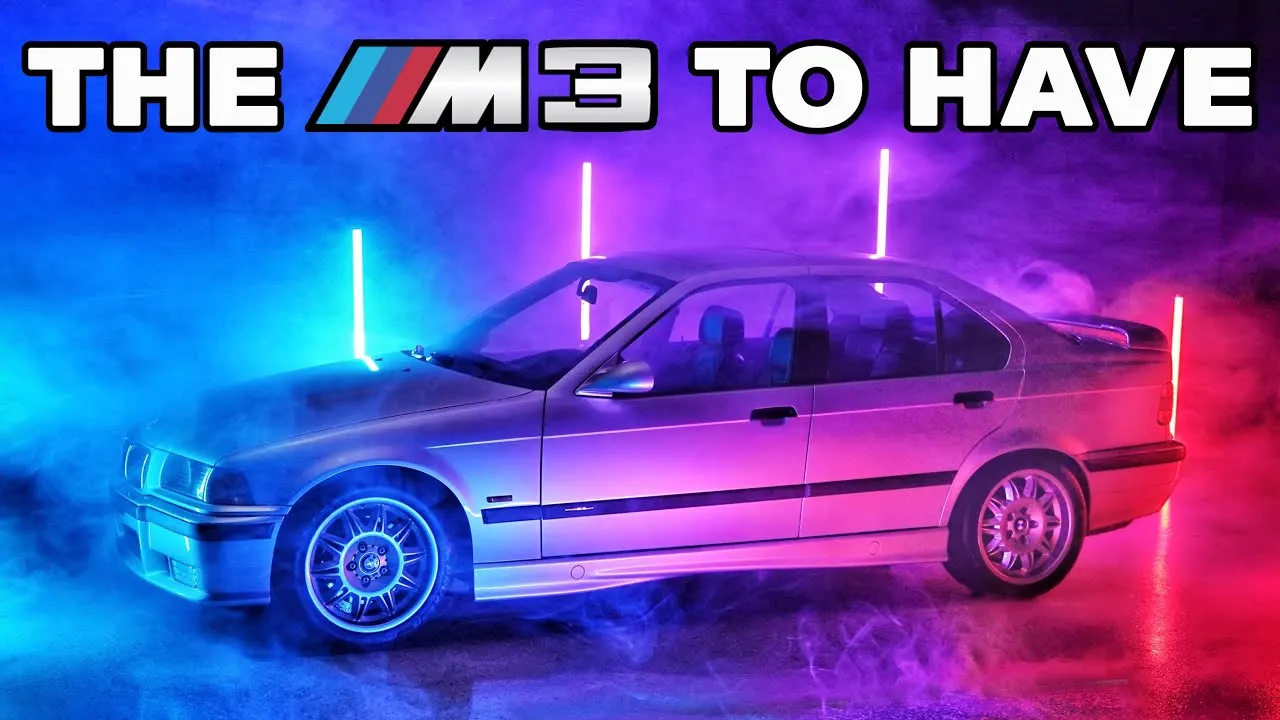
Two things about the E36 M3 that nobody wants to hear. Both of them are true.
The thing about the legend
The E30 M3 is the most revered M car ever built. It is also, in the American market, a commercial failure.
It sat unsold in US dealerships for years — even when it was offered with heavy discounts. Just 5,300 first-generation M3 coupes came to America from 1987 (as 1988 models) through 1991.
And the consequence was not a shrug. BMW of North America had no interest in another M3. It wanted to drop the entire M brand.
When Munich found out, the reaction from Germany was, in the telling, a fireball.
So the E30 is proof of something uncomfortable: the recipe that made the M3 legendary did not work in America.
The engine nobody could afford to sell
The E36 M3 was the answer, and the European version was spectacular. Its heart was the S50B30 — 3.0 litres, 7,280 rpm, 10.8:1 compression, individual throttle bodies, infinitely variable valve timing, straight six.
286 German horsepower — a 50% jump over the E30 M3 in both power and, more importantly, cylinder count.
And it cost an absolute fortune to build.
That was the whole problem. Put that engine in the American car and the M3 would have had to cost about $55,000 — and at that price BMW could sell maybe 50 or 100 of them.
But at $35,000, it could sell thousands.
What the US actually got
So the S50 came out of the American car. In its place went the regular M50 from the 325i, punched out to 3.0 litres with more aggressive cams — and yes, M did the work.
The US S50 made 240 horsepower — 42 fewer than the European engine.
And then the number that makes the argument: it was only a tenth or two behind the “real” M3 to 60 mph — as little as 5.3 seconds in the US car.
Because the rest of the car was identical. The real M suspension. The real M brakes. Same chassis, same everything that mattered.
In 1996 the engine grew to 3.2 litres as the S52 — same 240 horsepower, more torque.
What happened next
It sold out. BMW could not build the thing fast enough.
In its first year on sale in the US, BMW sold 5,800 of them. Set that against the 5,300 E30s that took four years to trickle into the country and then sat on lots.
And the awards came: Automobile Magazine’s 1995 Automobile of the Year; Car and Driver’s 10 Best list every single year it was produced; and until its final year it won every comparison test that magazine ran it in — including dethroning the Mk IV Toyota Supra and Supra Turbo.
The proof that it was the price
There is a clean natural experiment, and it happened in Canada.
A Canadian BMW employee got the Euro-spec car approved for his market: 45 cars, each with a numbered plaque. When the order books closed there were 42 orders.
Forty-two cars at the higher price, against almost 6,000 in the United States in a single year. Same car, same company, a $10,000 difference in what it cost to build — and a factor of a hundred in the result.
The engine you would actually want to own
The European S50B32 — 3.2 litres, dual infinitely variable valve timing, 7,600 rpm, 321 PS — is, in the assessment that prompted this page, the best BMW engine ever made because the person saying it does not have to live with one.
And the list of what living with one means: VANOS issues. Rod bearing issues. Main bearing issues. Individual throttle body synchronization problems. Poor idle.
Every high-revving M engine ever built has been, in a word, high maintenance. The US engines were high-tech where they needed to be and simple where simple was the better answer.
Which is the entire argument in one sentence: thirty years of repair bills is a different kind of specification sheet, and the US car wins it.
The chassis, which is the real reason
The E36 was a handling high-water mark, and there is a structural reason.
It was the first car in the 3 Series lineage designed as a four-door sedan first, with the coupe developed afterwards. That produced a stiffer, better-balanced shell than a two-door designed first and stretched into a sedan.
And the car that replaced it got worse. The E46 gained 260 pounds, most of it over the front wheels.
Which is why the E36 is remembered by people who drive them as the most balanced M3 — not the fastest, not the most powerful, the most balanced.
SPLASH'S READ
This is the same story as the NSX and the LFA, from a different angle: the car enthusiasts worship and the car that actually worked are rarely the same car.
The E30 M3 is a homologation special. It exists because racing rules demanded 5,000 road cars. It was never designed to sell — it was designed to qualify. And in America it did not sell, and BMW nearly killed the badge because of it.
The E36 did the opposite. BMW looked at the market, took the exotic engine out, priced the car where people could reach it, and sold out. Every M3 since — every M car, arguably — exists because that decision worked.
The engine everybody wants is not the engine anybody should buy. The S50B32 is the better engine and the S52 is the better car, and those two sentences are not in conflict — they are the whole point.
A car you can afford to keep running will always beat a car you are afraid to drive. The legend on the poster is the one that sat on the lot.
The E30 M3 in America. Just 5,300 first-generation M3 coupes were sold in the US from 1987 (as 1988 models) through 1991; the model existed to satisfy Group A homologation, which required at least 5,000 road cars. The characterization of the E30 M3 as a commercial failure that sat unsold in US dealerships despite discounts, and the statement that BMW of North America wished to drop the M brand as a result, are from Jason Cammisa’s Hagerty Revelations episode on the E36 M3, which prompted this page.
The engines. European S50B30: 3.0 litres, 7,280 rpm, 10.8:1 compression, individual throttle bodies, infinitely variable valve timing, 286 PS. US S50B30US: the M50 from the 325i enlarged to 3.0 litres with more aggressive cams, 240 hp — based on the passenger-car M50, as was the later S52B32US (3.2 litres, 240 hp, from 1996). European S50B32: 3.2 litres, dual VANOS, 321 PS. The US car retained the M suspension and brakes.
The pricing argument. At roughly $55,000 BMW could have sold on the order of 50–100 US cars; at $35,000 it could sell thousands. US first-year sales: 5,800. The Canadian Euro-spec allocation: 45 numbered cars, 42 orders.
Awards. Automobile Magazine’s 1995 Automobile of the Year; Car and Driver 10 Best in every year of production; and comparison-test wins through its final year, including over the Mk IV Toyota Supra and Supra Turbo.
Reliability. The catalogue of European-engine issues — VANOS, rod bearings, main bearings, individual throttle body synchronization, poor idle — and the assessment of the S50B32 as the better engine but the harder one to own, are from the same episode.
Chassis. The E36 was the first 3 Series designed as a four-door sedan first, with the coupe derived from it, and the E46 that followed gained 260 lb, most of it over the front axle.
Labeled as analysis. The conclusion that the US-specification car is the one to own, and the framing of the E30 as a homologation artifact rather than a product, are this page’s interpretation of the documented history.
This page contains no photograph of any person.
The GT40 wasn’t really a Ford
Americans stopped seeing Japanese cars as curiosities
They built a car for a future that bought an SUV
Sixty percent sold in two years
Two million a car to break even The gullwing doors were a math problem The engine was designed by Lotus and built by a boat company The 924 was a Volkswagen consulting gig Designed to last 24 years, it ran for 37 Four brands, one car