THE GULLWING DOORS
WERE A MATH PROBLEM.
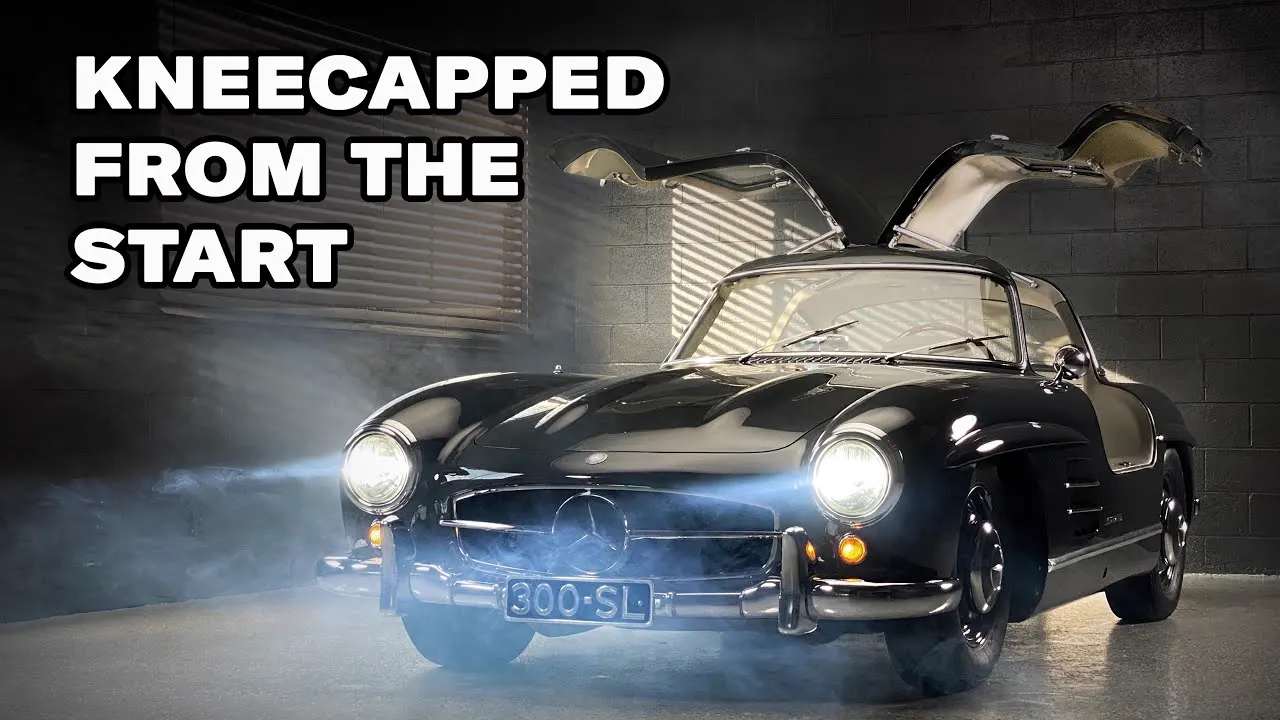
Mercedes’ slogan is “the best or nothing.” If that were literally true, there would never have been a 300 SL.
What SL actually means
People argued about it for decades. Mercedes eventually found a 1952 press release that settled it: SL stands for Sport Light.
The man with spare time
In the late 1940s Germany was in ruins, and the companies that survived did not have money to spend lavishly. If you had asked Mercedes whether it was going back racing, the answer would have been are you kidding me — they were still fighting for their lives.
Recovery came faster than anyone expected. By 1951 Mercedes was ready to race again, and it decided to prepare a car for the 1954 Grand Prix. In the meantime it would build a sports racer out of whatever it had — assembling components from the big, heavy S-Class, which were about the furthest things from race car parts you could want.
And in his spare time, an engineer named Rudolf Uhlenhaut had designed a space frame for a Formula 3 car — because that is what you did before Netflix existed.
Why the doors go up
A space frame is a solution to a math problem: arrange tubes into a truss so that each one carries all or most of its load in pure tension or compression, and the result is a frame that is very strong and extremely light. The W194 race car’s entire frame weighed 110 pounds.
And here is the whole story. When Uhlenhaut did that math, it did not need doors — because race drivers got in from the top.
To avoid redoing all of the calculations, the sills had to stay high. And high sills meant the original W194 race cars had tiny little doors.
You cannot step over a sill that high in a road car. So the doors went up instead of out.
The gullwing is not a styling decision. It is the price of not recalculating a truss.
There is even a strange remnant of the original math still visible in the shape: Uhlenhaut’s Formula 3 chassis had a high point at the cowl, and so does the SL.
What they put in it
The engine was the S-Class six, canted over at 50 degrees to keep the hood low, with more cam and higher compression. In race trim it made 171 horsepower.
The road car made more, and it made it with a genuinely historic piece of engineering.
Mercedes teamed with Bosch to develop the world’s first gasoline direct injection system, operating at 680 PSI.
The obvious joke is that this would be a disaster. It was the opposite. Those cars are dead reliable and run perfectly at any temperature and any elevation.
It was an unbelievable feat — and nobody tried it again for forty years.
There were also 17-inch-long intake runners, and grooved fins machined into the outer parts of the brake drums that spun close to the wheel, to help them cool.
What it could do
This was the mid-1950s. A Volkswagen Beetle could not hit 70 mph. A Porsche could barely manage 100. The 300 SL could do over 150.
Mercedes was not building commuter cars. It was demonstrating technical ability, and on road and track the SL proved the point.
The problem, which was real
The car wanted you dead.
One magazine described a habit of “coming wildly and suddenly unglued.” It was tuned to handle like a race car because it was a race car — and the people who could deal with that were a small group.
The Roadster, which is the better car
For 1957 the coupe was replaced entirely by a Roadster, and Mercedes took the edge off: more benign suspension tuning, with a low-pivot swing axle that tamed the oversteer. Toward the end of production it even got four-wheel disc brakes.
It rides better. It is the better car to drive. It also gets really hot in the cabin — you cook in there.
The coupe ran 1954 to 1957; the roadster ran 1957 to 1963.
The reason it exists at all
Mercedes did not decide to build a sports car for the joy of it. The 300 SL exists because Max Hoffman, the company’s American importer, told them to build one for the US market.
The most famous Mercedes ever made was a response to an American salesman asking for something to sell.
SPLASH'S READ
Every icon in this machines file has the same shape underneath: the thing people worship was never the plan.
The Gullwing is the purest example because the famous part is literally an engineering leftover. The doors go up because a truss was solved for a car with no doors, the sills ended up too high for human beings, and nobody wanted to start the arithmetic again.
That is not a compromise that got designed around. That is a compromise that became the entire identity of the car. Kids have posters of those doors. Not one of them knows the doors are a spreadsheet.
And the engineering underneath was real and better than the legend: the first gasoline direct injection in a production car, at 680 PSI, running clean at any altitude and temperature, decades before anyone else attempted it. The famous part was an accident. The excellent part was deliberate.
The best or nothing, as it turns out, was a truss with a door problem.
Production and naming. The 300 SL (W198) was built as a gullwing coupe from 1954 to 1957 and as a roadster from 1957 to 1963. Mercedes located a 1952 press release establishing that SL stands for Sport Light.
The doors. The car derived from the W194 sports racer; its upward-opening doors were made necessary by the high sills of the space-frame chassis, which was designed by Rudolf Uhlenhaut for a Formula 3 car that required no doors because drivers entered from above. The W194’s frame weighed 110 lb. The high point at the cowl carried over from the original Formula 3 chassis.
The engine. The S-Class six was canted at 50 degrees, with more aggressive camshafts and higher compression, making 171 hp in race trim; the road car used the world’s first gasoline direct injection, developed with Bosch, at 680 PSI. The 17-inch intake runners and the grooved brake-drum fins are as described in the source.
Performance and behavior. Top speed over 150 mph at a time when a Volkswagen Beetle could not reach 70 and a Porsche could barely manage 100. The characterization of the car as dangerous — including the magazine description of it “coming wildly and suddenly unglued” — and the assessment that the 1957 Roadster with its low-pivot swing axle is the better car to drive, are from Jason Cammisa’s Hagerty Revelations episode, which prompted this page.
Origins. The 300 SL was developed on the suggestion of US importer Max Hoffman, who wanted a sports car to attract American buyers.
Labeled as analysis. The reading that the car’s identity is an engineering leftover rather than a design intention, and the contrast drawn between the accidental famous feature and the deliberate engineering underneath, are this page’s interpretation.
This page contains no photograph of any person.
The E30 M3 sat unsold for years
The GT40 wasn’t really a Ford
Americans stopped seeing Japanese cars as curiosities
The man who made I Feel Love put his money into a V16
Sixty percent sold in two years The engine was designed by Lotus and built by a boat company The 924 was a Volkswagen consulting gig Designed to last 24 years, it ran for 37 Four brands, one car