THE CAR BARELY CHANGED.
EVERYTHING UNDER IT DID.
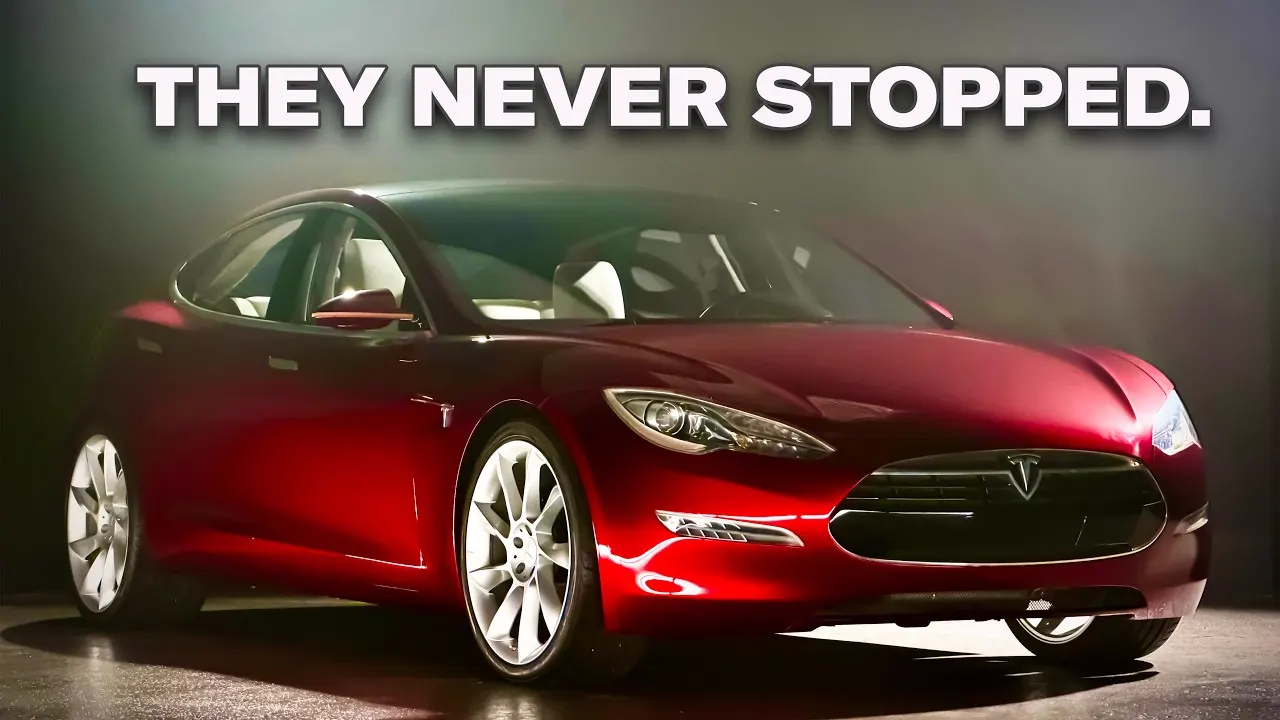
Most cars are finished the day they go on sale. This one was started then.
How it ended
On January 28, 2026, during Tesla’s fourth-quarter 2025 earnings call, the company announced that the Model S and Model X would be discontinued by the end of the second quarter.
The last cars rolled off the line at Fremont, California, in late May 2026, with Tesla’s stated official end of production set at June 30, 2026.
The final tally: fourteen years for the Model S, eleven for the Model X, more than 610,000 vehicles combined.
And the reason is not that nobody wanted them. Tesla was still selling roughly 30,000 a year at the end. The reason is that the floor space was worth more as something else. The Fremont line was torn down in 46 days and converted to Optimus robot production.
The goodbye they built
In April 2026 Tesla ran a final Signature Series: 350 vehicles total — 250 Model S and 100 Model X — each priced at $159,420, roughly $35,000 above a standard Plaid.
By July 2026, one of them was listed for resale in New Jersey at $260,490 — more than $100,000 over what Tesla charged.
Now the part that matters
Here is the difference between the Model S and every car company that tried to copy it.
A normal automaker has a moment where it tells its engineers to stop. The car enters production, and except for recalls, nothing changes for at least a model year — with maybe one planned facelift in the middle of the run.
Tesla never did that. It kept working on the Model S for fourteen years. When somebody found a way to cut weight, cut complexity, improve crashworthiness or improve efficiency, they just made the change. On the running line. On cars already being built.
Thousands of them.
What it looked like from outside
The result is a car that appears almost unchanged across a decade and a half, and is not the same car at all. Across the production run the Model S had four different front ends, three rear ends and two body widths — and an uncounted number of motors, batteries, drive configurations, trim names, prices and EPA ratings.
That is why an early car and a late car share a silhouette and share almost nothing else. The design was never updated because the design never needed to be. The updating was happening somewhere you cannot see.
The receipt
Put it against the car it was benchmarked on. In 2012 the Model S was roughly as quick to 60 as an F10 BMW M5, at similar power.
In the decade and a half since:
The M5 gained 157 horsepower. The Model S gained 604.
The M5 gained 1,040 pounds. The Plaid gained 110.
The current M5 is about 12.5% less efficient than it was then. The Plaid is about 23.5% more efficient than the P85 Plus was.
And the BMW costs about $32,000 more than it did.
Same fifteen years. One company kept developing the car. The other kept developing the next model year.
What it did first
The list is longer than the space here, but the ones that changed everything:
Over-the-air software updates — the Model S did this first, and a decade and a half later most car companies still cannot. Sentry Mode was developed in four days and deployed over the air. The whole touchscreen interface that is now in every car came from here.
And the detail that proves the point better than any spec sheet. In late 2012, a journalist took a Model S from Los Angeles to Palm Springs — a 125-mile trip over a mountain range — when the only other EV on sale was a Nissan Leaf rated at 73 miles on flat ground. The retracting door handles did not work and would not let him in the car. His first note read:
He went to bed. The next morning there was a software update waiting that mostly fixed the door handles. That is the whole company in one anecdote: the car was shipped incomplete and finished remotely, overnight, while the owner slept.
SPLASH'S READ
There is a version of this story where the Model S is a great car. That undersells it and also misses the interesting part.
The Model S is the first car that was treated like software — shipped, then patched, then improved for as long as anyone kept working on it. That is why it looks the same after fourteen years. The exterior was never the product.
And that is exactly why it is gone. A car that is continuously improved does not need a replacement model to sell you, which means it does not generate the cyclical trade-in that the entire dealership and manufacturer business model runs on. Every other automaker needs you to want the new one. Tesla spent fourteen years making the old one better.
The Signature Edition is the joke at the end. Three hundred and fifty cars at $159,420, and one of them asking $260,490 four months later — because the only way to own a Model S that will never receive another update is to buy one of the last ones.
The line is a robot factory now. The most important car of its era was discontinued because a machine that walks was worth more than the machine that drove.
Discontinuation. Tesla announced the end of Model S and Model X production during its Q4 2025 earnings call on January 28, 2026, with production to cease by the end of Q2 2026. The last cars rolled off the Fremont line in late May 2026; Tesla’s stated official end of production was June 30, 2026. Combined Model S and X output exceeded 610,000 vehicles across 14 and 11 years respectively. The Fremont line was converted to Optimus robot production, reported as torn down in 46 days.
Final variant. Signature Series run in April 2026: 350 vehicles, 250 Model S and 100 Model X, at $159,420 each, reported as roughly $35,000 above a standard Plaid. A July 2026 resale listing at a New Jersey dealer asked $260,490.
Development history and the comparison figures. The account of continuous rolling changes rather than annual model years, the four front ends, three rear ends and two widths, the M5 comparison (+157 hp vs +604 hp; +1,040 lb vs +110 lb; 12.5% less efficient vs 23.5% more efficient; ~$32,000 more expensive), and the 2012 door-handle anecdote are from Jason Cammisa’s Revelations episode for Hagerty, which prompted this page. The M5 and Plaid figures are as presented in that analysis.
Features — over-the-air updates, the touchscreen interface, and Sentry Mode’s four-day development — are attributed to the same account.
The 2012 range context — a 125-mile LA–Palm Springs trip over a mountain range with the Nissan Leaf as the only other EV on sale, rated 73 miles — is from that episode’s recounting.
Labeled as analysis. The reading that the Model S was discontinued because continuous improvement does not generate cyclical trade-ins, and the characterization of the Signature Edition’s resale as the market pricing the end of updates, are this page’s interpretation and are not Tesla statements.
This page contains no photograph of any person.
The engineer said six hours
The quota counted cars, not dollars
It started as a truck engine
Waymo vs Tesla
The fastest sedan on earth lasted one day They built a car for a future that bought an SUV It would have needed two million a car to break even Sixty percent sold in two years Twenty years earlier: Americans stopped seeing Japanese cars as curiosities It did 261 mpg, they built about 250