THE QUOTA COUNTED CARS, NOT DOLLARS. SO TOYOTA BUILT A BETTER CAR.
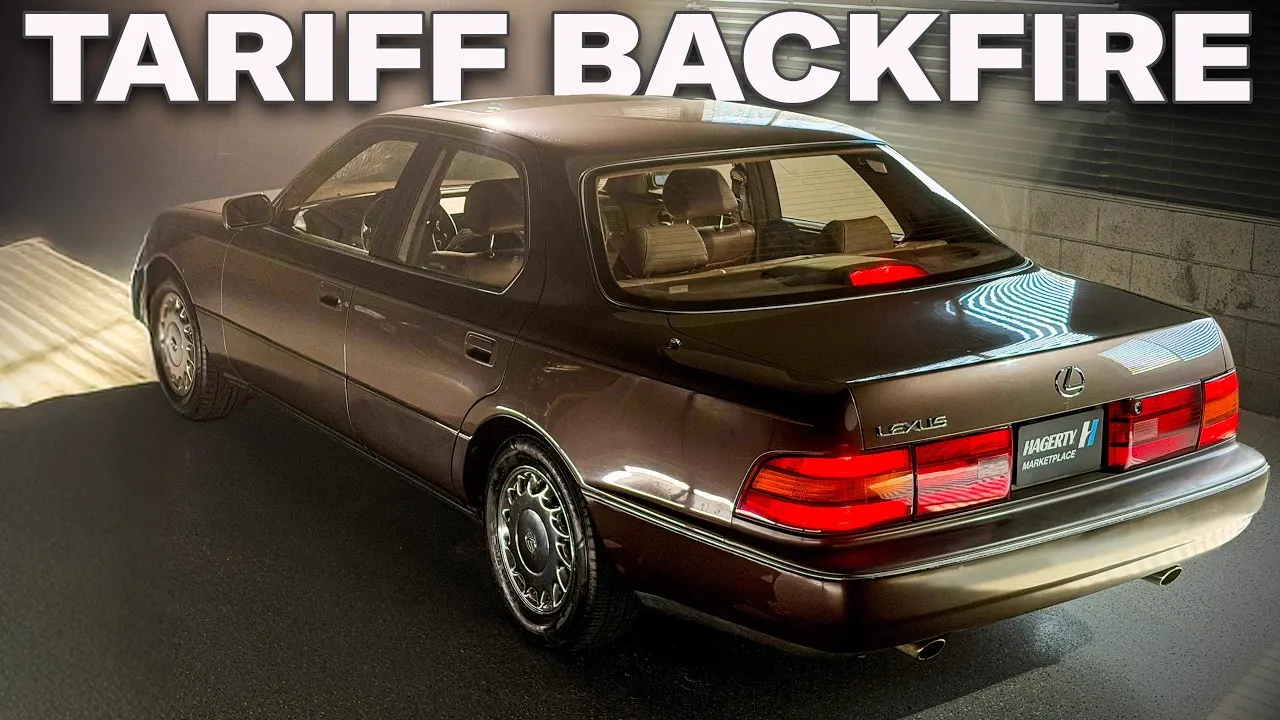
This is a story about a policy that failed in the most expensive way a policy can fail: it worked exactly as designed, and produced the opposite of what it was for.
Start with the humiliation
Toyota’s first attempt at the American market was the 1957 Toyopet Crown — a small sedan that, in the description that has followed it for seventy years, was known mostly for failing on freeways.
Just 257 were sold before Toyota withdrew the car. That is the baseline. The company that would eventually build the LS 400 had already been beaten in America once, badly, and it did not forget.
What followed was twenty-five years of studying the market instead of assuming it. And by the early 1980s Toyota was importing more cars into the United States than any manufacturer in history, while the Detroit automakers were sinking under two oil crises, a recession, a rising yen and, in the description that stings because it is true, years of engineering arrogance.
The ask that was not a request
So Detroit went to Washington for help, and Washington went to Tokyo. The American government asked the Japanese to voluntarily limit the number of cars they sold in the United States every year — voluntarily, if you set aside the public threats of sanctions and tariffs if they declined.
Japan agreed in 1981, and the cap was just under 1.7 million cars a year.
Read the fine print
Here is the detail that decides everything. The restraint applied to the number of automobiles exported — not their total value.
That is not a footnote. That is the entire mechanism. Write down a rule that says a country may send this many cars but says nothing about what the cars are worth, and you have just told every exporter in that country to put more money into each car.
The economic literature on the 1981 restraint says this plainly: because the limit applied to units rather than value, Japanese producers would be expected to shift toward higher-value vehicles. They did. And the shift had a name.
The pitch, and the silence
The man who saw it coming was the head of Toyota USA, Yuki Togo, a former rally driver. With the yen strengthening against the dollar, he understood that Toyota’s core advantage — cheap, good cars — was about to disappear. A stronger yen made every car more expensive in dollars, and the quota meant Toyota could not make it up on volume.
So in the spring of 1983 he made a pitch to Eiji Toyoda, the chairman, and Shoichiro Toyoda, the president. Toyota should build one of the best cars in the world: a luxury sedan for the American market. Go after BMW and Mercedes. Sell fewer units at fatter margins. Stay under the cap — and, critically, let Toyota set the value proposition instead of the government setting it.
When he finished, the Toyodas sat in silence. So he left the room. He took the silence as a green light, and he was right.
The engineer who compromised on nothing
The chief engineer was Ichiro Suzuki, and his targets were absurd on purpose. Every one of them was a number measured against a Mercedes S-Class, and every one of them was better.
Drag coefficient: the Mercedes was 0.37. Suzuki demanded 0.29 — the most aerodynamically efficient sedan in the world — and he refused to use a spoiler, which he considered vulgar.
Interior noise: a target of 58 decibels against the Mercedes’ 60. And because decibels are logarithmic, those two points are not a rounding difference — they are a fraction of the sound energy.
And the V8 had to be powerful and thrifty, because Suzuki wanted the flagship to reach market without the American gas guzzler tax. No luxury car had ever managed that. Not even the Germans.
The engine
The result was the 1UZ-FE: 4.0 litres, 32 valves, four camshafts, all aluminum, 250 horsepower and 260 pound-feet.
It was oversquare, it was unusually light for the era, and it carried eight crankshaft counterweights where most V8s use four — a choice made for smoothness at high engine speeds that cost money and bought refinement.
That is what "compromise on nothing" looks like in metal. Not a bigger engine. A more expensive way to build the same size one.
The dealers
Toyota did not put the car in existing showrooms. It built a separate brand, and it was ruthless about who got to sell it: of 1,500 dealers who applied in the first year, just 80 were approved, after having their finances and their customer-satisfaction surveys examined closely.
Eighty. Out of fifteen hundred. The car was going to be judged in a room Toyota controlled, or it was not going to be judged at all.
What it did
The LS 400 debuted in January 1989 and went on sale that fall. In December 1989, Car and Driver listed its base price at $35,000 against the Mercedes at $61,210 — a gap of $26,210.
For roughly half the money you got a car that was quieter, more comfortable, better built, faster, and used about a quarter less fuel. When European authorities tested it, they found the LS was as quiet at 125 mph as a BMW 7 Series at a speed 30 mph slower.
The journalists who had predicted failure drove it and stopped predicting.
SPLASH'S READ
The lesson people take from the LS 400 is that Toyota is scary good at engineering. That is true and it is the smaller half of the story.
The real lesson is about what a quota does when you write it in the wrong unit. Washington wanted to protect Detroit’s volume, so it capped volume. But a cap on volume with no cap on price is not a ceiling on an industry — it is an instruction to move upmarket, handed to the competition, in writing, with a deadline.
Toyota had spent twenty-five years making cheap cars well and could not beat Detroit in Washington. The quota took that fight off the table and replaced it with a fight Toyota was built to win: make the best car, charge what it is worth, and let the badge do the work.
Detroit got exactly the protection it asked for. It got one point seven million Japanese cars a year instead of two million — and every one of them was now a more expensive car, sold at a fatter margin, wearing a badge that would spend the next thirty years taking the customers Detroit could not afford to lose.
The policy worked. That is what went wrong.
The 1957 Toyopet Crown and its 257 US sales before withdrawal are documented in Toyota’s own corporate history and in the reporting that follows it.
The restraint. Japan agreed in 1981 to limit automobile exports to the United States, following an April 1981 agreement between US Trade Representative Brock and Japan’s MITI minister Tanaka; the cap was just under 1.7 million cars per year. Crucially, the restraint “applies to the number of autos exported to the U.S. (and not their total value)” — the phrasing of the academic literature on the 1981 VER, which also states the expectation that Japanese producers would shift toward higher-value vehicles as a result. That expectation is the spine of this page and it is a published economic finding, not this page’s invention.
The internal decision. Yuki Togo, head of Toyota USA and a former rally driver, made the case in spring 1983 to chairman Eiji Toyoda and president Shoichiro Toyoda; chief engineer Ichiro Suzuki set the development targets. The account of the meeting, the silence, and Togo leaving the room is as told in Jason Cammisa’s Revelations episode for Hagerty, which prompted this page; it is a retelling of Toyota’s internal history rather than a primary transcript, and is presented as such.
Engineering targets and specification: drag coefficient 0.29 against the Mercedes’ 0.37; interior noise target 58 dB against 60; avoidance of the US gas guzzler tax; the 1UZ-FE — 4.0 litres, 32 valves, four camshafts, aluminum, 250 hp and 260 lb-ft, with eight crankshaft counterweights.
Dealer network: 1,500 applicants and 80 approvals in the first year, per the same account.
Launch and pricing: the LS 400 debuted in January 1989 and went on sale that fall; the Los Angeles Times reported on August 7, 1989 that the car had 250 hp, a 150 mph top speed and a $35,000 base price. Car and Driver in December 1989 listed it at $35,000 against the Mercedes at $61,210 — a $26,210 difference.
Labeled as analysis. The reading that the quota functioned as an instruction to move upmarket, and the characterization of what Detroit received, are this page’s interpretation of the documented policy mechanics.
This page contains no photograph of any person.
It started as a truck engine
The engineer said six hours
The fastest sedan on earth lasted one day
312 mph, one direction, one run
Lamborghini’s other truck The car barely changed. Everything under it did. They built a car for a future that bought an SUV The man who made I Feel Love put his money into a V16 It would have needed two million a car to break even Sixty percent sold in two years Twenty years earlier: Americans stopped seeing Japanese cars as curiosities The GT40 wasn't really a Ford